Fluke (1995)
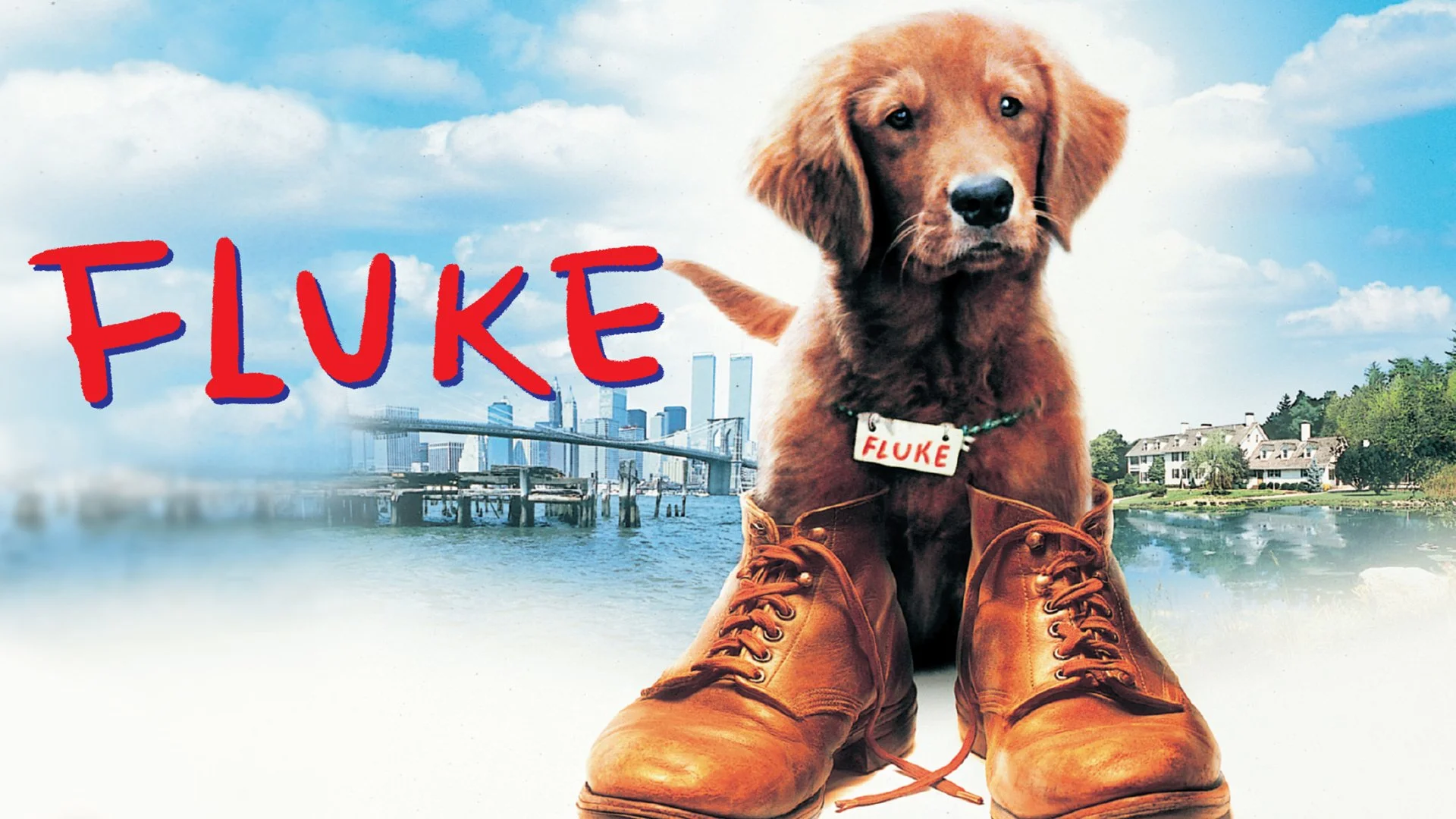
Fluke is a curious film about a man who is reincarnated as a dog and his subsequent realisation that he may have been murdered. It takes an adult novel by British author James Herbert, which is filled with philosophical musing and strives to adapt it in a far more family friendly fashion. The result is a somewhat bipolar production which thematically alternates between existential introspection and Buddhism. It then strives to deliver its message in a Disneyesque idiom. Children will potentially be confused and upset by what they see and adults will be wrongfooted by the continual shift in tone. Fluke was not a critical or commercial success upon release and the flaws that were identified by critics at the time still ring true today. That being said, Fluke is still an interesting and entertaining film, despite its faults.
A mongrel street dog puppy is adopted by a elderly homeless lady called Bella (Collin Wilcox Paxton). She names him Fluke (Matthew Modine). After Bella dies, Fluke is befriended by a street-wise dog called Rumbo (Samuel L. Jackson) who teaches him to live in the moment. Fluke and Rumbo spend time with Bert (Bill Cobbs) who runs a burger stand. They also visit a scrapyard, run by Boss (Jon Polito). Fluke has recurring dreams about a man and a car crash. He eventually recalls a past life in which he was a successful businessman who had a wife and son. He feels compelled to seek them out and leaves Rumbo on bad terms. After tracking down his former wife, Carol (Nancy Travis) and son, Brian (Max Pomeranc), he eventually becomes their family dog. When his ex-business partner Jeff (Eric Stoltz) arrives Fluke suspects he may have been murdered by him in his former life and seeks to protect his family.
Director Carlo Carlei gained the attention of MGM studios, when they acquired the US distribution rights for his previous Italian film, Flight of the Innocent. He was given a one picture deal and subsequently wrote an adaptation of the James Herbert novel. Being an international filmmaker, Carlei takes a far more matter of fact approach to some of the story’s more adult themes. People die and the world moves on. Animals are treated cruelly. At one point Fluke is stolen and used for experiments by a cosmetic company. Later during a car crash, he is thrown through the windscreen. Although not particularly graphic, these scenes are shown candidly, lacking the emotional soft pedalling common to US filmmaking. However, many other scenes involving Fluke and Rumbo’s adventures are shot in the style and manner you’d expect from this genre.
Despite the rather unbalanced style and approach to the subject matter, Fluke has a respectable cast and production values. Performances are solid and the cinematography by Raffaele Mertes is colourful and quite dynamic. There is also a suitably poignant score by Italian composer Carlo Silotto, who doesn’t usually write for many mainstream US productions, as he doesn’t view them favourably. What CGI there is is mainly confined to brief glimpses of the afterlife. Overall Fluke gets its story across in an efficient 96 minutes. If it had been made by an independent studio and leaned more into the darker themes of the plot, it could have been a superior film. As to how contemporary audiences receive it, that remains a lottery. If you watch Fluke with the understanding that it’s not Homeward Bound: The Incredible Journey and the ending is not especially happy, then you’re better prepared.