
The Hobbit by J.R.R. Tolkien (1990)
In 1989 Eclipse Comics produced a three-part adaptation of The Hobbit by Chuck Dixon, Sean Deming and illustrated by David Wenzel. A year later, due to public demand, this was subsequently re-issued as a single graphic novel that has remained in print ever since. The writers wisely chose to sensitively abridge Tolkien’s source text, rather than adapted the story and make any major changes. Hence this graphic novel version of The Hobbit retains much of the dialogue from the original novel and subsequently maintains the book’s inherent charm. There are no major plot omissions and the narrative flows well. The panel layouts are innovative and accommodate a wealth of written material without overwhelming the artwork.
In 1989 Eclipse Comics produced a three-part adaptation of The Hobbit by Chuck Dixon, Sean Deming and illustrated by David Wenzel. A year later, due to public demand, this was subsequently re-issued as a single graphic novel that has remained in print ever since. The writers wisely chose to sensitively abridge Tolkien’s source text, rather than adapted the story and make any major changes. Hence this graphic novel version of The Hobbit retains much of the dialogue from the original novel and subsequently maintains the book’s inherent charm. There are no major plot omissions and the narrative flows well. The panel layouts are innovative and accommodate a wealth of written material without overwhelming the artwork.
Tolkien's The Hobbit is a substantially different book to in comparison to The Lord of The Rings both in narrative style and tone. It was squarely aimed as children and takes a much lighter tone than its sequel. Artist David Wenzel captures this aspect superbly with rich, colourful illustrations. His visualisation of Middle-earth is lush and very European. His depiction of Bilbo Baggins, is suitably ruddy cheeked and rustic. He also distils the characters age and placid demeanour very well. His Goblins are scary but not the feral, demonic entities we see in Peter Jackson’s movies. His Dwarves are regal and less military than other depictions. Gandalf is especially understated, looking more like a village elder than a wizard. Overall the artwork is vivid, and all the characters are clearly defined, which significantly contributes to the readers emotional investment.
Part of the great appeal of Tolkien's work is the mental imagery that it inspires among readers. Tolkien often gave detailed description of people and places but always provided scope for those reading his books to conjure up their own unique interpretations. However, over the years a strong consensus on visual interpretations has developed, due to the popularity of Alan Lee's and John Howe's body of work. Their influence is such that both worked as creative consultants on both of Peter Jackson’s movie trilogies. David Wenzel's graphics are very different from this perceived status quo, yet clearly captures the essence of the story and offers strong characterisations. The Hobbit graphic novel also provides a great alternative introduction to Tolkien's work, without compromising the Professors narrative skills. This version of The Hobbit is therefore a welcome addition to anyone's bookshelf.

The House on the Borderland by William Hope Hodgson (2000)
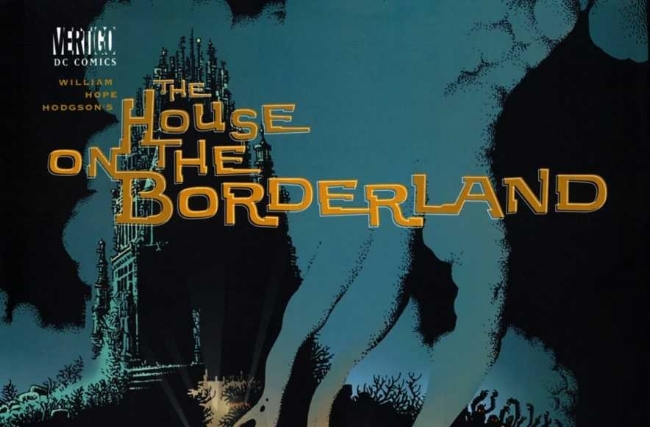
The House on the Borderland is a Vertigo comics graphic novel version of the 1908 baroque supernatural story by Edwardian writer, William Hope Hodgson. Adapted by Richard Corben and Simon Revelstroke, with illustrations are by Richard Corben of Hellblazer and Heavy Metal fame, The House on the Borderland proves to be a bold and innovative visual retelling of a rather densely narrated tale. The story tells a tale of two gentlemen on a week’s fishing holiday in the Irish village of Kraighten in the mid-fifties. Whilst exploring the local countryside they discover the ruins of a very curious house that appears to have been swallowed by a sinkhole. They subsequently find what appears to be the diary of its former owner. The torn pages seem to hint at an evil presence that was slowly and irresistibly encroaching upon the property. The author alludes to other events such as strange beasts in the ground at night and his own worsening nightmares. Is any of it to be believed, or is it simply the ravings of a deluded mind?
The House on the Borderland is a Vertigo comics graphic novel version of the 1908 baroque supernatural story by Edwardian writer, William Hope Hodgson. Adapted by Richard Corben and Simon Revelstroke, with illustrations are by Richard Corben of Hellblazer and Heavy Metal fame, The House on the Borderland proves to be a bold and innovative visual retelling of a rather densely narrated tale. The story tells a tale of two gentlemen on a week’s fishing holiday in the Irish village of Kraighten in the mid-fifties. Whilst exploring the local countryside they discover the ruins of a very curious house that appears to have been swallowed by a sinkhole. They subsequently find what appears to be the diary of its former owner. The torn pages seem to hint at an evil presence that was slowly and irresistibly encroaching upon the property. The author alludes to other events such as strange beasts in the ground at night and his own worsening nightmares. Is any of it to be believed, or is it simply the ravings of a deluded mind?
William Hope Hodgson’s original novel is an extremely difficult story to adapt to the graphic novel format. Most of the source text is written as diary entries, in which it describes arcane forces, astral projection and esoteric visions. Blending supernatural paranoia, fantasy and Lovecraftian horror in a first-person narrative that hints rather than discloses, it’s a tough book to crack. Yet Corben and Revelstroke make an inspired effort in condensing the text and visually extrapolating the complex descriptions. The artwork is innovative and does a good job of capturing the dark and eldritch tone of the story. The text adaptation strives to be as faithful to the source material as it can, yet inevitably has to relinquish on some of the more esoteric themes which are too difficult to render visually. However, the essential ideas of the original story are not only present but prove to be quite accessible. The understated approach of the artwork in keys scenes captures the menace conveyed by William Hope Hodgson in his original story.
Featuring an introduction by comics luminary Alan Moore that offers an affectionate appreciation of Hodgson's contribution to the horror genre, The House on the Borderland is a valiant attempt to bring a classic cerebral work to a wider audience via a very visual medium. Ultimately, the adaptation cannot offer the exact same experience as reading the original novel, but it must be applauded for bringing such material to a wider audience. It certainly succeeds in tapping into that disquieting quality that porcine horror can have, hinting at beasts who may well have a comparable intelligence to humans, while harbouring an inherent enmity to us as a species. Hopefully after reading The House on the Borderland, graphic novel horror fans will subsequently seek out and familiarise themselves with William Hope Hodgson’s other work, which is the equal to that of H.P. Lovecraft. I would certainly like to see further visual adaptations of the authors back catalogue.
Gravedigger Volume 1: Hot Women, Cold Cash (2015)
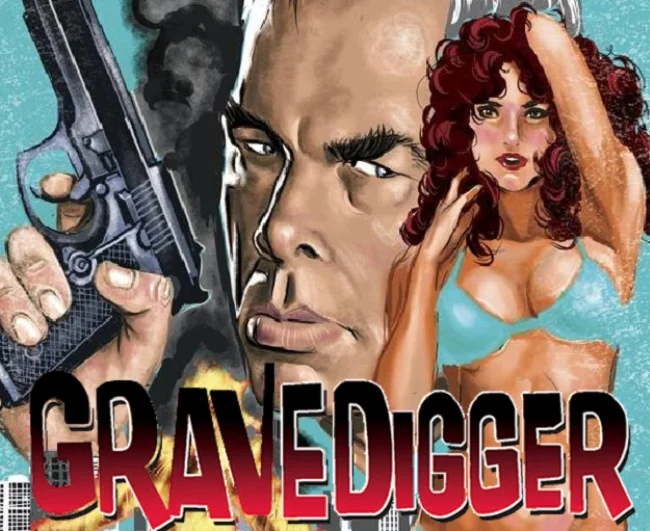
A fortuitous tweet in my timeline on Friday night afforded me the opportunity to buy Gravedigger Volume 1: Hot Women, Cold Cash for the bargain price of £2.50, over at Comixology. I’ve been aware of this film noir inspired comic series for a while but simply hadn’t gotten around to doing the right thing and supporting its creators Christopher Mills and Rick Burchett. Having now corrected this error I can now confidently state that Gravedigger thoroughly deserves all the plaudits it’s garnered of late. It’s been a while since a comic has grabbed my attention in this way and offered a thoroughly immersive experience.
A fortuitous tweet in my timeline on Friday night afforded me the opportunity to buy Gravedigger Volume 1: Hot Women, Cold Cash for the bargain price of £2.50, over at Comixology. I’ve been aware of this film noir inspired comic series for a while but simply hadn’t gotten around to doing the right thing and supporting its creators Christopher Mills and Rick Burchett. Having now corrected this error I can now confidently state that Gravedigger thoroughly deserves all the plaudits it’s garnered of late. It’s been a while since a comic has grabbed my attention in this way and offered a thoroughly immersive experience.
Volume 1 contains both parts of the 2015 story The Predators as well as the 2004 tale, The Scavengers. Both adventures centre on career thief and professional criminal “Gravedigger” McCrae; a hard, ruthless and calculating man with a weakness for the ladies and cold cash. The Predators finds McCrae in Florida for some rest and relaxation. When he wakes up next to the dead body of local mobster’s daughter he has to look to his wits to avoid both hired killers and the local wildlife. The Scavengers finds McCrae hired to plan a weapons heist and cutting a side deal with a femme fatale. Multiple double crosses lead to a desert showdown with no good outcomes.
What makes Gravedigger so compelling are its broad horizontal canvases and lean black and white art style. Rick Burchett’s artwork is tonally right, providing sufficient detail and pacing without getting bogged down in superfluous embellishment. Christopher Mills’ dialogue is very direct and he does a great deal with only a little. Both stories speak for themselves, yet there is depth and substance despite the lean and mean approach. It is clear that Burchett and Mills understand both the medium and the genre the story is set in. Gravedigger is aimed at a mature and savvy audience.
If you like the wise cracking, hardboiled literary thriller genre as well as the anti-hero driven crime movies of seventies, then Gravedigger has all that you need. It exudes atmosphere, menace and wry humour. The stories are concise and perfectly paced. If only Hollywood could make movies as classy as this. As for the Lee Marvin vibe that clearly runs through Gravedigger, what more can I say than it just works. McCrae even speaks his lines in Marvin’s sardonic tones when I’m reading. It’s a sublime embellishment. Therefore Gravedigger definitely gets the Contains Moderate Peril seal of approval (for what it’s worth) and I look forward to Gravedigger Volume 2, as soon as it becomes available.
The Keep by F. Paul Wilson (2006)
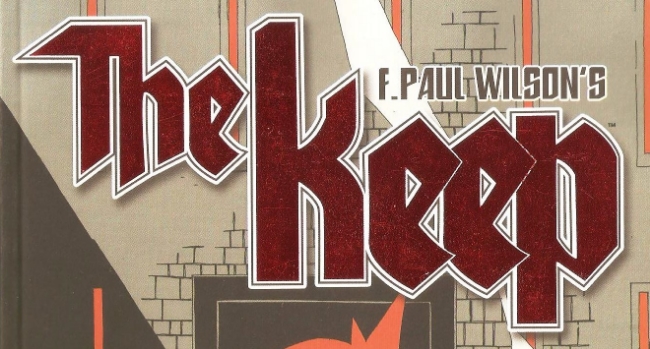
Author F. Paul Wilson has always been vitriolic regarding the 1983 film version of his novel. “Visually intriguing, but otherwise utterly incomprehensible” is one of his more sedate quotes. Michael Mann’s adaptation of the 1981 bestseller is a curiosity in itself, which I will not discuss at great length here. Suffice to say that I may write an extended piece on its troubled history and many versions, at some point in the future. In 2006 F. Paul Wilson scripted a graphic novel version of his book with artwork drawn by Matthew Dow Smith, of Hellboy fame. In the foreword F. Paul Wilson states “I consider this visual presentation of The Keep my version of the movie, what could have been... what should have been.”
Author F. Paul Wilson has always been vitriolic regarding the 1983 film version of his novel. “Visually intriguing, but otherwise utterly incomprehensible” is one of his more sedate quotes. Michael Mann’s adaptation of the 1981 bestseller is a curiosity in itself, which I will not discuss at great length here. Suffice to say that I may write an extended piece on its troubled history and many versions, at some point in the future. In 2006 F. Paul Wilson scripted a graphic novel version of his book with artwork drawn by Matthew Dow Smith, of Hellboy fame. In the foreword F. Paul Wilson states “I consider this visual presentation of The Keep my version of the movie, what could have been... what should have been.”
In April of 1941 a message is sent to German High Command from an Army Captain stationed in a remote castle keep in the Dinu Pass high in the Transylvanian Alps. “Something is murdering my men.” A Nazi SS extermination squad is dispatched as it is assumed that this is the work of partisans. A Jewish History Professor, Theodore Cuza and his daughter Magda, are forced by SS Sturmbannfuhrer Eric Kaempffer to provide background information and help with the investigation. The professor is useful at first in translating a mysterious message that has been written in an ancient Romanian dialect. It is not long before he encounters the malevolent force that is loose in the keep. Cuza fails to grasp that the being is not a mere vampire but actually something much worse. It is at this time that a stranger appears in the village as if summoned by the ongoing events.
The Keep works exceptionally well as a graphic novel and the minimalist artwork ideally suits the plot and characters. This is a story that would have suffered if the art work had over embellished the storyline. In its existing form the reader is given enough visual data but still has scope to use their imagination. This adaptation retains all the important aspects and themes of the source novel. If there is a weakness, it is that the ending is a little low key. Contemporary readers may be expecting something a little more spectacular. However this minor flaw can be overlooked as the story as a whole is engaging and offers an interesting perspective on a traditional genre.
In an age of poor film adaptations, it would be nice to see more authors using this medium as a means of adaptation. The graphic novel is extremely flexible format and can accommodate a wide variety of literary genres without having to compromise on dialogue or depth. They’re also ideal for tablets and other mobile platforms. If you are a fan of the horror genre then this version of F. Paul Wilson’s The Keep comes highly recommended.
Rediscovering Comics and Graphic Novels
As a child I avidly read comics during the seventies. I had a subscription to several titles and use to enjoy having them delivered. I purchased both US and UK titles and would trade old copies with friends. I wasn’t a collector or purists, I just loved what I read and in some respects that lead me on to discover other genres of fiction. However comics fell by the wayside when I hit my teens. I have no memory of there being any specific reason for this. It was simply a case of one pastime being replaced by another. I think music became more important to me and my reading moved on to classic horror and sci-fi literature.
As a child I avidly read comics during the seventies. I had a subscription to several titles and use to enjoy having them delivered. I purchased both US and UK titles and would trade old copies with friends. I wasn’t a collector or purists, I just loved what I read and in some respects that lead me on to discover other genres of fiction. However comics fell by the wayside when I hit my teens. I have no memory of there being any specific reason for this. It was simply a case of one pastime being replaced by another. I think music became more important to me and my reading moved on to classic horror and sci-fi literature.
In the late eighties and early nineties I returned to the genre and started reading a lot of graphic novels. The main attraction was their greater narrative depth. There was also a significant cultural shift roundabout this time and such material was becoming far more common place and popular. Watchmen and Batman: The Killing Joke, both by Alan Moore were literary milestones for me. I also enjoyed Eclipse Comics adaptation of Clive Barker’s Books of Blood. They offered far more with their visial interpretation of Rawhead Rex, than the film version. Sadly circumstance and a changing lifestyle meant that this hobby was also put aside.
I recently discovered that the Humble Bundle frequently offers selected comics and graphic novels at major discount. As I own a seven inch Android tablet that I don’t use as often as I should, I decided to resurrect my interest in the comic genre. After some basic research I decided to install the free version of Komik Reader on my Hudl and CoView on my PC. The results have been very satisfying. Reading comics on a seven inch screen is surprisingly good. The zoom facility solves any issues with the text and allows the artwork to be examined closely. Viewing on a PC is slightly different experience. My twenty four inch monitor presents the images perfectly but sitting at my desk lacks the comfort of perusing via a tablet on the couch or in bed.
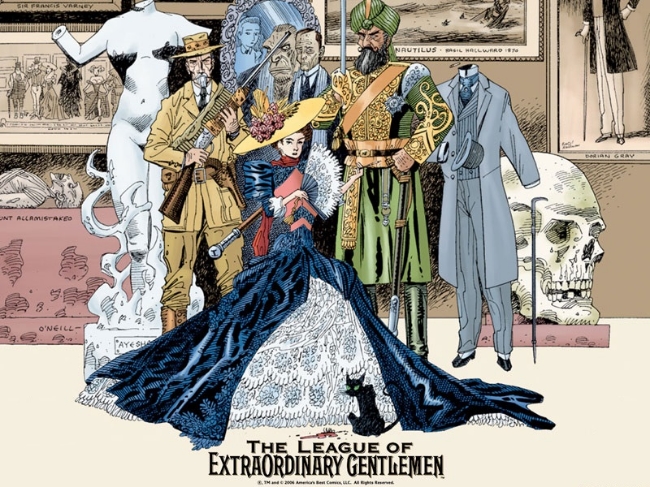
What I have found very surprising is the wealth of material that is available. Most major publishing houses have online portals that can supply electronic version of the latest titles as well as an extensive back catalogue. Furthermore I have managed to track down copies of specific comics I read as a child. As a result I have reacquainted myself with Beep the Meep (from Marvel UK Doctor Who Weekly circa 1980) and found on iTunes the classic strip Hookjaw (from UK Action comic circa 1976). It will be available for the Android platform shortly. I am also working my way through The League of Extraordinary Gentlemen series and intend to read The Punisher revival from a decade ago.
I am very pleased that the comic genre has successfully migrated over to this contemporary medium. It has many practical benefits such as negating the need for storage and significant cost savings. It has also reminded me that the standard of writing in the genre is often outstanding and that there is a great deal of quality reading material out there. My subsequent rediscovery of the comics and graphic novels has also fuelled my latest vice, namely bundles and group discounts. I shall have to ensure that I do not get too carried away with my purchases. In the meantime I look forward to hours of entertainment from a medium I had previously forgotten.