
The Land That Time Forgot (1975)
I first saw The Land That Time Forgot way back in 1975 at the Odeon Isle of Wight, when it was first released. We were on holiday at the time, which was cause for celebration in itself, as these were few and far between during my youth, due to the state of the UK economy at the time. But to then go to the cinema and see a fantasy film, filled with action, adventure and monsters, was the icing on the cake for an over excited eight-year-old. Adapted by Michael Moorcock and James Cawthorn from the 1924 the novel by Edgar Rice Burroughs, The Land That Time Forgot is a classic example of high adventure on a low budget. Its technical shortcomings were even apparent to me as a child, yet there was a charm and honesty to this curious British production, that had the audacity to try and compete with the likes of more expensive US productions such as The Golden Voyage of Sinbad and Island at the Top of the World.
I first saw The Land That Time Forgot way back in 1975 at the Odeon Isle of Wight, when it was first released. We were on holiday at the time, which was cause for celebration in itself, as these were few and far between during my youth, due to the state of the UK economy at the time. But to then go to the cinema and see a fantasy film, filled with action, adventure and monsters, was the icing on the cake for an over excited eight-year-old. Adapted by Michael Moorcock and James Cawthorn from the 1924 the novel by Edgar Rice Burroughs, The Land That Time Forgot is a classic example of high adventure on a low budget. Its technical shortcomings were even apparent to me as a child, yet there was a charm and honesty to this curious British production, that had the audacity to try and compete with the likes of more expensive US productions such as The Golden Voyage of Sinbad and Island at the Top of the World.
The Land That Time Forgot has a rather unusual production pedigree as it was financed by Amicus Productions who were best known during the seventies for their series of portmanteau horror films such as Tales from the Crypt (1972), Asylum (1972). It boasts a robust cast of British characters such as the late Keith Barron (Captain Bradley), Susan Penhaligon and Anthony Ainley. Barron got the role because he bought a house from the producer John Dark, who was casting at the time. Seeking a “known quantity” for the US market, actor Doug McClure secured the lead role as Bowen Tyler. McClure was popular due to his regular appearance in the successful TV western series, The Virginian. British actor John McEnery who played U-Boat Captain Von Schoenvorts, was not deemed to be “sufficiently German” when the movie entered post-production and subsequently had all his dialogue re-dubbed by Anton Diffring.
The Land That Time Forgot is a fairly faithful big screen version of the source novel. Set during World War I, the survivors of a torpedoed British merchant ship manage to capture the German U-Boat that sunk them. However, the German second officer Dietz, sabotages the compass resulting in the U-Boat straying into uncharted waters. Low on fuel and supplies, the combined crew find a strange volcanic sub-continent amid the frozen sea. Captain Von Schoenvorts surmises that this may be the “lost” island of Caprona, which was referenced by Italian explorer Caproni in 1721. Finding an underwater channel, the U-Boats manages to penetrate the outer cliff wall only to find a lush tropical zone, populated by both Dinosaurs and prehistoric people. While Captain Von Schoenvorts and Biologist Lisa Clayton contemplate the mystery of Caprona’s curious ecosystem, Engineer Bowen Tyler searches for a viable source of oil that they can refine and so escape back to civilisation.

The Land That Time Forgot is very much a product of its time, being made on a very modest budget. Yet despite its technical shortcomings the movie holds up very well. Roger Dickens dinosaur effects, which are mainly rod puppets, have a certain charm about them. They are not as sophisticated as Ray Harryhausen’s stop frame animated marvels, but they get the job done. Praise was heaped upon Derek Meddings’ superb miniature effects at the time and they are still impressive today. But what The Land That Time Forgot manages to achieve that many modern equivalent movies fail to do, is being honest and respectful towards its source material. Just because the movie is based upon a pulp fiction novel, it isn’t trivialised or presented in an ironic and self-deprecating way. The cast obviously took their roles seriously and delivered a very sincere film, irrespective of its humble origins and restricted production values.
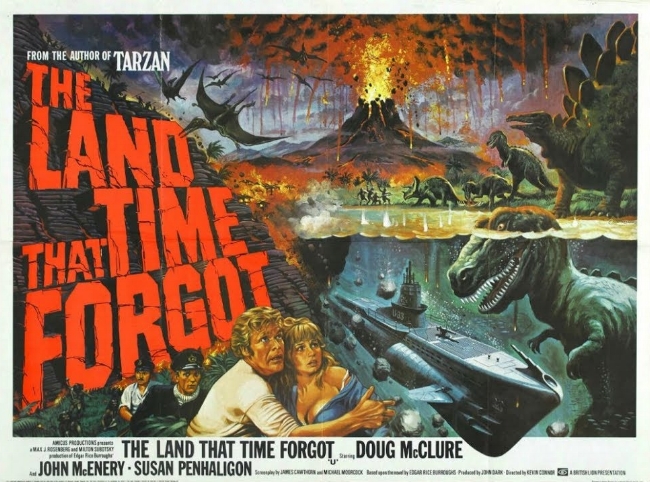
The Land That Time Forgot is an excellent example of low budget, but creative independent film making that was common place in the seventies. It has a simple plot, with clearly defined characters. The action scenes and dramatic scope of the film are ambitious considering the financial constraints and although casually violent, as so many family films ironically were at the time, it is never gratuitous. Susan Penhaligon’s role sadly reflects gender-based attitudes of the time. The movie doesn’t make any attempt to accurately reflect the state of geopolitics of the period. The hero is robust, masculine and decisive. The Germans are “bad” because the film requires an arbitrary set of antagonists. Naturally they also reflect the prevailing stereotypes and prejudices common to the UK society at the time. The film poster certainly overstates the scope of the production, promising action of a far more spectacular nature and a lot more dinosaurs. Yet it all works very well and is still very entertaining, if you accept it for what it is and when it was made.


The Land That Time Forgot by Edgar Rice Burroughs (1924)
The Land That Time Forgot is the first part of Edgar Rice Burroughs’ “Caspak” trilogy of science fantasy novels. Commencing as a wartime sea adventure, hence its original working title of The Lost U-Boat, Burroughs’ story ultimately develops into a saga with similarities to Sir Arthur Conan Doyle’s The Lost World and Jules Verne’s The Mysterious Island. What makes Burroughs work unique is his plot device of a biological system specific to his island, in which the slow progress of evolution manifests itself as individual metamorphosis. This biological feature is only implied in The Land That Time Forgot and explored in greater depth over the course of the next two novels, The People That Time Forgot and Out of Time’s Abyss.
The Land That Time Forgot is the first part of Edgar Rice Burroughs’ “Caspak” trilogy of science fantasy novels. Commencing as a wartime sea adventure, hence its original working title of The Lost U-Boat, Burroughs’ story ultimately develops into a saga with similarities to Sir Arthur Conan Doyle’s The Lost World and Jules Verne’s The Mysterious Island. What makes Burroughs work unique is his plot device of a biological system specific to his island, in which the slow progress of evolution manifests itself as individual metamorphosis. This biological feature is only implied in The Land That Time Forgot and explored in greater depth over the course of the next two novels, The People That Time Forgot and Out of Time’s Abyss.
Set during World War I the book opens with a framing narrative in which a manuscript relating the main story is recovered from a thermos off the coast of Greenland. It relates the history of Bowen J. Tyler, an American passenger on a ship sunk in the English Channel by a German U-boat in 1916. He is rescued by a British tugboat with another survivor, Lys La Rue. The tug is later sunk but its crew manages to capture the submarine when it surfaces. A German crew member sabotages the compass sending the U-Boat off course. By the time this is discovered they are deep in Antarctic waters. Low on fuel they discover a large island ringed by cliffs, which they identify as Caprona; a land mass first reported by the (fictitious) Italian explorer Caproni in. A freshwater current guides the sub to a stream issuing from a subterranean passage, affording them access to the island. The U-boat surfaces into a tropical river teeming with prehistoric creatures. The surrounding land is home to various forms of life long extinct in the outside world. An uneasy allowance is then formed between Germans and allied forces as they seek a source of fuel and a way to escape the strange land of “Caspak”.
Edgar Rice Burroughs has a very traditional and earnest style of writing. Heroes are manly, villains are fiendish and duplicitious. Women are mainly objects of veneration. Like many other authors of this genre at the time, contemporary new technology and science play an important part in the story. The American hero is a mechanical engineer who is well versed in ship and U-Boat design. There is also a very romantic view of the English as a see fairing nation. However the most interesting element of the plot is the notion of individual evolution. “Ahm” a friendly Neanderthal Man, who befriends the crew believes that he will over the passage of time transform from his current status to Sto-lu (hatchet men), then to Band-lu (spearmen), finally Kro-lu (bowmen). It is a very bold idea and Burroughs handles it well by subtle implication. Sadly his stereotyped view of Germans diminishes the books credibility but you have to take into consideration the politics of the times. All things considered The Land That Time Forgot remains enjoyable pulp fiction which still has the capacity to entertain