Biggles (1986)
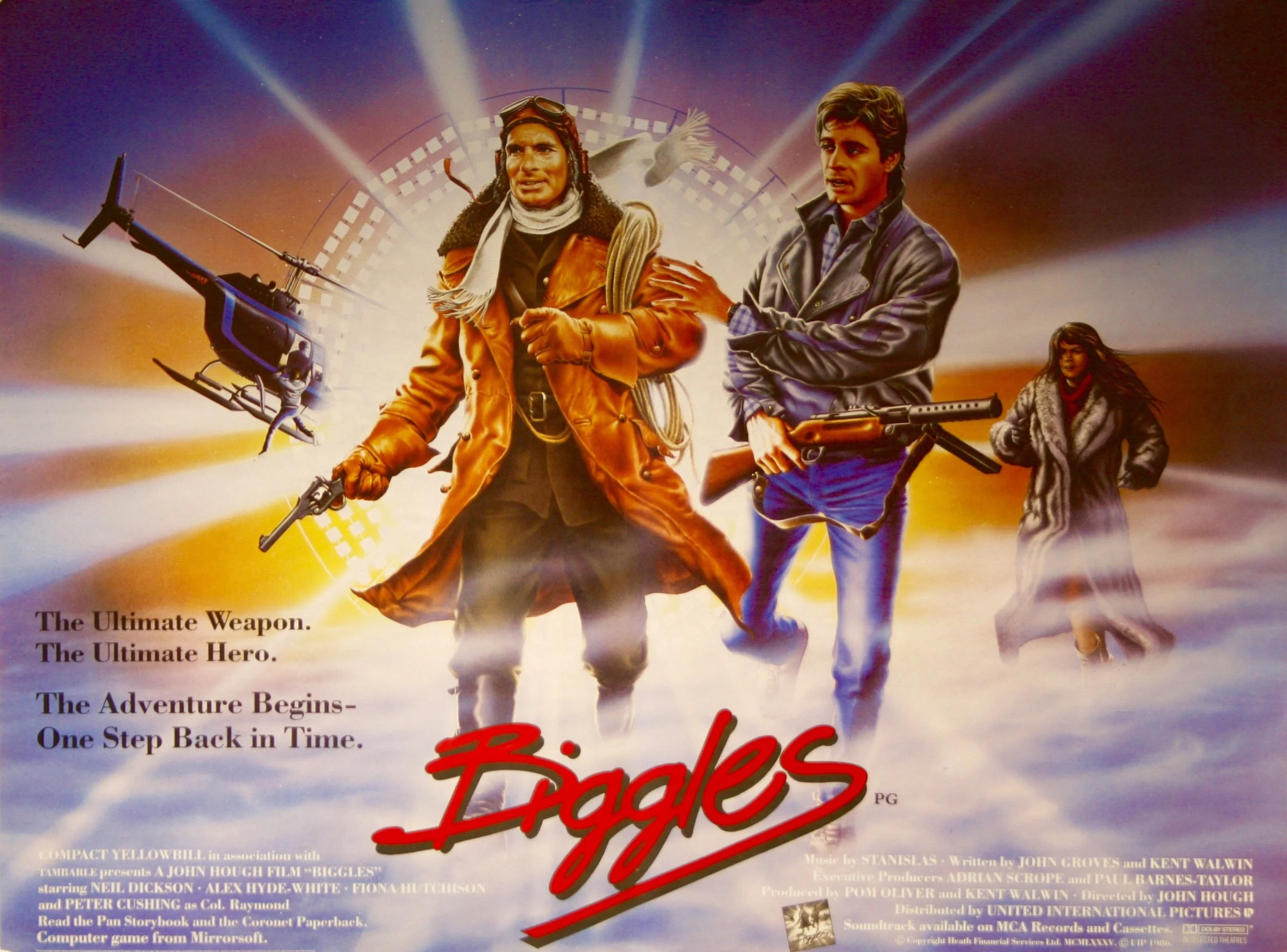
After the success of Raiders of the Lost Ark in 1981, filmmakers scrambled to find existing intellectual properties that they could use for similar films. Hence archaic heroes such as Alan Quatermain were hastily given a modern makeover and thrust into generic movies, in a vague attempt to replicate Steven Spielberg’s successful formula. Which brings us neatly on to James Charles Bigglesworth AKA “Biggles”, a fictional pilot and adventurer from a series of books written by W. E. Johns between 1932 and 1968. Several attempts had been made in the past to bring this character to the silver screen, including one by Disney but they all failed. However, the commercial and critical success of Indiana Jones provided sufficient impetus to greenlight a new film. However, due to some curious production choices, when Biggles was finally released it was far from just a period set, action movie.
Catering salesman Jim Ferguson (Alex Hyde-White), is unexpectedly transported from New York City to 1917 France, where he saves the life of Royal Flying Corps pilot James "Biggles" Bigglesworth (Neil Dickson) after he is shot down on a reconnaissance mission. Immediately afterwards, Jim is transported back to 1986, where his fiance Debbie (Fiona Hutchinson) struggles to believe his explanation as to what happened to him. However, Jim is subsequently visited by Biggles’ former commanding officer, Air Commodore William Raymond. Raymond tells him about his theory that Ferguson and Biggles are "time twins", spontaneously transported through time when the other is in mortal danger. Shortly after Jim is reunited with Biggles, along with Debbie who held onto Jim when he was transported across time. They discover that the Germans are working on a sonic weapon that could change the outcome of The Great War.
Yellowbill Productions acquired the rights to the Biggles books in 1981 and the initial aspirations of producer Kent Walwin were high. The plan was to produce a series of period set films, in the James Bond idiom, featuring action and drama. Both Jeremy Irons and Oliver Reed were originally associated with the production. Initial drafts of the screenplay were set in WWI and were faithful to W. E. Johns’ original novels. However, the producers subsequently decided to add a science fiction spin to the main story, possibly due to the imminent release of Back to the Future. Whatever the reason, the film morphed into a curious hybrid which didn’t really do justice to either the science fiction or period action genres. Furthermore, the production schedule was expedited so it could take advantage of UK tax breaks that were due to expire. As a result the screenplay was still being rewritten when director John Hough began filming.
As a result, Biggles (retitled Biggles: Adventures in Time in the US) is somewhat narratively and tonally inconsistent. Neil Dickson is well cast as James Charles Bigglesworth but has to compete for screen time with Jim Ferguson, his somewhat uninteresting time twin. The film briefly improves when Peter Cushing appears, in what was to be this iconic actor’s last role. But overall Biggles just doesn’t know what it wants to be. It feels like the writers have added multiple cinematic tropes to the screenplay out of desperation. Sadly, the romance and occasional slapstick humour fall flat. The action scenes, although well conceived, betray their low budget, featuring old tricks such as a plane flying behind a hill before exploding. Plus there’s a somewhat gory scene involving a soldier who is killed by the sonic weapon, which seems out of place.
Biggles failed at the UK box office and was equally unsuccessful when released later in the US. However, all things considered, a flawed film can still be an entertaining one. Biggles is all over the place but it does raise a wry smile from time to time. There’s plenty of the old “British stiff upper lip” with our hero telling his nemesis, Hauptmann Erich von Stalhein (Marcus Gilbert) “I'll not put a bullet in your head, old boy, because that’s not how we do business”. The flying scenes have a sense of momentum and are well shot by second unit director Terry Coles, who had done similar work on Battle of Britain. The soundtrack is also peppered with several very eighties songs from Mötley Crüe, Queen and Jon Anderson from Yes. Hence, if you’re looking for some undemanding entertainment or have an interest in the various films that tried to cash in on Indiana Jones, then you may wish to give Biggles a go.