
Echoes of Angmar and “Classic” LOTRO
Video games are evolutionary products that change over time, driven by technology, consumer preference and market trends. Furthermore, change is not always for the better. Video games are consumer products and all too often artistic and creative decisions are overruled by commercial considerations. Irrespective of the rectitude of such things, video games do not stay static. If you want a clear example of this, consider the MMORPG genre as it is today, as opposed to how it was in the late nineties. Compare the likes of Ultima Online with Guild Wars 2 of The Elder Scrolls Online and they are very different beasts. If you prefer a more specific example, then how about The Lord of the Rings Online as it is today with the game as it launched in 2007, fifteen years previous. Because the private LOTRO server Echoes of Angmar provides exactly that.
Video games are evolutionary products that change over time, driven by technology, consumer preference and market trends. Furthermore, change is not always for the better. Video games are consumer products and all too often artistic and creative decisions are overruled by commercial considerations. Irrespective of the rectitude of such things, video games do not stay static. If you want a clear example of this, consider the MMORPG genre as it is today, as opposed to how it was in the late nineties. Compare the likes of Ultima Online with Guild Wars 2 of The Elder Scrolls Online and they are very different beasts. If you prefer a more specific example, then how about The Lord of the Rings Online as it is today with the game as it launched in 2007, fifteen years previous. Because the private LOTRO server Echoes of Angmar provides exactly that.
Echoes of Angmar is currently undertaking stress tests. At present the server offers a version of LOTRO from November 2007. That is all content upto and including Book 11: Defenders of Eriador. For want of a catchy name and for convenience sake I shall refer to the game from this period as classic LOTRO. If you currently play this popular Middle-earth based MMO but have only done so in recent years, then the classic version differs greatly from the game as it stands today. Although running on an old game engine, LOTRO today still features a lot of contemporary, quality of life functionality that players expect from an MMO. Such things are conspicuously absent from classic LOTRO. Although released in 2007, LOTRO started development four years earlier and therefore was designed around the prevailing MMO trends of that time.
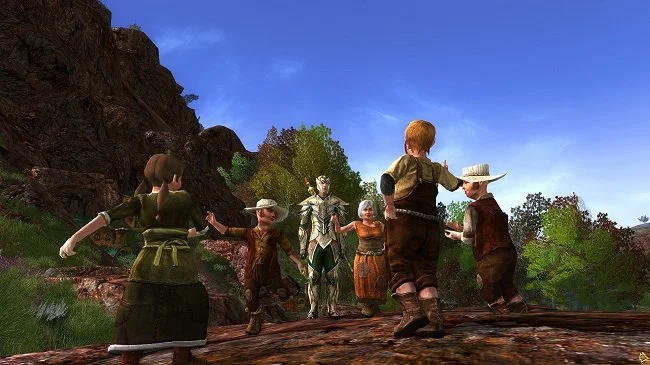
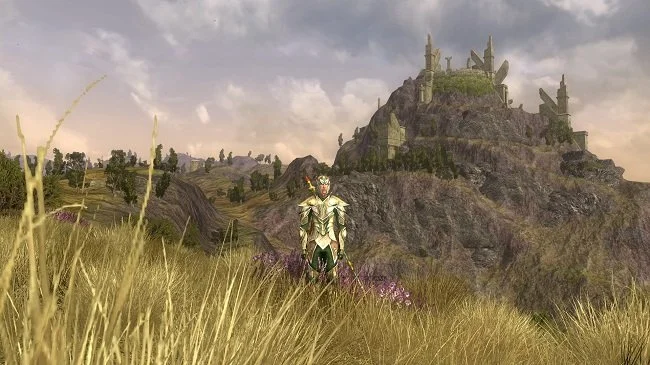
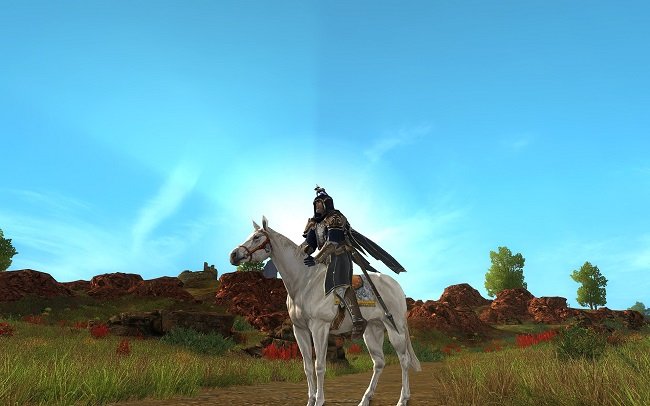
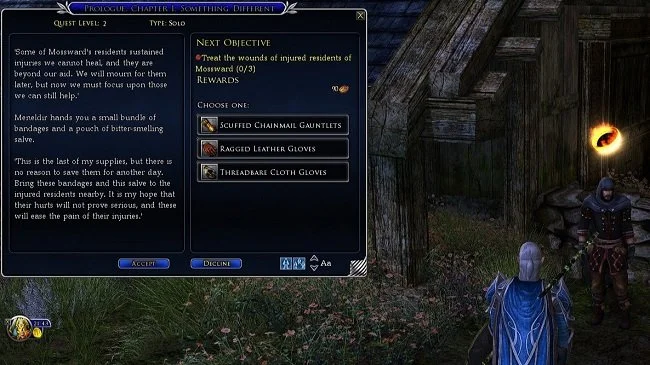
When playing on the Echoes of Angmar server, after creating a character you log into one of the game’s three starter zones, Ered Luin (Elves and Dwarves), Bree-land (Man), and The Shire (Hobbits). The tutorial is currently disabled. By default the regional maps are subject to the “fog of war” and devoid of detail. You have to explore to reveal detail. Players do not get a mount until level 35 and the current test is capped at level 15. It costs a lot of gold in classic LOTRO to purchase a mount and is also tied to the successful completion of a specific series of quests. With regard to quests, the quest tracker simply lists what tasks you are undertaking and does not provide a waypoint on the in-game map. Players are given a broad location such as “visit southern Chetwood” and have to search to find the specific object or NPC. It is quite noticeable compared to the current version of LOTRO, how emptier the classic game world is. There are fewer buildings in Bree and The Shire as well as less cosmetic NPCs, designed to to create a sense of activity. The game textures, especially flora and terrain, are lower in detail.
Another very noticeable difference between old and new LOTRO is the acquisition of class skills as your character levels. Rather than automatically being bestowed the player has to buy them individually from an appropriate class trainer. Furthermore there are only seven classes available. Burglar, Captain, Champion, Guardian, Hunter, Lore-master and Minstrel. Levelling is also far slower. Gear comes primarily from quests, crafting or players trading via the auction house. Vendor gear is also an important stopgap. The trait system is also different, allowing for choices from different lines. Hence certain skills are not dependent on you solely following a specific trait line. There is no barter wallet so storage is more of a pressing issue. The current cosmetic system didn’t exist back in 2007, so the level of sartorial elegance in classic LOTRO is lower. Players often wear identical gear earned from the same quests. It’s worth noting that there’s no “autoloot” either. You have to manually collect dropped items.
But classic LOTRO is not just about cataloguing the differences in game mechanics and systems. There is a major difference in the game’s pacing and play style. Although mobs are not quite so plentiful, they are far harder to deal with, even at lower levels. Hence even in the starter zones on Echoes of Angmar server, players will readily assist each other if they encounter a signature mob at level 5 because it is not a foregone conclusion that they’ll faceroll the fight. LOTRO in 2007 was heavily focused on group play and not all PVE content was designed to be soloable. There are also some other logistical benefits to be had from classic LOTRO. There is no skills lag or in fact any server lag. Having to travel the world on foot also means you tend to stay within the zones that you’re currently questing in. The slower pace of progression fosters greater focus on where you are and what you’re doing.
I have no idea whether Echoes of Angmar has a future or whether the legal reach of the Embracer Group will inevitably shut down the project. If the server does persist it will offer an interesting counter experience to the current iteration of LOTRO. Classic LOTRO is certainly not for everyone and will not necessarily excite the casual player who is looking for a quick and convenient gaming fix. In its original format, LOTRO was designed to be a game that you invest your time and effort into. A collaborative exploration of Middle-earth where you played through content at a measured pace, as it was presented to you. An MMO where you were dependent upon others but rather than that being a chore, it was part of the journey and a tangible selling point. There was no race to cap because it could take a year or so. Goals were long term and not immediately in reach. That is the difference between classic LOTRO and the game that exists today. Both represent the prevailing MMO ethos of their respective time.






Thoughts on “Classic LOTRO”
Cordovan (AKA Jerry Snook), Community Manager for the MMORPG The Lord of the Rings Online, stated in the last Developers Live Stream that “the idea of a formal classic (server) is never off the table”. Naturally, this comment has led to a lot of speculation on the official LOTRO forums. Many players by inference have concluded that the original code does exist for the game as it was at launch or immediately thereafter. As you can imagine this has resulted in much debate as to whether a classic LOTRO server based upon the original Shadows of Angmar release could be created. Assuming that this is the case and technically developer’s Standing Stone Games can do this, it raises the question of whether they should or not. Because a classic server is a different beast to the previous legendary progression servers. 14 years has seen a great deal of change within the MMO industry and with LOTRO as well. Let us take a moment to reflect.
Cordovan (AKA Jerry Snook), Community Manager for the MMORPG The Lord of the Rings Online, stated in the last Developers Live Stream that “the idea of a formal classic (server) is never off the table”. Naturally, this comment has led to a lot of speculation on the official LOTRO forums. Many players by inference have concluded that the original code does exist for the game as it was at launch or immediately thereafter. As you can imagine this has resulted in much debate as to whether a classic LOTRO server based upon the original Shadows of Angmar release could be created. Assuming that this is the case and technically developer’s Standing Stone Games can do this, it raises the question of whether they should or not. Because a classic server is a different beast to the previous legendary progression servers. 14 years has seen a great deal of change within the MMO industry and with LOTRO as well. Let us take a moment to reflect.
A classic LOTRO server would differ greatly from the game as it stands today. In the original version of the game the world map was subject to the “fog of war” meaning you had to explore each region of Middle-earth for the map to show what was there. Players did not get a mount until level 35. It cost a lot of gold and was tied to the successful completion of a specific series of quests. Talking of which, there was no quest tracker with quest locations marked on the in-game map. Players were given a broad location such as “visit southern Chetwood” and had to find things for themselves. The trait system was radically different, skills had to be bought from trainers as you levelled and gear came from quests, crafting or players trading via the auction house. There was no barter wallet so storage frequently became an issue. The current cosmetic system also didn’t exist back in 2007, so the level of sartorial elegance was much lower. And perhaps the biggest difference was that the game was still heavily focused on group play and not all PVE content was soloable.
LOTRO in 2007 was very much a product of its time. Clearly, as the forums show us, there is a percentage of the existing LOTRO community that would be happy to play such an iteration of the game. However, it would take a lot of developer resources to bring Shadows of Angmar back in a form that is playable on contemporary PC architecture and hardware. Modern screen resolutions and the need for a fully scalable UI are just a few examples of technical problems that would need to be addressed. Gamers often use World of Warcraft Classic as an example of how an older version of an MMORPG can be brought back. However, a completely different development team was established to achieve this and the project had the financing of Activision Blizzard underpinning it. SSG do not currently have such resources at their disposal. Are their current owners EG7 going to fund such an undertaking such as classic LOTRO server, with its limited appeal, or spend their money modernising the existing game, upgrading the current engine and porting it to console? The latter seems like the more fiscally prudent business decision.
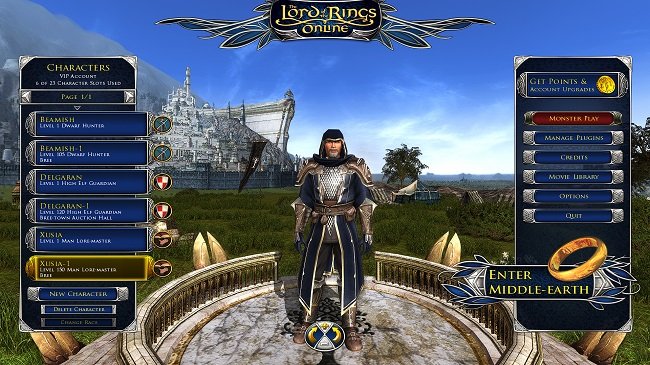
I personally would not be interested in a classic server. I enjoyed the game, as it was back in 2008 when I started playing, by default. It’s systems and mechanics were what they were back then but I cannot in all honesty say that I want to give up all the quality of life improvements that have come to LOTRO since then. Furthermore, I was at a point in my life where I could sink time into an MMO as was required by the genre back then. Those days have gone. I think the most I would ever do in classic LOTRO would be to log in to the game, recreate my existing Lore-master and potter around Bree. I do not think my interest would endure beyond a few hours of nostalgia. If a classic server follows the business model of the existing legendary servers it will require an active subscription for access. I don’t consider that to be worth my while. And then there’s the entire issue of the presence of the LOTRO store in a classic version of the game.
If LOTRO is to survive, it needs to modernise and requires a major overhaul. There are systems and mechanics to fix and some that need to be removed. If EG7 can afford to do this as well as provide a version of classic LOTRO, then so be it. But I don’t think that is the case and therefore I believe the first option is the most likely option. However, this entire debate is yet another example of what I call “gaming myopia”. Some gamers habitually forget that video games are consumer products and not public services. There are dozens of products that have been discontinued during my lifetime that I’d like to see return but the realities of business mean that none of them ever will. Producing classic LOTRO at the expense of the existing game would be a mistake. Churn and new customers are a reality that drive business. Do potential new players really want a game from 2007? I think not.
NB: This subject last became a talking point within the LOTRO community last November. The matter was addressed by SSG developer Jeff Libby (AKA MadeOfLions). Whether Cordovan’s recent comments indicate a policy change or whether he was just talking theoretically, I will leave to readers to decide.