
The Silmarillion by J. R. R. Tolkien - Read by Martin Shaw (1998)
Let’s not be coy about this. J. R. R. Tolkien’s The Silmarillion is not in any way a light read. It has a complex narrative, filled with staggering amounts of lore to digest. I certainly wouldn’t recommend it to anyone as their first point of entry into the Tolkien Legendarium. I think this is a book that you tackle after The Hobbit and The Lord of the Rings, if you are sufficiently enamoured with the threads of a wider backstory that are alluded to in both those volumes. If that is the case then brace yourself. However, despite its sprawling histories and dense genealogies, The Silmarillion is an incredibly rewarding book. There is an air of majesty surrounding the epic stories it contains and its themes about the eternal struggle between the dark and the light are timeless. Due to the immense detail that Tolkien lavishes upon the text, Middle-earth feels like a genuine living, breathing world. A world of languages, culture, geography and history. To date it has never been equalled.
Let’s not be coy about this. J. R. R. Tolkien’s The Silmarillion is not in any way a light read. It has a complex narrative, filled with staggering amounts of lore to digest. I certainly wouldn’t recommend it to anyone as their first point of entry into the Tolkien Legendarium. I think this is a book that you tackle after The Hobbit and The Lord of the Rings, if you are sufficiently enamoured with the threads of a wider backstory that are alluded to in both those volumes. If that is the case then brace yourself. However, despite its sprawling histories and dense genealogies, The Silmarillion is an incredibly rewarding book. There is an air of majesty surrounding the epic stories it contains and its themes about the eternal struggle between the dark and the light are timeless. Due to the immense detail that Tolkien lavishes upon the text, Middle-earth feels like a genuine living, breathing world. A world of languages, culture, geography and history. To date it has never been equalled.
The Silmarillion is the jewel in the crown of J.R.R. Tolkien’s imaginative writing, a collection of narratives ranging in time from the Elder Days of Middle-earth, through the Second Age and the rise of Sauron, to the end of the War of the Ring. The Ainulindalë is a myth of the Creation. In the Valaquenta the nature and powers of the gods is described. Quenta Silmarillion is set in an age when Morgoth was the first Dark Lord and dwelt in Middle-earth. The Elves made war upon him in his impenetrable fortress in Angband for the recovery of the Silmarils. Three jewels containing the last remaining pure light of Valinor, seized by Morgoth and set in his iron crown. The Akallabêth recounts the downfall of the great island kingdom of Númenor at the end of the Second Age. Of the Rings of Power tells of the great events at the end of the Third Age, as told in The Lord of the Rings.
The Silmarillion is a history, albeit an invented one. The book is not linear, nor is it always chronological. It blends expository mythological texts with more traditional story-telling. Despite this structure, it is hard not to feel a sense of awe at the totality of Tolkien’s visions. The book is a prodigious chronicle, highlighting events and individuals with a scope too large to easily summarise. Needless to say, it can often be difficult to keep track of all the characters. Often one story dovetails or impacts upon another, so that it frequently feels like a single narrative rather than a collection of smaller stories. There are events such as the founding of great cities, establishing dynasties, the sundering of peoples and the inevitable waging of war. Throughout these events there is tragedy, beauty, torture, escapes, murders and betrayals. Some characters are noble where others are blighted by hubris, although it often goes ill for them. Although these tales are long and complex, they’re never dull.
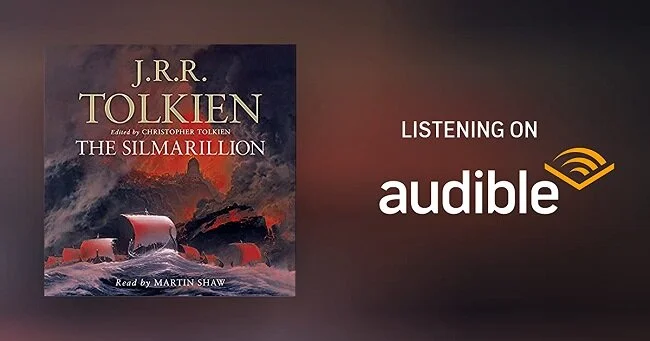
The HarperCollins audiobook, recorded in 1998 by British actor Martin Shaw, is possibly the most accessible way for relatively new fans of Tolikien’s writings to tackle The Silmarillion. Shaw narrates with a strong degree of reverence that borders on religious solemnity, guiding listeners carefully through epic battles and epochal events, as well as the legions of protagonists, antagonists and side characters. Shaw skilfully handles the difficult pronunciations of Tolkien's invented languages and inspires a frisson of pleasure when he breaks the straight narration to slip into character voices. The measured pacing of his reading is invaluable to the listener in allowing them to reflect upon the unfolding story and then digest it. I would also recommend listening to this audiobook while having a map of Beleriand to hand. Seeing the geography of the regions discussed is a major asset in understanding the events described. The Silmarillion read by Martin Shaw is currently available on Audible and would make a welcome addition to any Tolkien fan’s library.



The Silmarillion Movie
When Peter Jackson finished filming The Hobbit trilogy, there was some idle speculation by fans as to the possibility of a movie adaptation of The Silmarillion. It was meant mainly as a talking point, rather than a serious proposition and there certainly was an enthusiastic response from some quarters. Three years on, the fantasy genre is still a commercially successful genre both at Cinemas and on TV. Furthermore, production studios are regularly looking to existing literary properties that they can convert into viable long term franchises. Bearing all this in mind, is it possible that Tolkien’s complex mythopoeic work could be adapted for either the big or little screen?
When Peter Jackson finished filming The Hobbit trilogy, there was some idle speculation by fans as to the possibility of a movie adaptation of The Silmarillion. It was meant mainly as a talking point, rather than a serious proposition and there certainly was an enthusiastic response from some quarters. Three years on, the fantasy genre is still a commercially successful genre both at Cinemas and on TV. Furthermore, production studios are regularly looking to existing literary properties that they can convert into viable long term franchises. Bearing all this in mind, is it possible that Tolkien’s complex mythopoeic work could be adapted for either the big or little screen?
Although it is theoretically possible to make either a movie of TV show from the source material, the likelihood of such a project coming to pass is very remote. Hollywood studios are very risk averse, especially towards material that cannot be easily defined and pitched at the broadest demographic. Even if The Silmarillion were to be championed by a major director, there is no guarantee that such a project would be immediately green lit. Hollywood heavy weights such as Steven Spielberg and Martin Scorsese have fallen foul of this policy recently. However, if a Silmarillion adaptation could secure financing, let us consider some of the other potential obstacles that would have to be addressed before the project could move forward.
First, there is the fundamental issue of the rights to The Silmarillion, which are not included in those currently held by Middle-earth Enterprises. I think the Tolkien estate would move heaven and earth to block such a project from progressing, as Christopher Tolkien has made his views very clear on the existing movie adaptations of his father's work. He abhors what he sees as the Disneyfication of the source material. Therefore, this is an issue that cannot be addressed during his lifetime. Whether the heirs to the estate would think differently remains to be seen.
Then there is the source text of The Silmarillion itself, which would be would be extremely difficult to adapt and market to a mainstream audience. It would require considerable restructuring and frankly a lot of dumbing down to make an accessible narrative. It is episodic by nature with an excess of characters and explores a great deal of abstract concepts. There are certainly passages of the text that would make epic set pieces but overall the narrative does not support the traditional three act story arc that cinema prefers.
This then raises the question, rather than a series of movies, would a high budget cable show such as Game of Thrones, be a more suitable medium to showcase The Silmarillion. Either way, a live action adaptation would require a prodigious budget. Considering the philosophical and theological elements to the text, perhaps live action is not the best approach to adapting the work. Would the medium of animation be more appropriate? By this I do not mean mainstream CGI but something more traditional such as cel animation or perhaps some experimental stop motion method?
Then there is the risk that any adaptation may be usurped and extrapolated into something very different from Tolkien’s vision. Tolkien was a devout Catholic although this is not immediately obvious in his works. He also deplored the use of allegory as a literary device. There is a chance that whoever adapts The Silmarillion could colour it with their own personal religious, moral and philosophical baggage and make it into something that it is not. I would hate to see something as cerebral as this book, distilled into a clumsy and misplaced metaphor to be championed by the wrong sort of Christian institutions. The Silmarillion deserves better than that.
If we still consider such a project in movie terms, then it would require director of immense cinematic skill and vision. Peter Jackson, although visually talented, is not the film maker he was a decade or two ago. He is too big a name, too commercial and now appears to exhibit a degree of self-indulgence that often comes when directors become celebrities. Personally, I think his better work is now behind him. A true visionary would be required for The Silmarillion movie but these are a scarce commodity these days. Kubrick, Kurosawa and their like are long dead, so who exactly does that leave? Guillermo del Toro, Bong Joon-ho or Alfonso Cuarón?
As you can see, these are just a few potential problems that would plague such a project. Furthermore, it can be cogently argued that just because you can do something, it doesn't mean that you should. The Silmarillion may well be unfilmable in any meaningful way and to attempt to do so may well be disrespectful to the source text. Unfortunately, film makers and especially their financiers seldom understand such concepts and often end up debasing great literary works in pursuit of the lowest common denominator and box office gold. The Silmarillion was intended by its author to be a book and nothing more. Does it really need to exist in any other way?