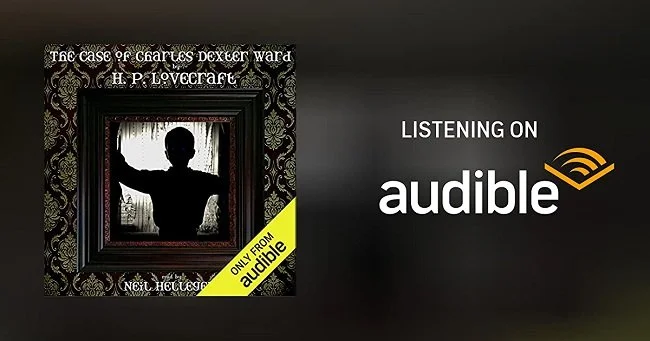
The Case of Charles Dexter Ward by H. P. Lovecraft - Read by Neil Hellegers
Charles Dexter Ward is a young man from a prominent Rhode Island family with a keen interest in history. He spends much of his childhood wandering the streets of ancient Providence, drawn inexorably to its architecture, as well as it’s colourful heritage. As an adult he continues his antiquarian leanings and subsequently discovers a hitherto unknown ancestor, Joseph Curwen. One with a shadowy past which hints at the pursuit of alchemy and other arcane practises. Charles decides to uncover the truth regarding Joseph Curwen and over time his interest changes into obsession. His Father begins to worry about his son’s fixation and the family Doctor, Marinus Bicknell Willett, decides to keep an eye upon the youth’s state of mind. A series of curious events hint at a growing eldritch malevolence and Doctor Willett begins to suspect that Charles is in grave danger from a menace stretching across time.
Charles Dexter Ward is a young man from a prominent Rhode Island family with a keen interest in history. He spends much of his childhood wandering the streets of ancient Providence, drawn inexorably to its architecture, as well as it’s colourful heritage. As an adult he continues his antiquarian leanings and subsequently discovers a hitherto unknown ancestor, Joseph Curwen. One with a shadowy past which hints at the pursuit of alchemy and other arcane practises. Charles decides to uncover the truth regarding Joseph Curwen and over time his interest changes into obsession. His Father begins to worry about his son’s fixation and the family Doctor, Marinus Bicknell Willett, decides to keep an eye upon the youth’s state of mind. A series of curious events hint at a growing eldritch malevolence and Doctor Willett begins to suspect that Charles is in grave danger from a menace stretching across time.
The Case of Charles Dexter Ward by H. P. Lovecraft, is a short novel that first appeared in Weird Tales in 1941. It is an uncomplicated story with a straightforward narrative arc. A young man’s obsession with an unsavoury ancestor leads to him replicating his alchemical and cabalistic research with suitably unpleasant results. However, it’s strength lies in the details that Lovecraft lavishes upon the proceedings. The loquacious descriptions of Providence, the historical details of 18th century life and culture in the State of Rhode Island and the inclusion of real characters from the era, such as Abraham Whipple, John and Moses Brown and Esek Hopkins is compelling. Once again Lovecraft alludes to ancient and arcane forces lurking beyond the veil of human understanding and perception. As ever the terror he evokes lies in the suggestion of something unfathomably evil and utterly alien impinging upon our world.
This unabridged reading of The Case of Charles Dexter Ward by Neil Hellegers is well paced and atmospheric. Hellegers, who has a great deal of experience with recording audio books, has clear diction and measured intonation, providing subtle detail to each character. His pronunciation of some of the complex names in the Cthulhu Mythos is assured. The story’s six hour running time is broken down into manageable audio chapters. Overall this is a well presented and exclusive reading of Lovecraft’s story, to be found only on Audible. It is accessible to both those familiar with the writings of H. P. Lovecraft and those who are new to his body or work. It certainly features one of his most notable and sinister villains. The story leaves several plot devices purposely vague and it is enjoyable to ponder on them after listening.


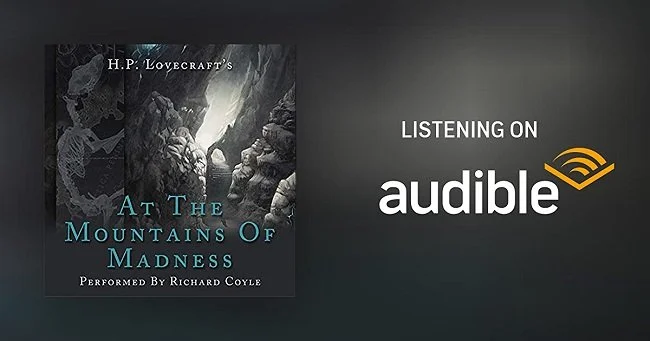




At the Mountains of Madness by H.P. Lovecraft - Read by Richard Coyle
At the Mountains of Madness is a story told from a first-person perspective by geologist William Dyer, a professor from Miskatonic University in Arkham, a fictional town in Essex County, Massachusetts USA. When a new scientific expedition to Antarctica is announced, Dyer breaks his silence and discloses hitherto unknown and closely kept secrets about his own explorations of the continent and exactly what befell his own expedition. He details how his team found the preserved remains of 14 prehistoric life forms unknown to science and outside of the existing geological and evolutionary timescale. He goes on to recount how some of the men and sled dogs are killed under mysterious circumstances. Dyer and graduate student Danforth, subsequently explored a mountain range by plane and discovered a vast, abandoned stone city, which is alien to any form of human architecture. What is the secret of this ancient ruin? Can Dyer convince subsequent explorers to stay clear of “the mountains of madness”.
At the Mountains of Madness is a story told from a first-person perspective by geologist William Dyer, a professor from Miskatonic University in Arkham, a fictional town in Essex County, Massachusetts USA. When a new scientific expedition to Antarctica is announced, Dyer breaks his silence and discloses hitherto unknown and closely kept secrets about his own explorations of the continent and exactly what befell his own expedition. He details how his team found the preserved remains of 14 prehistoric life forms unknown to science and outside of the existing geological and evolutionary timescale. He goes on to recount how some of the men and sled dogs are killed under mysterious circumstances. Dyer and graduate student Danforth, subsequently explored a mountain range by plane and discovered a vast, abandoned stone city, which is alien to any form of human architecture. What is the secret of this ancient ruin? Can Dyer convince subsequent explorers to stay clear of “the mountains of madness”.
At the Mountains of Madness was written by H.P. Lovecraft in 1931. The novella was originally serialised in Astounding Stories magazine in the US. While considered by fans to be an integral part of the Cthulhu Mythos some critics have argued that the author was attempting to “demythologise” his earlier work. I do not hold with this school of thought but I do consider the novella to be one of the author’s best works. It has a cosmic scope of vision and its sinister tone hints at so much more than the immediate horror. At the Mountains of Madness has proven so popular there have been several aborted attempts to bring it to the silver screen, with names such as Steven Spielberg and Guillermo Del Toro associated with the production. In the meantime the 2010 adaptation by Ladbroke Radio productions for BBC Radio 4 Extra, offers a superb five part dramatisation.
Read by actor Richard Coyle and accompanied with ambient music and sound effects, this concise audio version of the novella is a brooding and atmospheric affair. Purists should note that this is an abridged adaptation but the story does not suffer in any way by having some of the descriptive fat paired away. As for Richard Coyle his narration is authoritative and emotive. His dramatic range is extensive and he breathes life into the descriptions of the Cyclopean ruins. He clearly conveys the confusion and fear that Dyer feels as he explores the hidden city. This is a concise and well paced adaptation that breaks the story into five parts, with each episode running approximately 33 minutes. It is a very accessible version of Lovecraft’s classic tale and a great point of entry into the Cthulhu Mythos for those who are unfamiliar with it. At the Mountains of Madness is currently available on Audible.
H. P. Lovecraft's The Shadow Out of Time (2012)
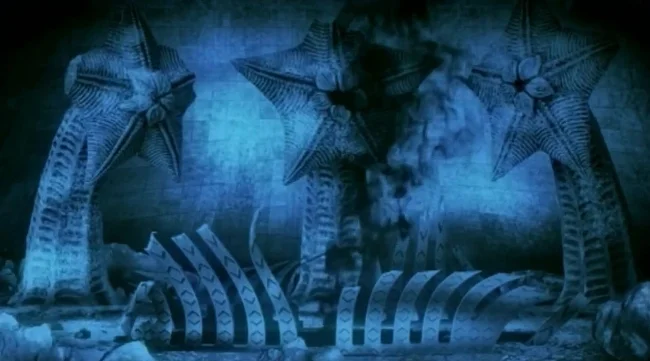
The writings of H. P. Lovecraft have been an inspiration for many a film maker. Their brooding atmosphere along with intriguing blend of science and the occult, offers a wealth of themes to be explored. Unfortunately, there have been very few movies that have come anywhere near to capturing the spirit of the author. So, it was with great interest that I watched the fifteen-minute short film The Shadow Out of Time. This low budget production made by independent film makers Richard Svensson, Daniel Lennéer and Christopher Johansson, succinctly distils a classic Lovecraftian tale without losing any of the ambience of the source text. It puts to shame some of the hand-fisted adaptations that have preceded it.
The writings of H. P. Lovecraft have been an inspiration for many a film maker. Their brooding atmosphere along with intriguing blend of science and the occult, offers a wealth of themes to be explored. Unfortunately, there have been very few movies that have come anywhere near to capturing the spirit of the author. So, it was with great interest that I watched the fifteen-minute short film The Shadow Out of Time. This low budget production made by independent film makers Richard Svensson, Daniel Lennéer and Christopher Johansson, succinctly distils a classic Lovecraftian tale without losing any of the ambience of the source text. It puts to shame some of the hand-fisted adaptations that have preceded it.
The plot follows an academic, Nathaniel Wingate Peaslee who collapses during a lecture to find that he has exchanged bodies with an extraterrestrial life form from Earth's past history. His own body is occupied by the alien who spend the next two years studying the present era. Eventually the process is reversed and Peaslee attributes the events to a mental collapse. However, it becomes apparent that he is not the only one to have had this experience. His resulting investigation leads him to Australia and an uncomfortable truth emerges. The story touches upon the experiences of both individuals and hints at a further menace that threatens the future of both species. Told via narration, the film is set in the 1900s and reflects the cinematic style of the time.
The period setting along with its stylised format really enhances the unfolding story. Åke Rosén performance is very much in the appropriate idiom and John Hutch narration embellishes without descending into melodramatics. Overall this is a polished production when you consider the budgetary and the logistical constraints imposed upon the film makers. It never ceases to amaze me the dedication and love that fans can muster to create such outstanding work using just “over the counter” hardware and software. Therefore, I thoroughly recommend The Shadow Out of Time and would urge readers to check out the creators You Tube channel for further H. P. Lovecraft adaptations.