
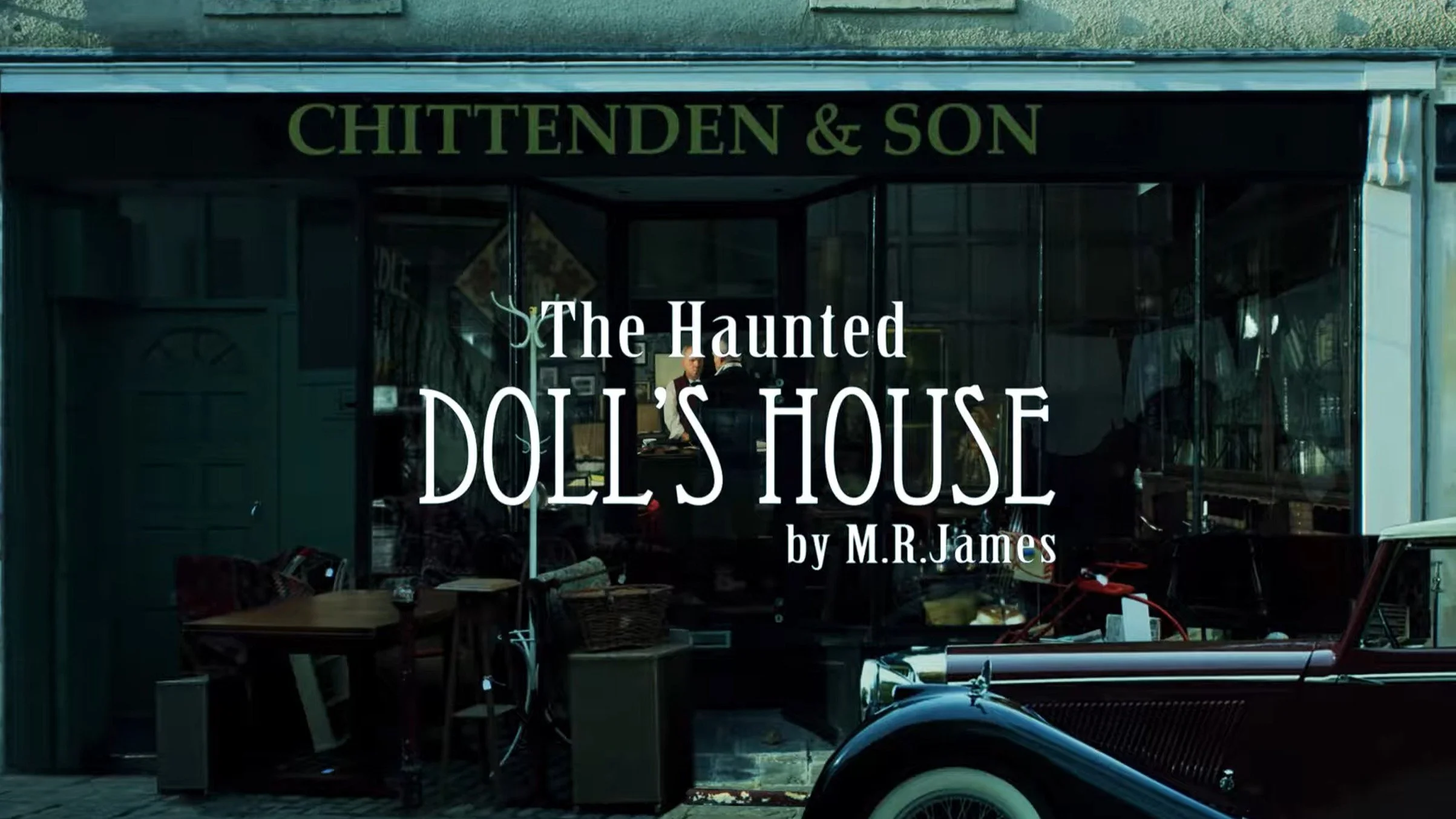
The Haunted Doll’s House (2012)
The Haunted Dolls House is a short film based on a story by M.R. James about a unique antique that is subject to supernatural phenomenon. Adapted by Stephen Gray and David Lilley, this is the third of three short films based upon James’ work that the pair have made. It stars Steven Dolton as Mr. Dillet, a collector of antique dolls houses, who acquires a bargain only to discover that it harbours a ghostly secret. Made on an extremely modest budget over the course of 2012 this clever, innovative and rather sinister adaptation is a fine example of short film creativity. It manages to offer a unique visual depiction of M.R. James’ classic story whilst capturing the unsettling quality of the author’s work. Like so many independently made short films it is clearly a labour of love, made with modest resources. It succinctly captures the spirit of the author’s work and is both innovative and rewarding.
The Haunted Doll’s House is a short film based on a story by M.R. James about a unique antique that is subject to supernatural phenomenon. Adapted by Stephen Gray and David Lilley, this is the third of three short films based upon James’ work that the pair have made. It stars Steven Dolton as Mr. Dillet, a collector of antique doll’s houses, who acquires a bargain only to discover that it harbours a ghostly secret. Made on an extremely modest budget over the course of 2012 this clever, innovative and rather sinister adaptation is a fine example of short film creativity. It manages to offer a unique visual depiction of M.R. James’ classic story whilst capturing the unsettling quality of the author’s work. Like so many independently made short films it is clearly a labour of love, made with modest resources. It succinctly captures the spirit of the author’s work and is both innovative and rewarding.
The Haunted Doll’s House creates an interesting period atmosphere of the early nineteen twenties and sets the scenes for the ghostly events. Professional antique collector Mr. Dillet seems very pleased with his latest acquisition and sits late into the night cataloguing its contents by dictating into a Phonograph Recorder. However, as Mr. Dilet lists the respective details, they seem to become more intricate each time he checks them. Perhaps he is just overly tired? He subsequently retires to bed for the evening, however he is woken during the night when a strange light illuminates the doll's house. It would appear that the latest addition to his collection has something to show him. A rather disturbing story plays out among the antique’s occupants; a family of dolls consisting of a husband and wife, two children and a bedridden Grandfather.
The director's use of stop motion animation is a major positive asset for this adaptation. The minimalist character design of the dolls and the lack of dialogue do not in any way hinder the narrative. The silent actions of the puppets not only clearly convey the story but embellish it with a great deal of atmosphere and pathos. In many ways it plays out like a sinister episode of Camberwick Green and I do not mean that in a derogatory manner but as the highest possible compliment. The transition from animation to live action is cleverly done and provides an appropriate codicil to this supernatural tale. The Haunted Doll’s House makes good use of its eleven minute running time making it an ideal seasonal ghost story. It is a fine example of the high quality independent short films that you can often find online, if you take the time to search them out. The Haunted Doll’s House is available to watch on YouTube.
The Mezzotint (2021)
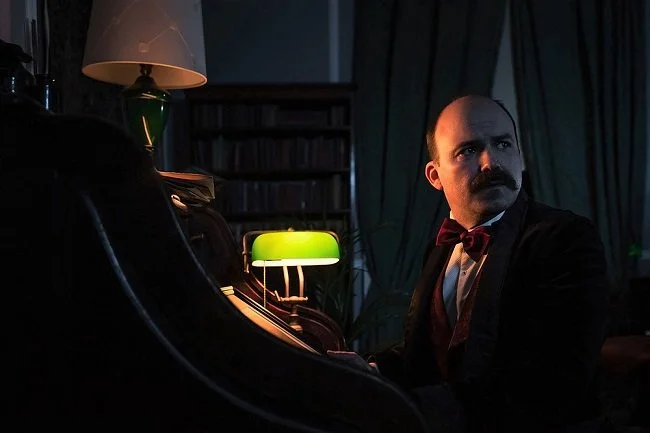
In 1922, middle-aged University Don Edward Williams (Rory Kinnear), is sent a somewhat “indifferent” mezzotint (a monochrome print made from an engraved copper or steel plate) on approval from one of his regular art dealers. On arrival the mezzotint features an unidentified English country house and has no distinguishing features to merit its price. Later that day, Williams shows the print to Binks (John Hopkins), a colleague he plays golf with. He comments that the moonlight is quite well done and there appears to be a figure just on the right of the image. Williams is puzzled that he hadn’t noticed it before. That evening Garwood (Robert Bathurst), a fellow academic, studies the picture and comments on a “grotesque” figure. When Williams checks again before going to bed there is now clearly a shroud covered shape crawling across the lawn in the mezzotint. Williams confers with his friends as to what they have seen, as it becomes clear that the picture is trying to show them something.
In 1922, middle-aged University Don Edward Williams (Rory Kinnear), is sent a somewhat “indifferent” mezzotint (a monochrome print made from an engraved copper or steel plate) on approval from one of his regular art dealers. On arrival the mezzotint features an unidentified English country house and has no distinguishing features to merit its price. Later that day, Williams shows the print to Binks (John Hopkins), a colleague he plays golf with. He comments that the moonlight is quite well done and there appears to be a figure just on the right of the image. Williams is puzzled that he hadn’t noticed it before. That evening Garwood (Robert Bathurst), a fellow academic, studies the picture and comments on a “grotesque” figure. When Williams checks again before going to bed there is now clearly a shroud covered shape crawling across the lawn in the mezzotint. Williams confers with his friends as to what they have seen, as it becomes clear that the picture is trying to show them something.
The Mezzotint is part of the A Ghost Story for Christmas series of short television films, produced by the BBC somewhat intermittently since 1971. More recently, writer, director and actor Mark Gatiss has resurrected this franchise and produced several adaptations of short stories by the great M. R. James. The Mezzotint is his latest production and was broadcast on Christmas Eve 2021. Running for just 30 minutes Gatiss builds an unsettling atmosphere as the story progresses.The changes that take place in the print are not dwelt upon onscreen but instead he focuses upon the impression they make on those who are looking. Rory Kinnear excels as the befuddled bachelor who begins to feel a sense of impending doom. There is also a strong cameo appearance by Frances Barber as Mrs. Ambrigail, an amateur historian. Scottish composer Blair Mowat provides a succinct and creepy score which adds to the overall ambience.
The original short story is set in 1904 and takes place mainly in the rooms of the various protagonists at the University. Although it is a sinister tale, it lacks a suitably strong ending, hence Mark Gatiss has chosen to expand the storyline. The drama is now set in 1922 and the staff of the University are debating whether to allow women students to study for degrees. To make the story a little less male-centric some characters have been changed to women; a University Porter becomes a Housekeeper. The most significant addition to the story is a subplot regarding William’s ongoing investigations into his family tree. Hence Mrs. Ambrigail, the Vicar’s wife, searches through the various parish records. This thread has a major impact upon the climax of The Mezzotint which in this adaptation ends with a substantial “Jamesian wallop” (the unofficial term for a shock or surprise twist in the stories of M. R. James).
Some purists have balked at the embellishments and changes that have been made to this adaptation. If you’re of a similar mind, then you may be better off listening to an audiobook version of the original short story. There is a very good collection read by David Collings available. However, I am of the view that the story requires expanding to lend itself to the requirements of television and I feel that the widening of the plot and additional ending are to the drama’s overall benefit. Mark Gatiss is clearly a consummate fan of M. R. James and I feel his screenplay is very sympathetic to the source text. As for the “Jamesian wallop” at the story’s denouement, I believe this is consistent with the author’s style which often featured a grotesque and eldritch flourish at the end of a story. I hope that the BBC has the good sense to commission further adaptations from Mark Gatiss so that the A Ghost Story for Christmas series can continue.









The Tractate Middoth (2013)
The BBC has a long and illustrious history of commissioning innovative adaptations of the works of M R James. Consider a moment the likes of Jonathan Miller's Whistle and I'll Come to You or The Ash Tree by Lawrence Gordon Clark. If you are unfamiliar with these short television dramas, then I strongly advise you to seek them out. They are the epitome of quality television forays into the world of the supernatural. The Tractate Middoth, written and directed by Mark Gatiss, once again demonstrates how well the finely crafted short stories of Monty James lend themselves to the medium of film. Mr. Gatiss has a clear understanding and passion for the horror genre and proves (as he did with Sherlock) that "adaptation" does not have to mean "bastardisation".
The BBC has a long and illustrious history of commissioning innovative adaptations of the works of M R James. Consider a moment the likes of Jonathan Miller's Whistle and I'll Come to You or The Ash Tree by Lawrence Gordon Clark. If you are unfamiliar with these short television dramas, then I strongly advise you to seek them out. They are the epitome of quality television forays into the world of the supernatural. The Tractate Middoth, written and directed by Mark Gatiss, once again demonstrates how well the finely crafted short stories of Monty James lend themselves to the medium of film. Mr. Gatiss has a clear understanding and passion for the horror genre and proves (as he did with Sherlock) that "adaptation" does not have to mean "bastardisation".
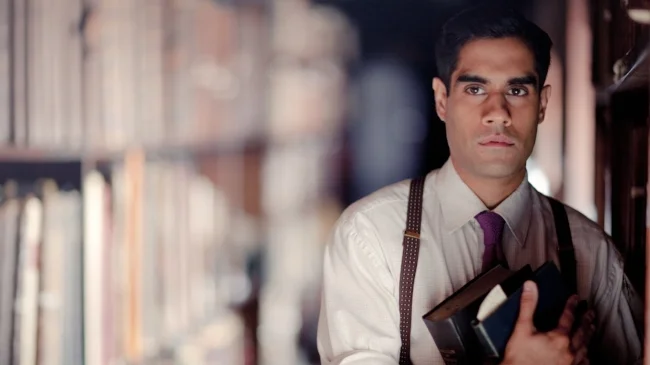
The Tractate Middoth relocates the events of the story from the Edwardian era, to the early Fifties but apart from this change the production remains remarkably faithful to the text. We meet young librarian Mr. Garnett (Sacha Dhawan) who has a rather disturbing experience while searching for an old tome of Hebrew text for an irascible academic John Eldred (John Castle). It would appear that a mysterious third part may have an interest in the book. While recovering from his shock, with a dose of country air, Mr. Garnett meets Mrs. Simpson (Louise Jameson) and her daughter Anne (Charlie Clemmow). They tell a strange tale of a missing last will and testament that would make them heir to a sizeable inheritance. Unfortunately, the document has been written in an obscure book. Could it be the very same volume that lead to Mr. Garnett's supernatural experience?
This delightful adaptation blends the erudition and macabre atmosphere of M R James with the wit and intelligence of Mark Gatiss. The two complement each other very well. M R James's liking for comedic minor officials and bureaucrats is embellished by Mark Gatiss, leading to some clever observational humour and comic asides. However, this is not done to the detriment of the brooding atmosphere or the central supernatural plot. The thirty-minute adaptation has a minimum of superfluous CGI, keeping as much effects work as possible in-camera, thanks to the stylish cinematography of Steve Lawes. The prosthetics for the central ghost are suitably ghoulish and very much in accord with the original story.
The period feel is authentic and still maintains M R James cardinal rule that a good ghost story should always be set in the past and related by those who have indirectly experienced it. Performances are universally good ensuring that characters do not descend in to genre caricatures. The handsome production design and art direction reflect the architectural and topographical detail that is synonymous with all of James's short stories. It is to the director’s credit that the supernatural climax is effectively carried out in broad daylight without losing any dramatic impact. The final sting in the tail, although a whim of Mark Gatiss, is far from out-of-place.
As with the BBC adaptations from the seventies, this latest production has a distinguished pedigree, sporting such names as Una Stubbs, Eleanor Bron and John Castle. There is also a clear sense that everyone involved has a love and respect for the work of Montague Rhodes James. The Tractate Middoth is text-book example of the sort of quality television that can be produced when the right people are involved and deferred to. Mark Gatiss has spoken of the freedom afford to him by the BBC Arts Department and it is clear that their trust in him has paid off. The Tractate Middoth, is well paced and lovingly crafted, delightfully unsettling. There are several jolts leading to a classic Jamesian Wallop (Thank you Will Ross and Mike Taylor for coining that phrase).
M R James: Ghost Writer (2013)
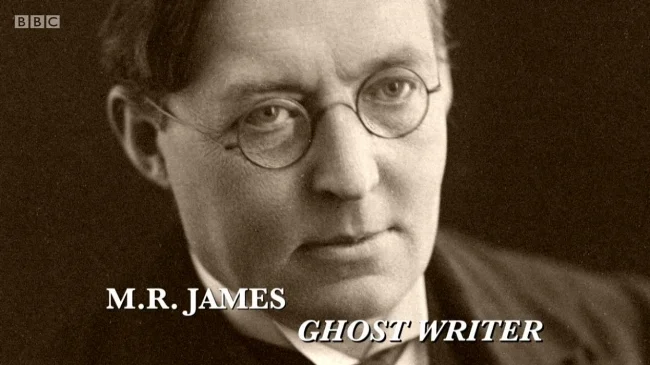
MR James: Ghost Writer is a sixty-minute documentary written and presented by Mark Gatiss, exploring the life of Britain's foremost ghost story writer. Gatiss, a long-time admirer of James, delves in to the life of the author from his devout Anglican upbringing and close-knit family life, through to his ascent to the summit of academia at King's college, Cambridge. The program seeks to discover what motivated this scholarly bachelor to create some of the most iconic and chilling ghost stories in English literature. By following in James’s footsteps, the documentary attempts to gain a greater insight in to the enigmatic author.
MR James: Ghost Writer is a sixty-minute documentary written and presented by Mark Gatiss, exploring the life of Britain's foremost ghost story writer. Gatiss, a long-time admirer of James, delves in to the life of the author from his devout Anglican upbringing and close-knit family life, through to his ascent to the summit of academia at King's college, Cambridge. The program seeks to discover what motivated this scholarly bachelor to create some of the most iconic and chilling ghost stories in English literature. By following in James’s footsteps, the documentary attempts to gain a greater insight in to the enigmatic author.
MR James: Ghost Writer explores in some depth the legacy of Mr James, emphasising his early life in Suffolk and the religious nature of his family. His academic prowess and near obsession with Medieval text and apocrypha clearly had an impact upon his writing, with much of the visual imagery from his writings being directly lifted from manuscripts he worked with on a daily basis. Only being familiar with James's work from a literary standing, I was greatly surprised by the great academic achievements of his life. His written treatise on illuminated Apocalypse manuscripts still remains an unparalleled achievement along with his rise to the office of provost and directorship of the Fitzwilliam Museum.
Despite the dry and formal nature of Victorian life, James was a surprising gregarious animal, taking an active part in college social life. Although he certainly reflected facets of the antiquarian characters that so often populated his stories, he was also a man of immense passion. His personal friendships were deep and of great importance to him, as correspondence with his inner circle demonstrate. His relationship with ex-pupil and illustrator James McBryde, succinctly demonstrates a profound platonic friendship of a type seldom seen these days. The documentary also addressed the impact of the "Great war" upon both James and the college and the subsequent way it influenced his later writing.
Perhaps the best aspect of Mark Gatiss's exploration of all things Jamesian, is the honest and fair way the subject of his "personal life" is explored. There is a trend in contemporary analysis to sometimes over zealously look for evidence modern schools of thought in those from prior eras. Several revisionist scholars seem to seize upon "examples" of a sexual subtext in the author's work and are then are happy to extrapolate this in to theories of suppressed homosexuality. Mr. Gatiss does not shy away from such notions but neither does he make any definitive conclusions. His interview with a former pupil of James whose father was also a close personal friend, perhaps sheds the most light upon the matter.
The visual and editing style of MR James: Ghost Writer is very compelling and follows a broadly linear narrative path, with many a tangential aside to explore illustrative points. Being a BBC commission project there a lot of use of footage from previous television adaptations in referencing James's literary work. The documentary effectively makes use of actor Robert Lloyd Parry, who recreates James celebrated readings of his stories at Christmas, to his fellow members of the " Chit Chat Club". Parry specialises in one-man performances of the work of M R James and provides some excellent readings from such stories as Canon Alberic's Scrapbook and A warning to the Curious.
Although it is an impossible task to definitively encapsulate a writer such as M R James in a single sixty-minute documentary, MR James: Ghost Writer certainly provides an interesting overview. Mark Gatiss has an obvious passion for the man and clearly identifies with him on many levels. However, this is far from an unobjective eulogy and depicts James as a man of his time with not particularly progressive attitudes on sexual equality or modernisation. I therefore whole heartedly recommend MR James: Ghost Writer not only established M R James fans but to wider scholars of the ghost stories who wish to learn more about one of the genres finest authors.





The Complete Ghost Stories of M R James – Read By David Collings (2007)
The supernatural fiction of Montague Rhodes James is a major milestone in the history of the literary ghost story. His work tangibly helped shape the genre as we know it today, focusing on classic themes such as retribution, vengeance and other aspects of traditional mythology literature. The protagonists are often socially dysfunctional intellectuals who face peril due to their excessive curiosity. The very physical nature of horror often masquerades for deeper psychological issues. They also serve as an invaluable window into the socioeconomic structure of Edwardian Britain.
The supernatural fiction of Montague Rhodes James is a major milestone in the history of the literary ghost story. His work tangibly helped shape the genre as we know it today, focusing on classic themes such as retribution, vengeance and other aspects of traditional mythology literature. The protagonists are often socially dysfunctional intellectuals who face peril due to their excessive curiosity. The very physical nature of horror often masquerades for deeper psychological issues. They also serve as an invaluable window into the socioeconomic structure of Edwardian Britain.
In more recent years critics have tried to determine if the author’s personal life and idiosyncrasies are reflected in his written work. Is there a hidden subtext within the narrative, hinting at inner conflict and repression in James own life? It’s quite possibly so. Either way there is no doubt that M R James is one of the finest authors of short stories, this country has known. His influence is still seen today in the works of Brian Lumley, James Herbert and Clive Barker. Furthermore his stories still have the capacity to disturb the reader.
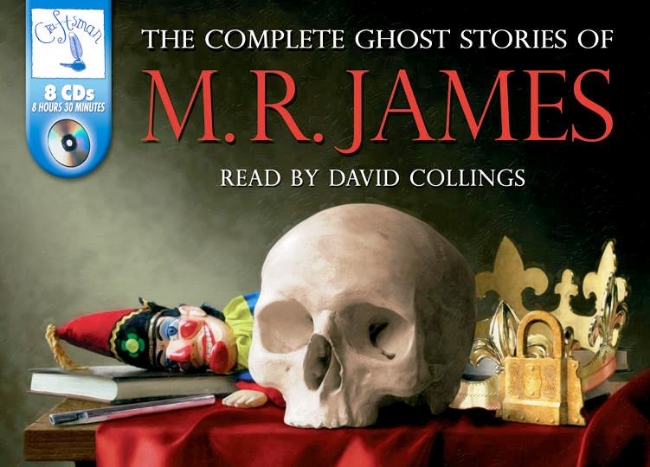
Recently I was pleased to discover a comprehensive audio book featuring the complete collection of M R James ghost stories, read by David Collings. Previously selected stories had been recorded in the middle Eighties by the great Sir Michael Horden. Sadly these are no longer available. The new recordings are presented in two volumes by Craftsman Audio Books. They contain all short stories in chronological order and are unabridged. Atmospheric music is used strategically to bridge the material.
David Collings reads the works of M R James as they’re meant to be heard. He is word perfect and his delivery is smooth and lyrical. He alternates between regional accents and Latin with polished aplomb. Collings must be an M R James aficionado as he brings out all the sly humour of the Edwardian text, adding charm and chilling nuance to every story. Although I am a strong advocate of reading for oneself this material lends itself strongly to the audio book format and is an utter delight. I cannot praise this collection enough and consider it to be the perfect way to while away the cold winter nights.