Gerry Anderson: A Life Uncharted (2022)
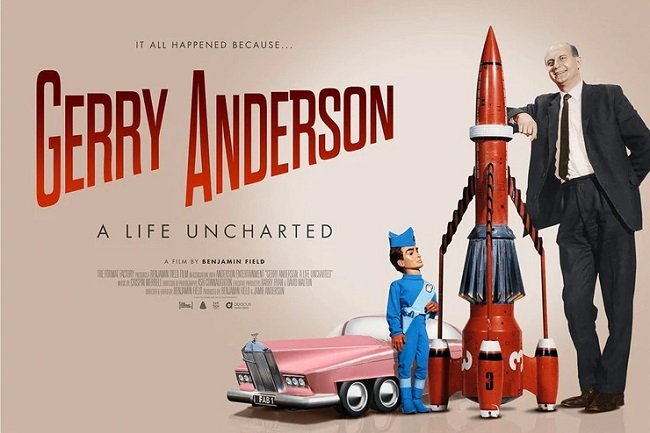
Gerry Anderson: A Life Uncharted is a documentary that focuses specifically on the man, rather than the shows that he created. If you are more interested in the latter then you would be better off watching Filmed in Supermarionation (2014), which provides a comprehensive overview of all productions, wrapped in a cosy blanket of nostalgia and fandom. Gerry Anderson: A Life Uncharted offers a more challenging viewing experience due to its honesty and candour. Gerry Anderson had a difficult childhood and suffered a bereavement early in life. During the course of this 88 minute exploration of his life it becomes clear that these traumas both drove his creativity as well as marred his own personal life. Furthermore, this documentary is also about a son looking for answers, as Jamie Anderson attempts to learn more about his father’s past.
Gerry Anderson: A Life Uncharted is a documentary that focuses specifically on the man, rather than the shows that he created. If you are more interested in the latter then you would be better off watching Filmed in Supermarionation (2014), which provides a comprehensive overview of all productions, wrapped in a cosy blanket of nostalgia and fandom. Gerry Anderson: A Life Uncharted offers a more challenging viewing experience due to its honesty and candour. Gerry Anderson had a difficult childhood and suffered a bereavement early in life. During the course of this 88 minute exploration of his life it becomes clear that these traumas both drove his creativity as well as marred his own personal life. Furthermore, this documentary is also about a son looking for answers, as Jamie Anderson attempts to learn more about his father’s past.
Gerry Anderson was born Gerald Alexander Abrahams in 1929. His secular Mother Deborah was frequently at odds with her Jewish husband Joseph and hence Gerry’s most formative years were blighted by the acrimonious and dysfunctional marriage of his parents. He was also subject to antisemitic abuse during his early school days which eventually led to his mother changing his surname by deed poll. Gerry idolised his older brother Lionel and always felt in his shadow. When Lionel died in a plane crash during World war II, Gerry was devastated. Needless to say these emotional issues both motivated and plagued him throughout his life. Gerry strove to escape the poverty of his youth and be successful. His scripts often featured strong father figures and absent mothers. His workaholic nature meant he often became estranged from his own family. He also struggled to maintain friendships beyond business.
Gerry Anderson: A Life Uncharted offers a broad spectrum of views and opinions. There is both old and new archive footage of Gerry talking quite candidly about his relationship with his parents, his failings as a parent and the deterioration of his marriage to Sylvia. It doesn’t always make for comfortable viewing but it is very credible and human. Contrary views are also aired from those who worked with him such as Roberta Leigh and three of his four children contribute in an equally candid fashion. From Gerry’s perspective, despite all his hard work he never seemed to reconcile himself to his success. He also felt that Sylvia over-stated her contribution to the success of AP Films and Century 21 and it is clear that he felt taken advantage of. Despite becoming successful and then subsequently losing it all, he eventually found happiness and stability with his third marriage to Mary Robbins.
A key part of Gerry Anderson: A Life Uncharted is its focus on Gerry’s struggle with dementia during the last few years of his life. It is a very personal account recounted from the perspective of son Jamie and mother and wife Mary. It will resonate with anyone who has first hand experience of a loved one succumbing to this condition and many of the anecdotes recounted will have a familiar ring to them. Yet despite the difficulty of dealing with such a debilitating illness, it is fascinating how Gerry managed to use his fame to raise public awareness, as well as £1 million for the Alzheimer's Society in a year. Tragically, when he finally passed away on Boxing Day 2012, Gerry had no memory of his life work or its popularity.
Gerry Anderson: A Life Uncharted takes a gamble by using deep fake technology in order to bring Gerry Anderson back to the screen, thus making the audio interviews more accessible. What viewers are presented with are a series of black and white scenes of Gerry sitting on a sofa talking to an interviewer off camera. The documentary clearly states its use before it begins and its inclusion does not in any way invalidate the authenticity or relevance of the actual audio interviews. Overall, if you wish to understand what drove Gerry Anderson to be so creative and successful, then Gerry Anderson: A Life Uncharted offers some insight. It also clearly shows the human cost as well. Fans who idolise their heroes may be uncomfortable with Gerry’s open admission of his own personal failings. Those with a capacity to separate their feelings of fandom from their curiosity will be rewarded with an engaging and somewhat melancholic documentary. Just bear in mind that some facts presented remain disputed and that this is documentary is weighted towards Gerry Anderson’s perspective.


Filmed in Supermarionation (2014)
Trying to encapsulate any artists body of work is a difficult enough task in itself. To then attempt to distil all associated anecdotes, vignettes and legends, while dispensing with the apocrypha, complicates matters further. Yet that's exactly what film maker Stephen La Rivière has done. The documentary Filmed in Supermarionation, is possibly the definitive history of the work of Gerry Anderson from 1957 to 1968. This insightful, meticulously researched exploration charts the rise of AP Films from its humble beginnings, to the halcyon days of Thunderbirds and the studios transition to Century 21 Productions. It also sheds some light into how things rather rapidly came to an end in the late sixties..
Trying to encapsulate any artists body of work is a difficult enough task in itself. To then attempt to distil all associated anecdotes, vignettes and legends, while dispensing with the apocrypha, complicates matters further. Yet that's exactly what film maker Stephen La Rivière has done. The documentary Filmed in Supermarionation, is possibly the definitive history of the work of Gerry Anderson from 1957 to 1968. This insightful, meticulously researched exploration charts the rise of AP Films from its humble beginnings, to the halcyon days of Thunderbirds and the studios transition to Century 21 Productions. It also sheds some light into how things rather rapidly came to an end in the late sixties.
Because Gerry Anderson is such an iconic figure in the world of popular culture there have been many attempts to delineate his career. Rather than simply retread familiar ground, Stephen La Rivière focuses upon the production crew and tells the story from their perspective. Over the course of two hours viewers are treated to an extremely interesting reunion of writers, directors, voice artists and puppeteers as they revists the Slough industrial unit that was once the home of AP Films. The interviews and various talking heads are linked by some wonder new material featuring Lady Penelope and Parker (lovingly voiced by the original artists Sylvia Anderson and David Graham). There is also extensive archive interviews with the late Gerry Anderson himself.
It is fascinating to consider that although making puppet shows for children was the farthest thing from Gerry's mind, when he formed a production company in 1957, it was still undertaken with great professionalism. Filmed in Supermaionation shows that the early shows, filmed at Islet Park in Maidenhead, were made on a wing and a prayer. Yet it was the team spirit and camaraderie that kept the business on track. By the time that Lew Grade became involved with the financing and the team had moved to Ipswich Road studios on the Slough Trading Estate, the entire production process had become a finely tuned machine. Yet the success and popularity of shows such as Fireball XL5 and Stingray did not seem to register with many of the cast and crew. It was still just an enjoyable, paying gig to them.
It is this quality that makes Filmed in Supermarionation so absorbing. There's a wealth of personal stories told from the voice artists perspective, such as Nicholas Parsons (Tex Tucker in Four Feather Falls), Shane Rimmer (Scott Tracy), Elizabeth Morgan (Destiny Angels) Matt Zimmerman (Alan Tracy) and even Robert Easton(Phones). The effects, art and directing departments are also well represented by Brian Johnson, Alan Pattillo, Desmond Saunders ( a total character), Alan Perry and Mike Trim. They also share some of their behind the scenes secrets and recreate some of the effects work for the viewers edification. The documentary also acknowledges the importance of Sylvia Andersons contributions to the studio output and pivotal role she played. It acknowledges the impact that breakdown of the Anderson's marriage had upon the business but it does not take sides or dish any dirt.
Sometimes films of this nature can be a little myopic when it comes to exploring some of the negative aspects of the matter in hand. This is not the case with Filmed in Supermaionation which tackles why the two Thunderbirds feature films failed at the box office. In fact some of the conjecture is very interesting and the simple fact that movie spinoffs were simply not "a thing" back then sounds very plausible in its simplicity. The fact that the final Supermarionation show, The Secret Service may have fallen victim to changing tastes and a studio over reaching itself is also honestly addressed. The closing anecdotes about Gerry Anderson taking up a suite of offices at Pinewood and the Slough studios being cleared and all contents destroyed is very poignant.
To effectively and efficiently tell a tale such as this, a film maker has to be realistic about what is and isn't covered. The two hour running time does not out stay it's welcome but director Stephen La Rivière has stated that about forty minutes of additional material had to excised from the documentary to accommodate a practical running time. The invaluable contribution that both Barry Gray and Derek Meddings made to the world of Supermarionation is unequivocally referenced. It's a shame that more time was not devoted to them but you just “can't get a quart in a pint pot”. As the documentary is exclusively about Gerry Anderson's Supermarionation shows, UFO, Space:1999, Terrahawks and Space Precinct are not referenced. The documentary focuses, quite rightly, on Thunderbirds which remains the jewel in the Anderson's crown.
Filmed in Supermarionation is subtle blend of a fan’s love for the object of their affection, as well as being a thorough critique of one of the UK's greatest technical innovators and consummate storytellers. Those who worked with the Andersons are still slightly bemused by the sheer impact their work had upon subsequent generations. Yet the documentary succinctly highlights all the reasons why these shows have remained so enduring. Perhaps the most important one is the sheer love that was poured into these productions by all involved. David Graham's closing ode to Parker regarding the impact the character had upon his life was very touching. I think it reflects the way the public continues to feel about Gerry Anderson’s unique and much loved body of work.
The Secret Service (1968)
The Secret Service is somewhat of an enigma, being the last Supermarionation show that Gerry Anderson produced. It was poorly received not only by critics but also by its own financier, Sir Lew Grade and was therefore given a limited broadcast upon its initial release. However, it marked the end of an era for Century 21 productions as they turned their creative attentions to film and live action TV after a decade of puppets shows. Subsequently, The Secret Service fell into obscurity over the following years and never gained the same degree of attention from the public, as previous Supermarionation shows had.
The Secret Service is somewhat of an enigma, being the last Supermarionation show that Gerry Anderson produced. It was poorly received not only by critics but also by its own financier, Sir Lew Grade and was therefore given a limited broadcast upon its initial release. However, it marked the end of an era for Century 21 productions as they turned their creative attentions to film and live action TV after a decade of puppets shows. Subsequently, The Secret Service fell into obscurity over the following years and never gained the same degree of attention from the public, as previous Supermarionation shows had.
Having recently caught up with the entire series and being a consummate Gerry Anderson fan, it is hard for me to be excessively critical of the show. I have a lot of love for his earlier work, especially Thunderbirds and Captain Scarlet. The Secret Service has many of the aspect that made previous shows enjoyable and unique. There are quirky and amusing characters, a rich and detailed production design and superb miniature effects by the legendary Derek Meddings. Once again, the score and ambient sounds created by Barry Gray play an integral role in the show. Yet even I must admit that two major flaws standout and validate why this final series was Anderson’s weakest.
Firstly, from Four Feathers Fall to Joe 90, there had always been an element of substituting human footage for material that puppets could not do. This was usually limited to shots of hands. However in The Secret Service this technique was greatly expanded upon. There are long shots of characters walking into building, along with footage of them driving vehicles down country lanes. The central character Reverend Stanley Unwin, is directly modelled on its voice actor Stanley Unwin. Furthermore, live footage of the said actor is frequently intercut into each episode. Although it can be argued that this innovative approach covered some of the puppets technical deficiencies, it also breaks the shows immersion. Is this a puppet or live action drama?
Secondly, Stanley Unwin himself was a comedian who became well known for his use of “Unwinese”, a faux comic language of his own creation. It was an odd choice to cast such an actor with a uniquely English comic trait, namely our love of linguistic humour and word play, into a television show destined for international distribution. Gerry Anderson’s argument was that Stanley Unwin’s occasional lapse into this verbal slapstick was to purposely confound all viewers. However, I think that rather than amuse the viewers it simply perplexed them. It was sufficient for Sir Lew Grade to lose confidence in the production and pull the plug.
If like me you have been raised on Gerry Anderson’s back catalogue, The Secret Service, despite its shortcomings, is still engaging and quality entertainment. It is yet another example of Century 21 Productions refining their process. However, for the more casual viewer, who is broadly familiar with Thunderbirds, this may be a little too niche market and obscure. The show also seems to have a somewhat nebulous view on Christian denominations. Stanley Unwin seems to frequently alternate between the Anglican and Roman Catholic faiths. Therefore, I can really only recommend The Secret Service to hardcore Anderson fans and those who are simply curious and forgiving.
Historically, the failure of The Secret Service although marking the end of Supermarionation ultimately led to Century 21 productions first live action TV series, UFO. A show that was a possibly five years ahead of its time. With regard to The Secret Service, after a consistently successful decade, the concept of the puppet series had run its natural course by the late sixities. One of Gerry Anderson’s great strength from this era was his capacity to experiment. The Secret Service shows us that not all experiment work, but even those which are deemed failures can still be or merit and quality.