
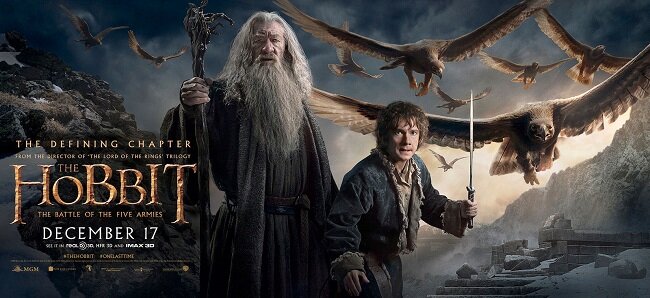
The Hobbit: The Battle of the Five Armies Extended Edition (2014)
This December marks the 20th anniversary of the release of The Fellowship of the Ring, the first instalment of Peter Jacksons' adaptation of J.R.R. Tolkien’s iconic novel, The Lord of the Rings. To celebrate this occasion, I shall post new reviews of the extended edition of all three films, as well as those of The Hobbit trilogy, which were made a decade later.
The Battle of the Five Armies is noticeably shorter than it's two predecessors, mainly because there is insufficient narrative to sustain the proceedings. Even the extended edition which adds a further 20 minutes to the running time, increasing it to 164 minutes, is mainly driven by one ongoing action sequence which is the titular battle. After the somewhat languid pace of the first movie and the bloated excess of the second, this further change of pace seems somewhat perplexing. Despite the more economical running time, events occur very rapidly. Perhaps a little too rapidly. It can be cogently argued that it somewhat diminishes the impact of some of them. Perhaps the biggest issue being the demise of Smaug. It comes promptly at the start of The Battle of the Five Armies and although spectacular, it quickly negates a major plot element.
This December marks the 20th anniversary of the release of The Fellowship of the Ring, the first instalment of Peter Jacksons' adaptation of J.R.R. Tolkien’s iconic novel, The Lord of the Rings. To celebrate this occasion, I shall post new reviews of the extended edition of all three films, as well as those of The Hobbit trilogy, which were made a decade later.
The Battle of the Five Armies is noticeably shorter than it's two predecessors, mainly because there is insufficient narrative to sustain the proceedings. Even the extended edition which adds a further 20 minutes to the running time, increasing it to 164 minutes, is mainly driven by one ongoing action sequence which is the titular battle. After the somewhat languid pace of the first movie and the bloated excess of the second, this further change of pace seems somewhat perplexing. Despite the more economical running time, events occur very rapidly. Perhaps a little too rapidly. It can be cogently argued that it somewhat diminishes the impact of some of them. Perhaps the biggest issue being the demise of Smaug. It comes promptly at the start of The Battle of the Five Armies and although spectacular, it quickly negates a major plot element.
Smaug is killed by Bard but his body falls on Lake Town leaving it in utter ruin. The survivors of Esgaroth are aided by the Wood Elves and both parties subsequently seek restitution from the Dwarves. The men of Lake Town hold the Dwarves accountable for their current situation and the Elves who harbour a longstanding grudge regarding outstanding debts that the Dwarves have not paid. However, Thorin refuses to help which leads to a diplomatic impasse. He summons his cousin Dain from the Iron Hills to provide reinforcements. In the meantime Azog then springs his trap and lays siege to Erebor and all camped outside, resulting in the battle between Dwarves, Elves, Men and Orcs. The film does resolve the major storylines, yet it does feel both a little rushed and contrived. Again the screenplay feels the need to reference and link to future events featured in The Lord of the Rings.
Lore purists will find The Battle of the Five Armies the hardest to stomach because Peter Jackson really does indulge his penchant for narrative simplification, restructuring events and the fetishization of weapons, armour and fantasy combat. The Fili, Tauriel, Legolas love triangle and associated fallout is simply too contrived and unengaging. The White Council's assault on Dol Guldur featuring a 92 year old Christopher Lee beating seven bells out of the Ringwraiths, although thoroughly amusing, does raise an eyebrow. The fact that you can conveniently ride from Lake Town to Mount Gundabad in a day and that Middle-earth is populated with Frank Herbert style giant worms, may also come as a surprise to the faithful. The less said about Beorn free falling from an eagle and turning into a Werebear on the way down, the better.
As I have mentioned in my previous reviews, the depiction of Thorin in these movies is woefully lacking, turning him into a broody, pouting, inaccessible caricature. This time round for want of a better description, Thorin goes a bit "Macbeth". I'll give credit where credit is due and state that Richard Armitage does provide a good performance. But the screenplay doesn't really do the character justice and the plot device about the "Dragon's sickness" is arbitrary to say the least. Yet every now and then, there are sequences and passages of dialogue that come directly from the book. Once again, for everything that Peter Jackson gets right, there's also something that is way off the mark. The pivotal point of the movie should have been Thorin's death but it lacks any emotional impact and is only saved by the presence of Martin Freeman.
Dain Ironfoot (Billy Connolly) makes an impressive entrance riding a War Boar and has an expanded role in the extended version. Beorn and Radagast appear briefly but serve no major purpose than to provide reinforcements to the climactic battle. And what on earth possessed Peter Jackson to kill off Stephen Fry so quickly in the story and yet keep Alfrid Lickspittle as some crass source of so-called comic relief? Mercifully, we still have stalwart performances from Martin Freeman and Sir Ian McKellen who do much of the heavy lifting. Lee Pace proves to be a more interesting character this time round, as Thranduil's motives prove to be less binary than those of Thorin Oakenshield. He tempers his desires for restitution when he sees the extent of the Elven dead and sees the folly of his actions.
As ever the set pieces are immaculately produced and push the violence levels for this kind of movie to the limit. They stay on the right side of the ratings board mainly because the bulk of the decapitations, impalements and bludgeonings happen to non-humans. The death of more central characters tend to be more discrete. The main problem with the frenetic action is that it strives to continuously outdo itself, resulting in scenes that tax the audience's credibility even for this genre of movie. For example Legolas climbs a flight of stone steps leading to a crumbling tower, literally as they fall away beneath him, proving that Elves are indifferent to the laws of physics. A better director would restrain themselves, rather than allow such self indulgence and excess. Also some of the mutilated Orcs and Trolls seem more at home in Clive Barker’s Hellraiser than in Tolkien’s The Hobbit.
If you like the aesthetic that Peter Jackson has created over the years, as well as grandiose spectacle, then The Battle of the Five Armies will prove to be an entertaining diversion. If you want anything more, then prepare to be disappointed. I find it ironic that a trilogy of movies about the adventures of Bilbo Baggins, seems so content to include so little of him on screen. By changing the shift of the story from his perspective, to that of the wider events in Middle-earth, something very important has been lost from these sprawling adaptations. Peter Jackson and his team may well be very knowledgeable in the works of Professor Tolkien but I do wonder if he has fully understood them. As I've said before, these movies are very much Jacksons’ interpretation of The Hobbit. I wonder if there would have been a greater emotional depth and perception of the source text, if these films had been directed by Guillermo del Toro as they were originally intended?


The Hobbit: The Battle of the Five Armies Extended Edition (2014)
The theatrical edition of The Hobbit: The Battle of the Five Armies was light on plot and heavy on action sequences. As a result it had many unresolved story lines. The extended editions once again attempts to address these deficiencies but sadly out of the twenty minutes of additional material that has been added, most are extended action scenes. There are moments of substance buried within this ponderous expanded edition but they are few and far between. Compared to other entries in the extended trilogy, this is the weakest as it really doesn’t add any major plot or narrative improvements. It does however add a lot more orc based violence.
The theatrical edition of The Hobbit: The Battle of the Five Armies was light on plot and heavy on action sequences. As a result it had many unresolved story lines. The extended editions once again attempts to address these deficiencies but sadly out of the twenty minutes of additional material that has been added, most are extended action scenes. There are moments of substance buried within this ponderous expanded edition but they are few and far between. Compared to other entries in the extended trilogy, this is the weakest as it really doesn’t add any major plot or narrative improvements. It does however add a lot more orc based violence.
If you are familiar with Peter Jackson’s earlier work such as Bad Taste and Braindead, then the splatter and CGI gore that has been added to The Hobbit: The Battle of the Five Armies will come as no surprise. As ever with his treatment of violence, Mr. Jackson tries to mitigate it’s over the top nature with a little slapstick humour. It may well me cunningly contrived and well-staged but it seems tonally out of place. Is this really Tolkien’s work? It’s a shame really because Peter Jackson is a very good film maker but he needs someone to curb his excesses and pull his focus back to the narrative when he becomes too enamoured with spectacle.
The new scenes added to The Hobbit: The Battle of the Five Armies are as follows.
Gandalf and Narya, The Ring of Fire.
The first new scene starts during Gandalf’s captivity in Dol Guldur. A large Uruk interrogates him regarding Narya the ring of fire. After brutally flinging him to the ground (shades of Pontius Pilate in The Life of Brian), the torturer attempts to sever the wizard’s hand.
Galadriel arrives and subsequently causes the Uruk to explode when revealing her power. Apparently this nameless Uruk, created via the use of an actor wearing prosthetics, was the original design for Azog.
Fighting the Ringwraiths and Radagast’s staff.
There are additional shots of Saruman and Elrond fighting the Ringwraith, which remains an entertaining but incredibly lore breaking sequence.
A more important scene is added after the expulsion of Sauron from Dol Guldur by the White Council. Radagast gives Gandalf his staff, as Mithrandir had lost his when confronting the Necromancer. Bunny Sled fans will enjoy its brief return during this expanded section.
Bilbo and Bofur.
One of the few strong points of this trilogy is the interaction between Bilbo and Bofur. During the night Bilbo decides to leave Erebor and go the Dale and give the Arkenstone to Bard and Thranduil to stop the ongoing conflict. Bofur mistakenly thinks that Bilbo is leaving for home again, as he did in the first movie. It’s a nice character driven vignette, that highlights the quality of the performances of both Martin Freeman and James Nesbitt.
Thorin considers Bard and Thranduil’s terms.
In this expanded scene Thorin ponders Bard and Thranduil’s terms, with regard to ransoming of the Arkenstone. This is a nice embellishment that showsThorin’s resolve wavering. There’s a nice lore based quip when Thranduil says to Bard “Ecthelion of Gondor will give you a good price for it”. However the arrival of a Raven on the wall informs Thorin that his Cousin Dáin Ironfoot has come and the negotiations swiftly end.
Send in the Goats.
In this considerably expanded section of the movie Dáin Ironfoot arrives with a sizeable army of Dwarves armed with Ballistas and Battle Rams in armour. After a pithy exchange with Thranduil, he decides to “send in the Goats” against the Elven Archers. It all ends in a scene very reminiscent of Braveheart with the Goats being skewered by a sheltron.
The Dwarves also deploy a Ballista based weapon that deals with the Elven arrow barrage very effectively. This new content adds gravitas to the decision by all parties to cease fighting when the Orc army arrives.
Bofur and the Troll.
After Thorin and company join the battle, there is new material involving the Dwarves. One such scene features a reoccurring joke involving a hand axe being thrown between Dwarves. This is the sort of embellishment that works very well and adds character to the proceedings.
Sadly shortly after this fun new addition, we get a completely over the top action sequence in which Bofur rides a Blind Troll and causes havoc among the Uruks.
The Dwarven War Chariot.
This next action scene is quite lengthy and is possibly the most controversial addition to the extended edition of the film. When Thorin decides to attack Azog at Ravenshill , he rides on a Battle Ram, with Kili Fili, Dwalin and Balin providing support in a Dwarven war Chariot. A hectic pursuit ensues as they are attacked by Wargs, Orcs and an armoured Troll.
This scene contains a lot of CGI splatter violence that may well have pushed the US rating from PG-13 to R. There is a short pause for a dialogue exchange between Dwalin and Balin which again shows that there is some depth to the little narrative there is.
The Death of Alfrid.
Alfrid (Ryan Gage) is an utterly contrived character and frankly serves no real purpose in this movie, beyond the functional. Did the story really need a comic foil? However in the extended edition at least we get to see his demise, which is equally phony and laboured. The scene benefits from some light relief as Gandalf tries to get the staff that Radagast gave him to work.
Bifur and the Axe in his Head.
I’ve always found the concept of Bifur having an axe embedded in his head a step too far. However this new scene does at least make use of this particular “MacGuffin”. After headbutting an Orc Bifur finds himself stuck. Both Bofur and Bombur wrestle to free him resulting in the axe head finally being removed from his skull. A zinger line follows, which I believe is the only piece of dialogue Bifur (William Kircher) has in all three films.
Legolas and the Gratuitous Action Scene.
If you are a fan of the scene in the theatrical version of the movie in which Legolas hung from a Gaint Vampire Bat, then you’ll love this expanded scene in which he dangles upside down and attacks an entire column of Uruks singlehandedly. It is staggeringly crass and frankly embarrassing to watch.
The Funeral.
Finally and perhaps in some ways the most important addition to the movie, we have the funeral for Thorin Oakenshield. This short and sombre scene does see the Arkenstone restored to Thorin as he as well as Kili and Fili lie in state on top of their stone tombs. The montage then cuts to Dáin Ironfoot being crowned king under the mountain.
Fans of this trilogy will no doubt enjoy this latest extended edition, as will those viewers who are not Tolkien aficionados and are just looking for come casual fantasy entertainment. However there are many who still feel that this adaptation of The Hobbit is deeply flawed and is very much a case of style over substance. This is very much Peter Jackson's interpretation of Middle-earth, rather than an authentic depiction of Tolkien's. However irrespective of your point of view this extended edition is ultimately superior to the theatrical release and remains the recommended version of the film.