
Diaries
There has been a great tradition of keeping diaries and journals for many centuries. Though they may seem at first glance, mundane, unimportant and even self indulgent they are extremely valuable historical documents. Compared to other source material, diaries are often unambiguous and can indirectly reference a wealth of important detail, providing a useful overview of the world at the time of writing. They reflect the perspective of ordinary people and everyday life, unencumbered by wider considerations faced by historians. For example, consider the diaries of Samuel Pepys or Anne Frank. There are also a lot of personal benefits to keeping a diary. They can help improve self-awareness, your memory and metacognition. They also provide stress management, reduce procrastination and have a positive effect upon one’s mental wellbeing.
There has been a great tradition of keeping diaries and journals for many centuries. Though they may seem at first glance, mundane, unimportant and even self indulgent they are extremely valuable historical documents. Compared to other source material, diaries are often unambiguous and can indirectly reference a wealth of important detail, providing a useful overview of the world at the time of writing. They reflect the perspective of ordinary people and everyday life, unencumbered by wider considerations faced by historians. For example, consider the diaries of Samuel Pepys or Anne Frank. There are also a lot of personal benefits to keeping a diary. They can help improve self-awareness, your memory and metacognition. They also provide stress management, reduce procrastination and have a positive effect upon one’s mental wellbeing.
The reason I mention all this is because I found a diary of mine recently, while going through my later Father’s paperwork. It was for the year 1977, when I was 9 years old. Needless to say, it was my Father’s idea for me to keep a diary. He felt it would improve my English skills and be “fun”. I personally didn’t have any inclination to do such a thing and I did so under duress. This becomes more apparent as the year progresses and the entries become shorter, less informative and increasingly indicative of a child who has no interest in what they’re doing. However, even as it is, I genuinely believe that there is some useful information to be found in my diary, although it is not there by intent. I frequently obliquely refer to things that were commonplace at the time, which are quite different now. The other thing that’s clear is that my family and I were very much a product of the times.
So exactly what revelations are hidden in my diary entries? Well being nine, naturally my school routine is referenced frequently. What stands out immediately is that corporal punishment was still common place in 1977. I refer to the Headmaster, Mr Green, caning several boys “who were naughty”. He would on occasion patrol the corridors of my junior school with a cane under his arm if he felt there was “mischief in the air”. Looking back now and assessing Mr Green with the eyes of an adult he was a Belfast Orangeman and militant protestant. He was often condescending to the female teachers and held exactly the sort of attitudes you’d expect from such a person from such a background at that point in time. Another interesting aspect of school which differs from now is the approach to exams and assessments. At the end of each term there were intelligence (IQ), mathematics and English tests. The results were read out in class in order of success, so everyone was acutely aware of the abilities of their peers.
In 1977 there were only three terrestrial TV channels available in the UK. Those channels did not run 24 hours a day and VCRs were not yet commonplace. Hence TV was considered a bonus leisure activity from a child’s perspective. I reference in my diary how I would rush home from school to watch Time Tunnel. I also mentioned watching The Six Million Dollar Man and Charlie’s Angels. However, reading was a major pastime and I would do so some nights instead of watching TV. Going to the library was a ritual and a source of great pleasure. One entry expresses my excitement of managing to secure three Asterix books. I also spent my pocket money on books. I would sometimes accompany my Father on a Saturday, while he did chores such as going to the butchers and paying the paper bill. Sometimes we’d visit a genre oriented book shop in Welling called The Edge of Forever. My Father would buy books by Isaac Asimov or Arthur C. Clarke, while I’d spend my money on Doctor Who novels (which were adaptations of episodes).
Going away on holiday during the summer was not a common occurrence for my family. My Father was refurbishing the house, a room at a time and hence this is where the household finances were focused. However, 1977 was an exceptional year and we spent 10 days on the Isle of Wight in a rental cottage. On mature reflection the self catering holiday was hardly a break for my Mother but the change of scene was welcome. It rained for 4 of the 10 days but we still managed to do quite a lot (although that is a relative term). I enjoyed the Blackgang Chine theme park and was traumatised by the spooky wax museum at Brading. The museum is now a pub and a restaurant but Blackgang Chine is still open. I saw a recent video of it on YouTube and it’s exactly the same. The diary notes that I lost a frisbee that was bought for me and was subsequently beaten. Raising a child in the seventies involved a surprising amount of casual violence.
My diary also reflects the social etiquette and culture of the UK at the time. For example my Father wouldn’t start mowing the lawn on a Sunday until after 11:00 AM. Sunday was a very dull day from a child’s perspective because nothing was open and it very much felt like the world had dropped down a gear. Reading through the year’s entries it becomes clear that myself and my sister were very self sufficient and made a lot of our own entertainment. We did go out as a family to parks, museums and such like during the school holidays but it was incumbent upon us not to bother the adults and expect to be entertained constantly. The phrase “I’m bored” was forbidden in our household as my Father would say “an intelligent mind is never bored”. The diary also mentions how in April we went to see the remake of King Kong. This is interesting insofar as it shows the time delays between international releases dates. The film was screened in the US in December 1976.
Children these days are superficially very worldly. The TV and internet brings them face to face with all the glories and iniquities of humanity as soon as they’re capable of looking at a screen. My diary entries reflect a less busy time and casts me in a very earnest light. I was a child and content to be one, judging by what I wrote. School was not a struggle for me and I did well academically at this point in my life. I had forgotten how much I enjoyed swimming but it appears to be an important part of my life, according to what I’ve written. I did guffaw hard at one particular entry in which I had a stomach ache after a meal and my Mother said with classic parental wisdom and authority that it was because I talked too much while eating. My diary also shows me how fortunate I have been and that by the standards of the time, I had a very happy childhood with two loving and supportive parents. Not everyone is fortunate.




















Write Now, Edit Later
"Don't get it right, just get it written". James Thurber. This is a quote that is often bandied about with regard to creative writing. I was watching a documentary last night about a guy trying to find financing for an independent film he was making and a variation of this philosophical statement came up. I suppose that the reason it is so commonplace is because it is true. All writers at some point find themselves procrastinating to a greater or lesser degree. While writing this simple blog post, I’ve been distracted by incoming email and a message notification from my phone. Sometimes I will draw the curtains in my office so I don’t end up aimlessly staring out of the window at life’s rich pageant or the bird on Mrs Coletart’s roof. Because I am an organised person and like to plan, sometimes I focus too much upon the detail of my writing, rather than just getting the raw ideas down. Hence even the most simplistic of blog posts can at times take an hour or more to get written.
"Don't get it right, just get it written". James Thurber. This is a quote that is often bandied about with regard to creative writing. I was watching a documentary last night about a guy trying to find financing for an independent film he was making and a variation of this philosophical statement came up. I suppose that the reason it is so commonplace is because it is true. All writers at some point find themselves procrastinating to a greater or lesser degree. While writing this simple blog post, I’ve been distracted by incoming email and a message notification from my phone. Sometimes I will draw the curtains in my office so I don’t end up aimlessly staring out of the window at life’s rich pageant or the bird on Mrs Coletart’s roof. Because I am an organised person and like to plan, sometimes I focus too much upon the detail of my writing, rather than just getting the raw ideas down. Hence even the most simplistic of blog posts can at times take an hour or more to get written.
One of the first things I learned when writing is not to correct your work as you go along. If you do, you end up obsessively re-writing the same sentence over and over again. It is very inefficient and far less enjoyable. Hence "don't get it right, just get it written" is such good advice. Especially so if your writing style is more of a stream of consciousness. I tend to favour bullet points when creating a post. These can be used for ideas or an argument and then counter argument. Later, they can then be developed into paragraphs or combined to make wider points. I also create a lot of draft documents. If an idea comes to me then I open a new document in Google Drive, give it an obvious title and then add a few points that are relevant or simply write the original thought(s) that came to me. This way, good ideas have a better chance of coming to fruition and becoming fully formed blog posts.
A dilemma I often wrestle with is exactly how much to write on any given subject. There are different schools of thought on this and it very much depends who you are writing for. Commercial writing is usually far more targeted and specific. Hence brevity and the use of easy to understand language is important. I prefer a more substantive approach and enjoy using my vocabulary, creating metaphors and making obscure pop culture references. I like my arguments to be clear and backed up with supporting data. However, there’s longform writing and then there’s just being verbose and I worry that I drift too often into the latter. Thankfully, this is why we edit and as a writer one has to be ready to make hard choices with regard to what stays in the final version of your post and what gets cut out. I am currently trying to hone my editing skills, to be more ruthless and produce more succinct posts.
With all this in mind, I am going to do some experimentation with my writing over the next few months, to see if I can produce shorter posts and to also try and speed up my writing process. But it can be hard to break yourself of certain habits. For example I have an odd attitude towards writing three paragraphs or less in a post. I feel that it is too insubstantial and even lazy. Yet other bloggers I know produce concise and on point material and I don’t think the same of them. So I’m going to try to do things differently. This has the added benefit of making the actual process of writing a little more interesting and adding a sense of variety. Because writing like any other task, takes focus and discipline and at times can be a chore. Trying to transfer the thought, idea or point that is abundantly clear in your mind, onto the virtual page is not as easy as it sounds. But that is also part of the fun. It also brings me back to the James Thurber quote. "Don't get it right, just get it written". Make this your mantra.




















Writing Film Reviews
"You’ve probably gone over it before, but I’d like a refresher for how you go about choosing the movies you watch - I’ve got Netflix and Amazon Prime, but your titles always seem to go all over the place. Did you ransack a Blockbuster Video before it went bankrupt?" Rambling Redshirt. I was asked the above question recently, via Discord chat, because I do appear to post a rather eclectic range of film reviews. So, I thought I’d clarify my respective process (or lack thereof) as to which movies I choose to write about. I’d also like to share my thoughts on what I consider constitutes a good film review and the procedure I use when writing about the films I’ve watched.
"You’ve probably gone over it before, but I’d like a refresher for how you go about choosing the movies you watch - I’ve got Netflix and Amazon Prime, but your titles always seem to go all over the place. Did you ransack a Blockbuster Video before it went bankrupt?" Rambling Redshirt. I was asked the above question recently, via Discord chat, because I do appear to post a rather eclectic range of film reviews. So, I thought I’d clarify my respective process (or lack thereof) as to which movies I choose to write about. I’d also like to share my thoughts on what I consider constitutes a good film review and the procedure I use when writing about the films I’ve watched.
First off, here’s a little background about my relationship with cinema. Both my parent grew up during the thirties and forties when the primary form of entertainment were films and radio. Hence when I was a child, watching movies together was a common family activity. Mainstream network channels showed a lot more movies during the seventies, where now they’ve been replaced with property, cooking and quiz shows. Satellite and cable options did not exist in the UK at the time and there were just three analogue terrestrial channels. Sunday afternoon was a day where there’d be a movie scheduled on BBC Two mid-afternoon. We’d have our Sunday roast and then settle down to watch the likes of The Mark of Zorro or Top Hat or The Dam Busters. As these were my most formative years, my passion for film was kindled. This was how I was introduced to the works of Ray Harryhausen, George Pal and Hammer Horror.
As a carer, I now have a fixed schedule which although busy, provides me with periods of time that I can use to pursue my interests. Thus, during a week, I will watch about three or four movies. Because I don’t go to the cinema so often these days, some of these will be recent releases, especially now that the gap between the theatrical and video-on-demand release is as little as two months. I also have a “watch list” that contains both old and new films, that regularly has new titles added to it. These will be recommendations from critics or genre classics that I want to familiarise myself with. I often re-visit films I’ve previously seen for a re-evaluation, especially if it has recently been “dissected” on any of the film related vlogs and podcasts that I subscribe to. However, there is not a great deal of rhyme or reason to the order in which these movies are watched. All can potentially be written about.
I do not consider myself a casual watcher of films. I believe film making to be an art form and I can find merit in all genres. Many people see films as disposable entertainment. Something you passively observe and then move on from. That’s fine. You do whatever is good for you. I however, watch, analyse and reflect. I like dialogue and the way it’s written. I focus and consider the composition of shots and the construction of scenes. Lighting, production design and style are all important to my enjoyment. I can also remember details and visualise how scenes played out, after I have watched a film. As I have this level of interest, I naturally read and seek out data about film stars, film makers and movie production. If you like sports you will often become knowledgeable on the subject, especially stats. I do the exactly the same with films. Why? Because they bring me pleasure, they tell stories and they entertain. And this passion drives me to write about them.
Moving on, here are the rules that I broadly try to apply when writing about a movie. Just for the record, I often sit on the sofa with a pen and notebook in hand to write my thoughts down as they occur to me. This can be a little confusing to anyone watching with me.
1). Be sure to establish the genre of the film in question. Is it a comedy, a drama, a horror? If so, judge the film within the confines of said genre. Don’t make the mistake of comparing apples to oranges. All movies require a degree of “suspension of disbelief”. You have to vary this according to what you are watching. A drama such as On the Waterfront does not need to be watched with the same objective removal from reality as Dog Soldiers.
2). Consider all aspects of filmmaking when writing your review. Reflect upon directing, writing, editing, acting and other aspects of the production. Did they contribute positively or negatively to your experience? Where they of note contextually? IE with regard to the budget of the movie. If you have points you wish to highlight, then give specific examples in your review.
3). Imagine that your readers know nothing about the film in advance. It’s your job to introduce it to them and to provide them with a succinct and salient summary. How would you describe the film to a friend in one sentence? That may not always be possible with movies like Cloud Atlas but strive to be concise. Also do your best to avoid spoilers. If there is a dramatic event that serves as a surprise, don’t reveal this in your review. Provide enough information to intrigue readers so that they can choose to watch the film if they see fit.
4). When summarising your overall experience, think about who would enjoy this film, what its appeal is and in what circumstances. It helps to contextualise this, so if possible, why not make a broadly equivalent film comparison. IE Under Siege is Die Hard on a ship. Watership Down is essentially The Wild Bunch but with Rabbits. Any movie with Ben Stiller, is like a good comedy but with all the humour, talent and enjoyment conspicuously absent.
Finally, I’d like to finish with a quote from top UK movie critic Mark Kermode. Here are his top five ingredients for a proper film review, taken from his book The Good, The Bad & The Multiplex. Needless to say, I think he’s spot on.
“Opinion, description, contextualisation, analysis and entertainment.
1. Opinion
Saw 3D is rubbish.
2. Opinion and description
Saw 3D is a horror film that is rubbish.
3. Opinion, description and contextualisation
Saw 3D is the seventh episode and the first stereoscopic instalment in a long-running horror series, and it is rubbish.
4. Opinion, description, contextualisation and analysis
Saw 3D is the first instalment in a series that began life as a tortuously inventive low-budget chiller but which has descended over the course of six sequels into gory, boring torture porn which is rubbish.
5. Opinion, description, contextualisation, analysis and entertainment
It took the once-inventive but increasingly depressing Saw series seven movies to resort to the hackneyed headache of 3-D, but despite the promise that this is ‘The Final Chapter’ (just wait till the sums say otherwise) you keep wishing those protruding spikes would leap a little further out of the screen and puncture your eyeballs to ensure that you never have to watch rubbish like this ever again”.
Searching Content on Contains Moderate Peril
If you are a WordPress user, there are a multitude of plugins that you can apply to your blog to tweak and customise it. The only downside of this is that every time WordPress upgrade their software, all your plugins subsequently need to be updated. Many plugins are written by third parties and therefore you do not have guaranteed long-term support. Plugins can also be exploited, which is why I ultimately decided to stop using WordPress for my website. I made the transition to Squarespace for my hosting needs in August 2015 and have never looked back since then. However, I have been using the same template for three years now and I was pondering recently whether it was time to change it. Yet a change of this kind is bound to have knock-on effects and could potentially end up creating more problems than it solves. So rather than go off half cocked, I decided to do some research to see if I could improve the functionality of my blog.
If you are a WordPress user, there are a multitude of plugins that you can apply to your blog to tweak and customise it. The only downside of this is that every time WordPress upgrade their software, all your plugins subsequently need to be updated. Many plugins are written by third parties and therefore you do not have guaranteed long-term support. Plugins can also be exploited, which is why I ultimately decided to stop using WordPress for my website. I made the transition to Squarespace for my hosting needs in August 2015 and have never looked back since then. However, I have been using the same template for three years now and I was pondering recently whether it was time to change it. Yet a change of this kind is bound to have knock-on effects and could potentially end up creating more problems than it solves. So rather than go off half cocked, I decided to do some research to see if I could improve the functionality of my blog.
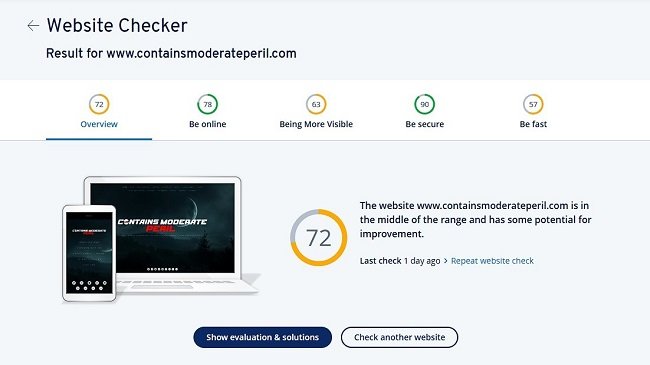
After taking an in-depth look at my blog stats, both via Squarespace and Google Analytics, it’s clear that a third of readers are using their phones to access Contains Moderate Peril. Fortunately, the template I’m currently using is mobile friendly and I’m pleased with its performance. For PC users the blog is functional, despite lacking is certain interactive elements such as sidebars, blog rolls and social media links. All posts are clear and easy to read. As I think that content is by far the most important aspect of any blog, as long as it is accessible and easy to navigate then the current template is doings its job. I also consider it important to provide readers with links to similar material to that which they are already reading. Hence, all articles have a list related posts at the bottom of the body of text. This is invaluable for building an audience and exposing readers to more of your work. I find it most rewarding when I look at my blog stats and see that someone has read an article about LOTRO and then perused further content of a similar theme.
However, there is one limitation to these “summary blocks” as Squarespace calls them. They only display a maximum of 28 links to previously posted content. Subsequently as more content is added to Contains Moderate Peril, older material is gradually excluded from the “summary blocks”. Yet there is an obvious and convenient workaround. All posts are indexed by categories displayed at the page footer. If you click on any category it will then list all other posts associated with it. Hence clicking on “movies” will list all posts in that category. The site shows twenty posts at a time and readers can then access the next twenty by clicking on “older”, again at the bottom of the page. You can search by author in the same fashion. There is also a calendar on the Post Archive page (which you can access via the top menu) which lists all posts for the month. The month can be adjusted, and so readers can comprehensively see all posts that have been published since Contains Moderate Peril migrated to Squarespace. There is also a search facility for the entire site, again found on the top menu.
Ultimately, all the changes I have made to the website template are to the backend. Minor changes to SEO, key words and indexing will hopefully improve performance and allow readers to find further material if they so wish. It will be interesting to see if this post has an impact upon traffic and the way the site is used. As I’ve said in such events as The Newbie Blogger Initiative and Blaugust, writers or bloggers shouldn’t be driven by purely stats and website traffic. But if you are publicly publishing your work it is logical to make it as accessible to you readers as possible and to ensure they can search it effectively. Promotion of content via social media is one way of doing this but having an online presence that is easy and intuitive to use is also essential. Not all posts are time specific and there may be occasions when you specifically want your audience to find older content that is still pertinent. Therefore, if you aren’t already using a “related posts” or a post archive facility on your blog then you are doing yourself and more importantly your readers a disservice.
Language, Style and Tone
One of the many choices that you’re presented with when you start blogging is what style to adopt. You can make a conscious decision right from the outset regarding the tone and language you intend to use, or you just “dive right in” and see what evolves over time. Blogging is a far less formal kind of writing compared to traditional mediums and therefore lends itself to a wider range of choice and means of expression. Language, style and tone certainly have an impact upon your work and are key (along with content) in creating your identity and online brand. Therefore, they have a direct bearing upon what sort of readership you may attract and cultivate. Hence it is beneficial to be aware of the significance of language, style and tone.
One of the many choices that you’re presented with when you start blogging is what style to adopt. You can make a conscious decision right from the outset regarding the tone and language you intend to use, or you just “dive right in” and see what evolves over time. Blogging is a far less formal kind of writing compared to traditional mediums and therefore lends itself to a wider range of choice and means of expression. Language, style and tone certainly have an impact upon your work and are key (along with content) in creating your identity and online brand. Therefore, they have a direct bearing upon what sort of readership you may attract and cultivate. Hence it is beneficial to be aware of the significance of language, style and tone.
So here are a few thoughts on all three of these factors. Their relevance depends on what you write about and how seriously you consider your work. Although language, style and tone are important, if you are writing light and entertaining material that is meant to be enjoyed rather than dissected, then it is not necessarily such a pressing matter. If you like to write reviews or opinion pieces and are happy to express opinions about controversial issues, then their significance and impact are greater. It is for you to decide if these three aspects of writing are important to your content creation.
Language:
Brief and concise writing using plain and simple words can be an eminently practical approach to blogging. It allows you convey your thoughts quickly and easily. If you are writing anything explanatory, then writing in this manner is ideal. Guides, walkthroughs and FAQs benefit immensely from an economy of words. But writing is not a “one size” fits all undertaking. Long, complex and even verbose writing can be appealing to certain demographics. Sometimes you can more accurately express yourself when using florid language. Brevity can be constraining and doesn’t always allow you to accurately convey your thoughts and sentiments. Hence, there are times when long form writing, written in a scholarly manner is an appropriate means to an end. The great thing about the English language is that it there are multiple words meaning the same thing, so you get to choose the ones that best serve your needs.
How you use language, naturally has a bearing on your readership. Some will prefer concise and straightforward prose. Others will seek out the opposite. Newspapers are a prime example of this, adopting the language that best suits their target audience. And let us not be naïve and fail to recognise that there’s a culture of snobbery surrounding language. It is after all a socio-political tool. Whether you like it or not your written content will be judged in part by the very words that you use, or in some instances not use. This is why some writers will spend a great deal of time editing their work to ensure that they use the right language to express their point clearly and unequivocally. Of course, you can also do the complete opposite if that is your intention.
Style:
I personally favour a conversational style with my online writing. I am sharing my thoughts which I rhetorically question and analyse. As such, I do not see the need to couch them in the formality associated with a scholarly essay or that of a broadsheet newspaper. I will make quips and jokes to lighten the tone, as well as using pop-culture references. Yet I still use conventional methodologies if I am constructing a reasoned argument. Premises and conclusions need to be established and if I’m writing a “think piece” about a subjective matter, I will try an include multiple perspectives on the subject.
Because I do enjoy “word play” and believe wholeheartedly in the old adage “you must say what you mean, or else how can you mean what you say”, I am somewhat verbose. But words are nothing to fear and if someone uses one that you’re not familiar with then there is no shame in asking for an explanation. Indeed, add it to your personal lexicon. Expanding your vocabulary is empowering. However, I fully recognise that others are far more comfortable doing the opposite. Namely, writing as they would speak among their peers. It all about finding what’s right for you and your content. A twenty-year-old and someone twice that age can both express the same point, but their choice of words will often be radically different. That is one of the pleasures of reading other peoples blogs. Not only to learn what they think, but to enjoy how they express themselves.
Tone:
In some respects, a writer’s tone is the most telling thing about themselves, their content and world view. It is the written equivalent of body language and verbal expression. Tone lets the reader know if the author is angry or amused, outraged or enthused. It also determines whether a written point is being presented for your consideration or whether it is being expressed as an unassailable “truth” or empirical fact. Tone also provides scope for an author to be frivolous, welcoming, measured or bellicose. Some writers are cognisant of tone to the extent that they can use it along with style as a way of controlling the way readers perceive them. Why state when you can imply? Ambiguity has advantages when exploring certain subjects. Again, tone is something you can choose to use within your writing. For some writers, it just inherently bleeds out into their work. It is something else that readers can use to judge the author.