Bluesky
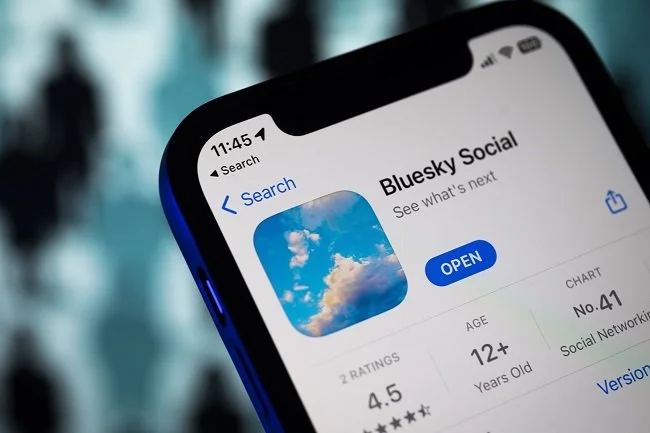
A couple of weeks ago I decided, like so many others, to create an account on Bluesky. My decision to do so wasn’t so much driven by a personal dislike of Twitter/X but because so many people that I follow had gone. I fully recognise that Twitter has been in decline since it was bought by Elon Musk but I still have found the social media platform useful, even during recent months. Through judicious use of the block and mute facilities, I have managed to keep my timeline relatively free of crap. However, the advertising has become more pervasive of late and most of the people whose Tweets I have enjoyed over the years have either migrated to other platforms or simply stepped away from social media altogether. It was the desire to spend time with a like minded community that ultimately prompted my move to Bluesky.
A couple of weeks ago I decided, like so many others, to create an account on Bluesky. My decision to do so wasn’t so much driven by a personal dislike of Twitter/X but because so many people that I follow had gone. I fully recognise that Twitter has been in decline since it was bought by Elon Musk but I still have found the social media platform useful, even during recent months. Through judicious use of the block and mute facilities, I have managed to keep my timeline relatively free of crap. However, the advertising has become more pervasive of late and most of the people whose Tweets I have enjoyed over the years have either migrated to other platforms or simply stepped away from social media altogether. It was the desire to spend time with a like minded community that ultimately prompted my move to Bluesky.
I joined Twitter in August 2010. Most of the people I started following I knew from the video games blogging community. Twitter was a great means at that point to promote one’s work and share material. Over time, I started following a broader spectrum of individuals and found Twitter to be a great source of breaking news. At its peak, the social media platform was a key source of both social activity and information. I used Tweeten as my Twitter client and had it running continuously on my second monitor throughout the day. When I was away from my desk, I had Hootsuite on my phone. For a while, Twitter was very much a focal part of my day. However, overtime, I learned that this wasn’t necessarily a good thing and I curtailed my enthusiasm. The loss of key individuals that I followed, contributed a lot to this change in mindset. Social media is only as good as the people you follow.
New technological mediums often start with innovative pioneers that create a new market and subsequently dominate it for a while. Twitter falls into that category, just like Steam and Netflix. All have had their day in the sun where they effectively enjoyed a monopoly. However, competitors and a fragmenting market ultimately have knocked them all off their respective pedestals. In the case of Twitter, management decisions have contributed to the diminishment of the brand. I suspect that in time, there will be several social media platforms that become the established leaders and people will make their choice depending on a multitude of personal factors. Politics may be one. Friends, community and the ability to carefully curate your timeline may be others. A year or two from now, what social media platform you use may become a key question in market research.
With regard to Bluesky, I find that its functionality is nearly identical to that of Twitter. I was very pleased to find so many old friends so quickly and at present, there are many familiar faces in my timeline. Plus I have discovered many new people to follow with similar interests and hobbies. I have already started proactively policing my timeline to ensure it suits my needs. There is a lot that you can do to mute words, block people and generally ensure that you’re not exposed to a load of tedious and unnecessary bullshit. Social media has the capacity to do a lot of harm to one’s mental wellbeing, therefore it is very important to ensure that it serves you and not the other way round. As for Twitter, I still have an account but I’m not especially active. It is sad how things have changed but that is just the nature of life. Keep moving forward. See you on Bluesky.



The End of Twitter?
I have been using Twitter since 2010 and to cut a long story short, although it can be a virtual septic tank of human bile, ignorance and stupidity it can also be very informative and uplifting. I rely on Twitter for the latest news and find it far more immediate and succinct than traditional TV bulletins. When the shit hits the fan, as far as I’m concerned Twitter is the way to stay abreast of a developing story. Furthermore, I very much enjoy the social element of Twitter and the online banter with those I follow and who follow me. Twitter doesn’t do anything particularly unique but it did it first and hence everyone is in one place. That makes it invaluable. Sadly, if Elon Musk continues to mess with things to the point of breaking the Twitter community, then I will be forced to go elsewhere. Some folk are jumping ship already. Because of Musk’s erratic nature there’s a prevailing atmosphere that something is going to happen and it’s not going to be good.
I have been using Twitter since 2010 and to cut a long story short, although it can be a virtual septic tank of human bile, ignorance and stupidity it can also be very informative and uplifting. I rely on Twitter for the latest news and find it far more immediate and succinct than traditional TV bulletins. When the shit hits the fan, as far as I’m concerned Twitter is the way to stay abreast of a developing story. Furthermore, I very much enjoy the social element of Twitter and the online banter with those I follow and who follow me. Twitter doesn’t do anything particularly unique but it did it first and hence everyone is in one place. That makes it invaluable. Sadly, if Elon Musk continues to mess with things to the point of breaking the Twitter community, then I will be forced to go elsewhere. Some folk are jumping ship already. Because of Musk’s erratic nature there’s a prevailing atmosphere that something is going to happen and it’s not going to be good.
My biggest concern is that the existing Twitter community is going to fragment, with online friends migrating to multiple alternative platforms. It may also cause some existing Twitter users who are already disillusioned with the existing status quo, to simply quit social media. With respect to those Twitter accounts that I follow for news and information, rather than social engagement, I wonder what will be the new platform of choice to reach an audience. I don’t want to have to maintain multiple social media accounts across multiple services. And I am not going to pay for the service that I already have enjoyed free of charge for the last 12 years. The only people who potentially benefit from a fragmented community are the traditional media outlets. Print media in the UK hates the fact that Twitter provides a platform that can challenge their news agenda and give the public the right of recourse.
I’ve always take a “belt and braces” approach to life and so, although it hasn’t happened as of yet, I am already working on my Twitter exit strategy. Anecdotally, it would seem that Mastodon is the next best place to go, so I have set up an account there. Unfortunately, this endeavour seems to have fallen at the first hurdle as I’ve still not received my verification email to make my new account active. This doesn’t bode well for a platform that some claim is the anointed successor to Twitter. Assuming that I can set up and start using Mastodon, there then remains the issue of which client to use. I currently use Tweeten for Twitter and am looking for identical functionality in a third party Mastodon client. However, nothing I’ve seen so far seems to offer that. It is so important to get the data that you want, presented in an accessible manner or else you run the risk of drowning in white noise and bullshit when it comes to social media.
I’ve written posts in the past about becoming reliant on free services, only to then have them withdrawn or monetised. We’ve all been down this road before so if the worst case scenario happens and Twitter goes to the wall, at least we won’t be caught off guard. However, the thing about Twitter is that there are so many potential ways you could monetise it without having to restrict usage or radically alter the way it functions. Sadly, that doesn’t seem to be Elon Musk’s intent. I am naturally sceptical of billionaires per se and especially so in his case because he is “anomalous” (the politest thing I could say about him). However, Twitter is now his “bat and ball” and so if he wants to neuter it for political or business reasons, then that is his prerogative and there’s nothing much the average user can do about it. If it all ends up going south, it was fun while it lasted.
Update: I managed to get myself on Mastodon and it is not an exact Twitter clone. It appears to require a lot more curation and interaction for it to yield the results that I want. Those seeking for a “like for like” replacement may wish to look elsewhere.
Why I'm Not Leaving Twitter
A lot of people seem to be concerned about Elon Musk buying Twitter. Apparently the billionaire, who describes himself as a “free speech absolutist”, considers the social media platform to be a “digital town square where matters vital to the future of humanity are debated”. Really? I’ve obviously missed all that, unless it’s being done through the use of cat videos. Setting aside Musk’s penchant for hyperbole, legitimate concerns have been raised by various Human Rights groups regarding the new owner’s intent to reduce moderation on Twitter. Also will previously suspended accounts be reactivated? Hence, even in my quiet backwater of Twitter, I’ve seen several discussions about whether people should leave and a lot of concern for what is to come in the weeks and months ahead.
A lot of people seem to be concerned about Elon Musk buying Twitter. Apparently the billionaire, who describes himself as a “free speech absolutist”, considers the social media platform to be a “digital town square where matters vital to the future of humanity are debated”. Really? I’ve obviously missed all that, unless it’s being done through the use of cat videos. Setting aside Musk’s penchant for hyperbole, legitimate concerns have been raised by various Human Rights groups regarding the new owner’s intent to reduce moderation on Twitter. Also will previously suspended accounts be reactivated? Hence, even in my quiet backwater of Twitter, I’ve seen several discussions about whether people should leave and a lot of concern for what is to come in the weeks and months ahead.
For starters, let’s address some of the pachyderms that accompany this situation. Elon Musk is a “curious” character. His perception and personal experience of the nature of free speech will most certainly be different to ours, due to his wealth and power. Remember his “pedo guy” comments? He’s also a thin skinned individual who has often gone after journalists who are critical of him. So I don’t place any credence upon his claim to be a “free speech absolutist”. He’s a businessman and I therefore see his acquisition of Twitter as being a means to an end either for him directly or his peer group. Twitter may or may not be the “town square” that he claims it to be but it certainly is an immense source of useful information, from a corporate perspective. It is also a tool that not only reflects opinion but can potentially be used to shape it. That makes it important.
So what happens next? Is Twitter going to become even more of a Wild West under Elon Musk’s watch? Maybe. Maybe not. He does claim to have other aspirations for the platform and not all of them appear bad. I certainly would favour a clampdown on “bot” accounts. However, if people leave preemptively, especially those from minority groups or with specific political leanings, then that decline that everyone fears will be accelerated. Sometimes, conceding ground is a sound strategy but I don’t believe that is the case in this instance. You don’t counter opposing ideologies by ignoring them or dismissing them. You meet them head on and your arguments stand or fall on their merits. Education is a slow process at times. Retreating won’t achieve any of that. “The line must be drawn here! This far, no further!” if you want a motivational Star Trek quote to validate the argument.
I am fully aware that Twitter can be an utter cesspool at times. But broadly speaking that is not my own personal, daily experience. This is due to the fact that I control what does and doesn’t appear in my timeline. I often get the impression that a lot of people are using the default Twitter client and are not curating their timeline as well as they should. I expect Twitter to make some effort with regard to moderation and sanction when rules are broken but I also think it is incumbent on me to take an active role in managing what I am exposed to. Although I expect the local council to keep the streets clean, I still pay attention as to where I walk. If I step on a dog turd due to my own inattentiveness, that’s on me. Therefore, mute keywords and block users accordingly. It makes a surprising difference to your overall Twitter experience.
If you want a life that is totally devoid of risk, unpleasantness, upset and controversy then perhaps the best policy is to eschew all forms of social media. You may also wish to stay at home, avoid all family and personal relationships and any other form of direct human interaction. I’m not opposed to the concept of “safe spaces” but some mediums simply do not lend themselves to being one. Twitter is one example. Like a swimming pool, someone is always going to piss in it. Therefore, the most you can do is manage your own virtual borders and regularly curate your Twitter timeline. If done wisely your experience online can be very rewarding. Twitter will never be perfect, as it involves people who are by default “flawed”. As to how the platform performs under its new owner’s stewardship, perhaps a “wait and see approach” is appropriate. In the meantime, do what you can to protect yourself and focus on the positive aspects the platform provides.
A Year in Social Media
I can’t speak for others but my relationship with social media has certainly changed over the last two years. Whenever new internet technologies emerge, there is a brief period when it feels like some sort of new frontier. Often such innovations become a means of empowering the marginalised and the voiceless. For a while new platforms can even be a force for good. But eventually commercial interests creep in along with rules and regulations. Hence, it all inevitably takes a turn for the worst. The frontier is finally tamed and ends up being just another corporate space. Social media is certainly not a forum for discussing social issues or politics, instead being a medium for tribalism and rancour. Because of these factors and others, I have moderated my use of social media and it has proven extremely beneficial to my state of mind.
I can’t speak for others but my relationship with social media has certainly changed over the last two years. Whenever new internet technologies emerge, there is a brief period when it feels like some sort of new frontier. Often such innovations become a means of empowering the marginalised and the voiceless. For a while new platforms can even be a force for good. But eventually commercial interests creep in along with rules and regulations. Hence, it all inevitably takes a turn for the worst. The frontier is finally tamed and ends up being just another corporate space. Social media is certainly not a forum for discussing social issues or politics, instead being a medium for tribalism and rancour. Because of these factors and others, I have moderated my use of social media and it has proven extremely beneficial to my state of mind.
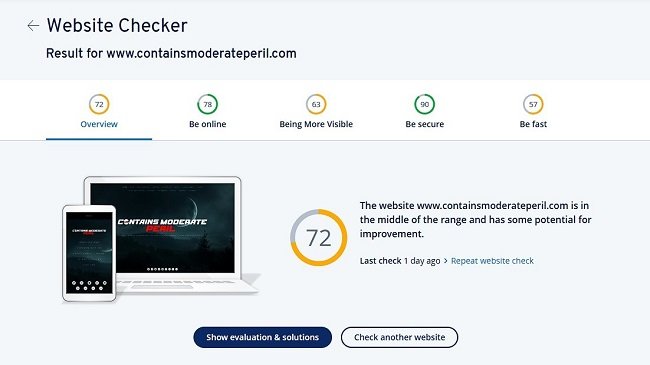
A decade ago, I thought that using social media to promote my writing would be an invaluable tool and have positive results. Reflecting upon that now, I can't help but raise a wry smile at such naivety. Over the last twelve months, the amount of traffic to Contains Moderate Peril which is directly attributable to social media is just over 1%. Thus as a promotional tool, for me at least, it isn’t really worth the bother. Occasionally a Tweet about a game specific story may get a degree of traction with its player community but even then, it will only result in 100 or so additional visits to the post. Google is the primary source of people finding my writing and social media promotion has proven ineffective. Plus writing a blog doesn’t really lend itself to a presence on TikTok or Instagram. Platforms geared towards brevity and the concise delivery of targeted content, don’t really suit long from written material.
So after dabbling with instagram, I’ve ceased to actively participate on the platform. I mainly use it now to keep up to date with what my immediate family are doing, especially my granddaughters. Facebook is another medium I no longer use or check. I think the main reason I stopped using it was because rather than being a means to cross promote material, it simply became its own ecosystem which wasn’t especially helpful. As for older forms of social media such as forums and subreddits, they seem to be rapidly falling by the wayside. Many of the ones that I’ve used over the years, associated with specific games or types of fandom, have either closed down or dwindled into insignificance. Or they just become monopolised by a small cadre of dedicated posters who treat it as their own personal fiefdom. It often leads to an extremely partisan environment and hardly a suitable medium for debate and discussion.
Discord continues to be somewhat of a paradox, from my perspective. It’s a great way to chat and answer immediate enquiries. It’s also a solid foundation for a social group. However it is not exactly useful for archiving discussions and information. I feel it is a medium that deals in the here and now and although very useful it ultimately is very ephemeral. Yet many traditional gaming communities are moving to this platform, which I find somewhat confusing. Because it doesn’t offer the range of services that a traditional forum does. You can organise and manage events perfectly on Discord. But you cannot curate information and easily search for older content. I also feel that a Discord community over a certain size of active contributors is too hard to keep up with. You either follow it 24/7 or it eludes you.
As the year nears its end, I find myself using Twitter as my primary social media platform. I stopped following numerous twitter accounts earlier in spring, especially those associated with political and social commentary. I find that not having vast amounts of controversy and daily brouhahas flooding my timeline is extremely good for my psychological equilibrium. I mainly use Twitter now as a means of staying in touch with my online friends whose company I enjoy immensely. Overall, I’m finding the novelty of social media to be ebbing away and its practical benefits are overrated. Reaching large groups of potential customers is fine for business. Being exposed to excessive amounts of random members of the public is neither edifying, desirable or fun. I suspect that I shall continue to refine my social media experience in 2022.









Walter
I shall be taking a degree of “artistic license” with today’s Blaugust Promptapalooza writing prompt. The original question (as given by Rambling Redshirt over at Beyond Tannhauser Gate) is “If you had a mascot to represent you, what would it be?” but I’ve decided to adjust this slightly. I already have an unofficial mascot for Contains Moderate Peril and they have featured in several blog posts. Furthermore, as an experiment in marketing, they have also appeared in several social media campaigns. The idea was to see whether they could gain more traction with existing “followers” and provide a more effective means of promoting this site. I was initially surprised by the results but upon reflection, given what usually proves popular on social media (IE things that are deemed “cute”), it should have been obvious from the start. So without further ado, if you are not familiar with him already, allow me to introduce Walter.
I shall be taking a degree of “artistic license” with today’s Blaugust Promptapalooza writing prompt. The original question (as given by Rambling Redshirt over at Beyond Tannhauser Gate) is “If you had a mascot to represent you, what would it be?” but I’ve decided to adjust this slightly. I already have an unofficial mascot for Contains Moderate Peril and they have featured in several blog posts. Furthermore, as an experiment in marketing, they have also appeared in several social media campaigns. The idea was to see whether they could gain more traction with existing “followers” and provide a more effective means of promoting this site. I was initially surprised by the results but upon reflection, given what usually proves popular on social media (IE things that are deemed “cute”), it should have been obvious from the start. So without further ado, if you are not familiar with him already, allow me to introduce Walter.
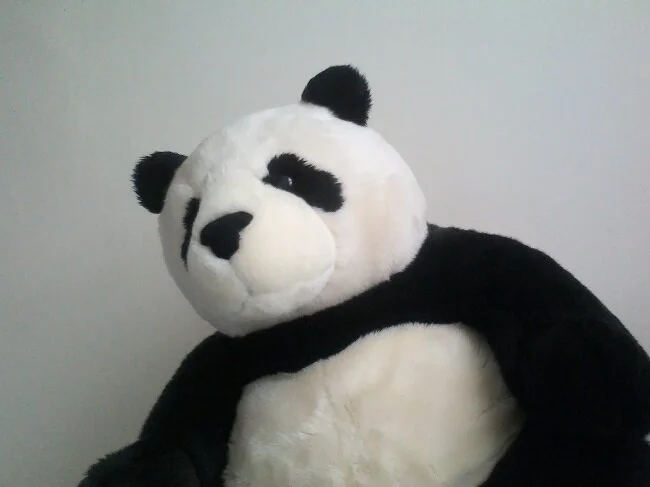
Walter is a cuddly Panda soft toy or plushy as they call such things “across the pond”. He’s about 3 feet and has his own chair, which is positioned in the lounge, next to the TV. His origins are somewhat mysterious. Walter first appeared in my home roundabout Easter 2014. Mrs P saw him in a charity shop window for the bargain price of £3 and in a fit of generosity, bought him for £5. I woke up to find him looking at me and thus began a strange and interesting symbiotic relationship. I have often wondered about Walter’s previous life before he became part of the Peril household but he has remained uncommunicative about the subject. He likes to give the impression that his past is enigmatic but I suspect he was given his marching orders by his previous “owners” for taking up too much room. Walter doesn’t help out with household chores, preferring to “hold court” from his chair. He watches a lot of TV and has strong opinions on popular culture.
Now if you have a 3 foot cuddly Panda, knocking about your abode, it’s only a matter of time before you decide to take a photo of them in a comical situation or with some kind of droll caption. Hence Walter made his first appearance in a post I wrote about the perils of playing Mortal Kombat. NB This featured on a previous iteration of the Contains Moderate Peril website but the post was updated and republished here. Naturally, readers were curious about my new companion and he made further appearances both on the blog and Twitter. His dry sense of humour gained him a degree of traction with readers and followers alike and I started getting requests for him to feature more often. Hence I decided to try a small experiment and planned a series of tweets featuring Walter watching classic movies and TV and making informed pronouncements upon the proceeding. There are some very good online tools available for analysing social media traffic, so I created #WalterWatches as a means of tracking the experiment.
If I may quote Spandau Ballet, to cut a long story short Walter’s viewing commentary generated about four to five times more online activity than my regular tweets. Season 1 (for want of a better phrase) of #WalterWatches ran from March to May in 2019 and proved that if used properly, then social media can really “boost your signal”. Season 2 ran from January to February 2020 and stopped mainly due to the lockdown. Naturally, I have genuinely considered creating a separate Instagram and Twitter account for Walter. Mrs P even suggested making outfits for him (she’s a dab hand at sewing and dressmaking). However, all these ideas have withered on the vine. Walter’s popularity is due to him. I’m not sure if trying to crowbar his persona into promoting my work would be so well received. Plus making outfits, videos and setting up photos is time consuming and I struggle enough to write consistently. Plus now that Walter’s cousin Finwë has come to live with us, the pair of them are too busy and not especially fussed about becoming “influencers”.
There may well be a lesson to be learned in this tale, although I’m not quite sure what it is exactly. Certainly mascots are a great marketing tool but I suspect you have to have a clear idea of how to use them effectively to get the most out of them. And before I end this post I will share two further Walter related anecdotes. Firstly, Walter got his name because if you look at him from the right angle (and with the help of alcohol), he looks like the actor John Noble who played Walter Bishop in the TV show Fringe. Secondly, in late summer 2014, I was ill with Swine Flu. At one point I was running a very high temperature and beginning to slip in and out of consciousness. I awoke from a lengthy sleep to find a wet towel tied not around my own forehead but Walter’s. I’ve never quite got to the bottom of what happened and he’s never felt disposed to say anything. It’s just another of the many unanswered questions surrounding him. I’m still trying to figure out how come he’s got his own special chair and I haven’t?










A Year in Social Media
The term social media is a broad church. For me it primarily means Twitter as that is the only platform of that ilk that I use regularly. I maintain a presence on Facebook simply to stay in touch with friends who have emigrated to the US. We have a private page where we catch up instead of using the traditional medium of emails. It is more immediate but also more frivolous. If it weren’t for need that it serves, I would have long closed my Facebook account. 2018 was also the year where I tried to continue using Instagram but failed. I don’t tend to catalogue and display my life in the manner that this medium tends to demand and use it mainly to see what my granddaughters have been up to. For me Twitter is the social media platform I feel most comfortable using and feel that I have mastered. I use it to promote my writing and for quips, banter and social interaction. Beyond that I think its benefits are both limited and even questionable.
The term social media is a broad church. For me it primarily means Twitter as that is the only platform of that ilk that I use regularly. I maintain a presence on Facebook simply to stay in touch with friends who have emigrated to the US. We have a private page where we catch up instead of using the traditional medium of emails. It is more immediate but also more frivolous. If it weren’t for need that it serves, I would have long closed my Facebook account. 2018 was also the year where I tried to continue using Instagram but failed. I don’t tend to catalogue and display my life in the manner that this medium tends to demand and use it mainly to see what my granddaughters have been up to. For me Twitter is the social media platform I feel most comfortable using and feel that I have mastered. I use it to promote my writing and for quips, banter and social interaction. Beyond that I think its benefits are both limited and even questionable.
Initially I thought that having a large Twitter following would be invaluable for promoting my writing and podcast. Ten years later I have definitively concluded that it is not so. Yes, I do generate traffic from my tweets but it’s less than a quarter of all visits to my blog. You also very quickly learn that informed debate is also an impossibility on this platform. Muting specific keywords, blocking people and generally pruning the list of accounts that you follow is the key to happiness and success when using this Twitter. You are not obliged to debate and discuss with all and sundry who see fit to question you. Twitter is not a moderated, civilised arena for intellectual discussion. It is more akin to a hectoring at a sporting venue. Treat Twitter like your own front door. You don’t have to open it, especially if an itinerant asshole or professional malcontent is knocking.
On a more serious note, as you get older (or at least I find so), friends and colleagues tend to settle down, have families and do the “usual” things in life. Social circles therefore contract and alter. This is perfectly natural and nothing out of the ordinary. Over the last ten years, I have come to know a broad and diverse group of people via Twitter. They hail from all walks of life and from numerous countries. I greatly value their company and daily thoughts. I consider this to be the real benefit that Twitter brings, as the virtual company of my colleagues has often helped me through some bleak periods. The debate over the validity of online friendships still rages on but I genuinely believe that is can be just as important as those offline. I would happily meet up with all my Twitter chums and enjoy their company over a meal. Hopefully these positive benefits of social media will continue into 2019.
Fans, Community Management and Social Media
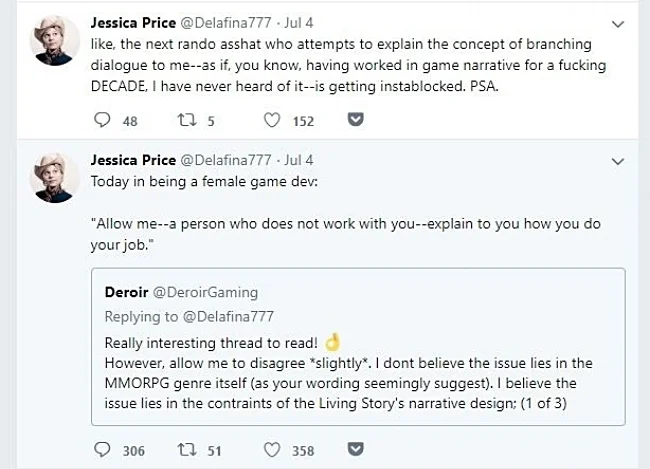
When I first read about the furore caused by Jessica Price’s comments yesterday, I knew it wouldn’t end well. There’s a tedious inevitability to the outcome of most video game related “outrages” these days. For example, a senior member of staff from a major developer will same something crass, double down, dig a hole and then finally after being bitten on the ass by reality, will put out a mealy-mouthed half ass apology. The other scenario is that an employee affiliated to a studio says something completely left field, is presented with short window of opportunity to retract it and blame it on over the counter flu medication, before they get fired due to the ensuing PR shit storm. This particular controversy falls into the latter category. However, if you take a step back from the Jessica Price debacle you quickly notice it raises a lot of questions beyond her obvious transgression. Namely, the problem of always being “on the clock” when you work in certain professions, the need to separate your work and personal social media presence and the place “influencers have in the video games industry.
When I first read about the furore caused by Jessica Price’s comments yesterday, I knew it wouldn’t end well. There’s a tedious inevitability to the outcome of most video game related “outrages” these days. For example, a senior member of staff from a major developer will same something crass, double down, dig a hole and then finally after being bitten on the ass by reality, will put out a mealy-mouthed half ass apology. The other scenario is that an employee affiliated to a studio says something completely left field, is presented with short window of opportunity to retract it and blame it on over the counter flu medication, before they get fired due to the ensuing PR shit storm. This particular controversy falls into the latter category. However, if you take a step back from the Jessica Price debacle you quickly notice it raises a lot of questions beyond her obvious transgression. Namely, the problem of always being “on the clock” when you work in certain professions, the need to separate your work and personal social media presence and the place “influencers have in the video games industry.
First up, let’s deal with the most obvious things that standout from this “wee stooshie”. The moment you have your employers name in your twitter biography, you rightly or wrongly are now an ambassador for that company. This is a problematic foible of working in an age dominated by social media. I also think it is further exacerbated by the US work ethic which is curiously more zealous than its European counterpart. Work is more of defining factor in American culture to begin with. Irrespective of this, if you work for a major games developer and cite that in your profile then the fans will take it as read that you’re accessible 24/7 and they’ll cross examine you at every opportunity. It’s ironic but the term “emotional courtesan” that Jessica Price refutes in one of her tweets, is not a bad definition of the role that is thrust upon such employees. A company’s reputation and standing with its customers is one of its most prized assets. Questions regarding the capricious nature of fans and the fact that some totally lack any filter are ultimately irrelevant. You don’t upset the gravy train.
Next there’s the need to compartmentalise. If you work for a big player in any type of industry and feel that there are constraints placed upon your freedom of expression online as a result of that, then simply create separate social media accounts. Apply common sense to your work-related platforms and if need be follow a clear set of rules with regard to your customer interactions. As for your personal accounts, keep them separate and don’t make the mistake of getting drawn into needless arguments. Use mute or block judiciously if need be. And remember that Twitter is a public space and is therefore governed by rules of speech in such an environment. Ultimately if you want privacy in your discussion then use What’s App or something similar. Also, manners have declined in the last fifty years. Some people either lack a filter or simply refuse to use one for their own dysfunctional reasons. You have very little say or control over who decides to interject in any ongoing conversation. The sad reality is that your work related social media account forces you to do your job with one hand tied behind your back. It’s not a level playing field but if that’s place you’ve chosen to set up your stall, then that is how you have to roll with things.
Then there is the whole thorny issue of influencers. In this case, I’m not aware that You Tuber and Streamer Deroir has ever been considered a difficult or controversial individual. From what I’ve gleaned from the internet, they are a relatively benign community conduit. He’s even got an NPC named after him in the Mistlock Observatory. Therefore, it is not unreasonable for Deroir to want to interact with an ArenaNet employee such as Jessica Price. His comments were not in any way rude, so he really didn’t deserve the response he received. However, the wider gaming dependency upon influencers is a questionable practice. Not all are as measured as Deroir. It should not be forgotten that many influencers are not directly employed by the games developers and therefore not subject to the same scrutiny and security checks as regular staff. It’s a powerful position to be in and people are flawed. There have been instances of influencers going rogue in the past, although again I say this is clearly not one.
Finally, I am becoming increasingly sceptical of overt fandom of any kind. Pop culture, like politics and sports, is losing all semblance of measure and introspection and slowly becoming far more zealous. Everybody seems to have a stake or a personal claim on some part of the internet or aspect of fandom, regardless of whether it is legitimate or justified. Fandom isn’t collective ownership, although that is fast becoming a minority view. Dealing with such communities is becoming increasing hard. Who wants to navigate a daily diet of anger, accusations and bile? In the case of Jessica Price, her ill-conceived comments were wrong, and she has been sanctioned by her employers (The degree of which is subject to debate). However, what is worrying is the increasing trend that sees justifiable anger and complaint from legitimate quarters, being subsequently hi-jacked by those who simply smell blood in the water. The internet lynch mob is an extremely blunt tool and the dirty footprints of its affiliate members who often have their own agenda, ultimately just end up muddying the waters of measured and reasoned criticism. Thus, gaming culture declines further and it’s more mature and measured members find themselves moving ever further to its periphery, so as not be tarred with the same brush.


This is Why We Can't Have Nice Things
"This is why we can't have nice things" is a well-established internet meme. Over time it has been over used and has become a bit of a cliché. Yet under certain conditions it can still be utilised in a pertinent fashion to make a salient point. Recently, something somewhat innocuous and trivial occurred that caused me to recollect this saying. The incident itself is not of any major importance but it resulted in me realising that this sort of thing happens more and more often these days. Allow me to explain myself. I like many of you frequent a few forums and subreddits. On one particular site, a thread was derailed by someone who decided to just simply name call. Nothing unusual there I hear you say. But for me personally, it was one time too many. Name calling serves no purpose in an adult debate, so I decided to point this out. Eventually, the problem post was removed as there were others that thought that such behaviour was crass. However, the person in question who posted the remark, would not concede the point in any way shape or form. They either did not want to or what was more likely, were totally incapable of comprehending their own transgression.
"This is why we can't have nice things" is a well-established internet meme. Over time it has been over used and has become a bit of a cliché. Yet under certain conditions it can still be utilised in a pertinent fashion to make a salient point. Recently, something somewhat innocuous and trivial occurred that caused me to recollect this saying. The incident itself is not of any major importance but it resulted in me realising that this sort of thing happens more and more often these days. Allow me to explain myself. I like many of you frequent a few forums and subreddits. On one particular site, a thread was derailed by someone who decided to just simply name call. Nothing unusual there I hear you say. But for me personally, it was one time too many. Name calling serves no purpose in an adult debate, so I decided to point this out. Eventually, the problem post was removed as there were others that thought that such behaviour was crass. However, the person in question who posted the remark, would not concede the point in any way shape or form. They either did not want to or what was more likely, were totally incapable of comprehending their own transgression.
Whether they were trolling, or utterly convinced of the certainty of their position remains unknown. As they were only sanctioned and not banned, they will no doubt continue to pursue their "unique style" of social interaction. I am left considering whether I wish to continue to participate in such an environment. Hence my recourse to the titular meme, because this always seems to be the pattern. It appears that any medium that is designed for social interaction is eventually usurped by the lowest common denominator. Furthermore, the problem elements who often cause these problems are sufficiently savvy to keep within the rules (although they are often a moderator’s nightmare), thus remaining relatively unassailable.
Now I'm sure we've all experienced this sort of behaviour in some shape or form, during our excursions online. It’s quite common place. Here are a few examples of the usual sort of tactics that are used to derail or hijack any conversation:
- Straw man and Ad hominen arguments. Pretty much the oldest two tricks in the book. Argue against something that wasn't said or attack the person to discredit their opinions or position.
- Gaslighting.
- Whataboutery.
- Grammar Nazis. If you can't win an argument then why not criticise someone's spelling. A classic act of misdirection.
- The Wall of Text. This is often done by minutely dissecting a previous post and is a tool designed to wear an opponent down. If the wall of text is not replied to in kind, a victory is claim by default.
- "Freedom of speech". This nebulous ideological concept (which so often erroneously interpreted) is the "get out of jail card" of choice for many online malcontents. Allegedly it affords people the right to be racist, sexist, and pretty much any other sort of "ist" that you can name. Sometimes it is seen as a justification to simply be bellicose and ill mannered, affording the individual the option to abdicate from normal social conventions.
For those who would like to explore further examples of these esoteric arts, try the following links. How to Win Online Arguments and The Subtle Art of Trolling. Also checkout Graham's Hierarchy of Disagreement. It seems that there is little scope for a civilised debate and social interaction anywhere on the internet these days. In researching this post, I picked three random articles that were linked on Twitter and read their respective comments section. All descended into chaos within a short period of time. Furthermore, this seems to be the standard mode of debate in all walks of life these days. TV shows and news channels seem to favour it, as does the press. Politics has fully embraced the Punch and Judy approach to public discourse. It no longer seems to be about having an intelligent debate. Now it's simply about shouting someone down, not blinking while lying through your teeth and revelling in the perceived glory of your victory. All of which is far easier than having a proper discussion based around critical thinking and decorum, because that obviously takes too much effort and more importantly skill.
So, what do people such as you and I do about this problem? Well it would appear the common solution is to simply withdraw. Thus, we see forums and websites become havens for trolls and gain the label "toxic". Just go and look at the small cadre of malcontents on the LBC website. It’s a sad reality of modern life that regular people frequently have to manage their affairs around avoiding problems and conflict, rather than the problems and troublemakers being dealt with. Yet withdrawing is ultimately counterproductive. So what can we do. Well rather than wade in and make a potential slanging match worse, why not simply use the facilities that are in place? Use the moderation procedures that are available to you. If you are unhappy with the way a debate is being conducted, then flag it for moderation and give cogent and succinct reasons as to why you have done so. Encourage other users to do so. However, this doesn’t guarantee results. Moderation comes with a cost attached and thus often gets neglected. If that’s the case, then escalate matter further up the chain of command. Email the owners, or domain holders. Complain publicly via Twitter. Negative publicity can often attract attention.
If you find yourself in a situation where you write or provide a forum or subreddit, then it is essential to have a clear policy with regard to comments and interaction. I take a fairly liberal approach to policing comments on Contains Moderate Peril and often allow the crass and trolling posts to remain, as their stupidity is often self-evident. Occasionally I will delete a comment if it is simply of no value. As it is my site I reserve the right to determine exactly what the definition of "value" is. I would again encourage others to do the same regardless of what platform they are maintaining. Decide your rules, be clear about them and enforce them rigorously. You are not obliged to have an "off topic" channel on your Discord server if you don’t want one. If you do, then enforce an adherence to standards of behaviour that are commonly held.
It is very difficult to counter the negative effects that alleged internet anonymity generates. Broadly speaking freedom means we have to endure a degree of unpalatable behaviour and that it is the price that we pay for liberty. However, I see no reason not to attempt to re-educate those who troll and rile. We should more often use the existing procedures to sanction problem individuals and re-iterate the fact that there are consequences to certain actions. In some respects, it is similar to the recent debate had in the UK regarding regulation of the press. It was argued that there are sufficient rules in place at present that can deal with transgressions without the need for further legislation. The current rules just need to be enforced. The same is applicable to Twitter. Prosecute those that breech the current laws with regard to threat and libel. As for general bad behaviour, the responsibility lies with you and I to state are displeasure.
I am very interested at present with the way that some games developers are dealing with this problem. Community decisions on a troll’s punishment, temporary exile of problems players to specific servers and other sanctions do seem to have an impact. It would seem attempted rehabilitation is a more beneficial approach to simply banning. Perhaps this is the future and a way to stop the spread of the rot. Hopefully these methods can be brought to bear on other mediums and platforms. The first step on this road is for regular folk to remain robust, express their displeasure and not to withdraw. I know that’s hard and a big ask. But the only truly effective way to counter bad ideas and ideologies is to tackle them head on. No-platforming simply doesn’t work. Stupidity should be exposed and ridiculed. You don’t have to be like Peter Tatchell and fight every battle. But calling someone out who says something racist or such like, helps reinforce the notion that some behaviour in not acceptable. It’s the weight of all the smaller battles that often eventually tip the scales.
But it takes time for things to change. It’s not going to happen overnight. Technology, human behaviour, and ethics have not kept in step with each other. The law is also lagging behid in some areas. However, if we're persistant, then we will be able to bring about change. During the seventies, there started i the UK, a long campaign against drinking and driving. By the mid-nineties the message finally got traction and the culture begin to shift accordingly. I believe if we take a similar long-term approach with social media can "have nice things" eventually. It may not ever be perfect but hopefully it can be better than it is now. Because the alternative simply doesn’t bear thinking about. Therein lies madness.





Social Media and Personal Identity
I'm fascinated by social media and the way it has been adopted by the wider community. A multitude of people utilise in a multitude of ways for so many different reasons. Therefore, I felt that it was time again to focus and discuss the phenomenon in a blog post. I have embraced social media, especially Twitter, mainly to promote my writing. I started “tweeting” in 2010 and along the way my use of the medium has become more socially orientated. I enjoy the interactions I share with a broad and eclectic group of people immensely. However, it should be noted that my Google + page, as well as Twitter and Facebook accounts are all based around Contains Moderate Peril and not my specifically my personal life. I like to maintain a distinction between these different aspects of my life. At present, I believe I have found the right balance.
I'm fascinated by social media and the way it has been adopted by the wider community. A multitude of people utilise in a multitude of ways for so many different reasons. Therefore, I felt that it was time again to focus and discuss the phenomenon in a blog post. I have embraced social media, especially Twitter, mainly to promote my writing. I started “tweeting” in 2010 and along the way my use of the medium has become more socially orientated. I enjoy the interactions I share with a broad and eclectic group of people immensely. However, it should be noted that my Google + page, as well as Twitter and Facebook accounts are all based around Contains Moderate Peril and not my specifically my personal life. I like to maintain a distinction between these different aspects of my life. At present, I believe I have found the right balance.
Now this raises the question of whether my online persona is genuine. How much do readers of Contains Moderate Peril, listeners of the podcast (which is on hiatus at present) and Twitter followers actually see of the "real me"? Well I think they get a measured version of myself. I keep certain aspect of life private while amplifying others. I also think that a certain amount of the "real me" inevitably permeates my writing and online presence by some process of emotional osmosis. Over the last eighteen months I have touched upon more personal aspects of my life, because they are significant aspects of my daily reality. However, I don’t share everything and there is much that I deem off limits.
Some people think this controlled flow of information via social media is somewhat cynical and contrived. Yet I think we all do it to a greater or lesser degree in the real world in our day-to-day relationships. As a species, we always strive to present the best possible representation of ourselves to others. In fact, I've noticed that some cultures are far more invested in this idea than others. In principle, there is nothing wrong with this. Speaking your mind all the time could prove problematic; hence we have social niceties and etiquette. However, if you are continuously trying to reinvent yourself for public consumption because you are inherently uncomfortable in your own skin then that is most definitely a problem.
I think age and how you feel about yourself most certainly have an impact upon how you conduct yourself on Twitter and other platforms. People naturally want to be liked and also be accepted. There is an imperative to be an individual and at the same time “normal”, which is a very nebulous concept. I prefer the broader concept of societal norms and knowing when to accommodate them. Social media as many has pointed out, liberates us from social cues and other vital aspects of communication. Then there is the old chestnut of anonymity and the lack of consequences that come with the internet. There is often scope to forget that we are dealing with another individual when using social media. I think most of us have made this mistake at some point and may have regretted what we've said or how we've treated someone.
Naturally there are counter points to all the above. As I've already stated, I have set limits and constraints on my online interactions. Others go a step further and live completely different lives online, so it is prudent not to take everything on face value. As in the real world, online friendships need to be approached with a similar degree of caution and common sense. I think it is important to focus on the positive things that social media and online friendships can achieve, such as breaking down of geographical boundaries perceived cultural differences. Although Twitter is often associated with birds of a feather flocking together and entrenched views, the complete opposite can often happen. Social media is a great way to bypass misinformation and learn about how others truly live and think. Sometimes the similarities between us speak far louder than the differences.