
Classic Movie Themes: The Day the Earth Stood Still
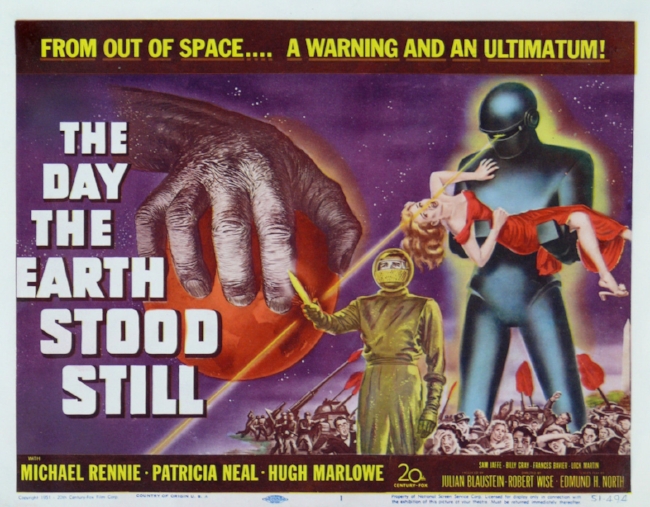
Film producer Julian Blaustein had a long-standing desire to make a film that addressed the fears and concerns of the post war Atomic Age. With the backing from Fox Studio Executive Darryl F. Zanuck, he hired screenwriter Edmund North to adapt the short story Farewell to the Master by Harry Bates. The screenplay provided a moral commentary about the ongoing arms race and featured an alien visitor with Christ like qualities who delivers an apocalyptic message. Veteran director Robert Wise was brought in head the project and a fine cast of established characters actors such as Michael Rennie, Patricia Neal Hugh Marlowe and Sam Jaffe was assembled. The finished movie has proven to be one of the greatest science fiction movies ever; it is The Day the Earth Stood Still made in 1951.
Film producer Julian Blaustein had a long-standing desire to make a film that addressed the fears and concerns of the post war Atomic Age. With the backing from Fox Studio Executive Darryl F. Zanuck, he hired screenwriter Edmund North to adapt the short story Farewell to the Master by Harry Bates. The screenplay provided a moral commentary about the ongoing arms race and featured an alien visitor with Christ like qualities who delivers an apocalyptic message. Veteran director Robert Wise was brought in head the project and a fine cast of established characters actors such as Michael Rennie, Patricia Neal Hugh Marlowe and Sam Jaffe was assembled. The finished movie has proven to be one of the greatest science fiction movies ever; it is The Day the Earth Stood Still made in 1951.
Alfred Newman was Director of Music at 20th Century Fox at the time and decided to assign the project to Bernard Herrmann, who has recently relocated to Los Angeles. Director Robert Wise had worked previously with Herrmann on The Magnificent Ambersons in 1942 and the pair had a good working relationship. So, he effectively gave him an open remit to create something different and special. Herrmann was far from a musical traditionalist and chose to craft an innovative soundscape to highlight the differences between the Alien Klaatu the bellicose and bombastic nature of humanity. He therefore elected to remove acoustic string and woodwind instruments from the orchestra and expanded the horn section. He then further embellished the sound of the film by adding such diverse instruments as an electric violin, Theremins, Hammond organs, vibraphones, and a celesta.
“Prelude and Outer Space” is a magnificent opening cue which highlights Herrmann genius in capturing the narratives emotional essence. The opening credits roll against a shifting panorama of stars and the sumptuously eerie main motif, featuring multi-tracked Theremin and tuba, juxtaposed by piano arpeggios, horns and crystalline harp. Herrmann further embellishes this portentous theme with a vibraphone played backwards. This cue is a masterpiece in both conception and execution. “Radar” offers another incredible track, which demonstrates Herrmann’s compositional aptitude. As the world watches on at the alien space ship, a harp glissando preludes a rapid duet between two pianos, one with bass and the other with vibraphone, which are octaves apart.
Bernard Herrmann was one of the most innovative composers of his generation who endeavoured to bring new and dynamic methods to the process of film scoring. His decision to remove the acoustic instruments from the string and woodwind sections of the orchestra and to augment his score with the abstract otherworldly sounds of the Theremin, vibraphone, and celesta was a bold move. Yet it proved to be a genre defining decision and adds another layer of subtlety to the storytelling. Over the years, many of the unique aspects of the film score have become standard genre tropes. You only have to listen to Danny Elfman’s main them for the 1996 Tim Burton movie, Mars Attacks to hear the reach of Herrmann’s influence.








Classic Movie Themes: The 7th Voyage of Sinbad
The 7th Voyage of Sinbad (1958) directed by Nathan Juran, was the first of three Sinbad feature films produced by Columbia Pictures. The other two being The Golden Voyage of Sinbad (1974) and Sinbad and the Eye of the Tiger (1977). All three Sinbad films were a showcase for Ray Harryhausen’s stop motion animation special effects works, which was marketed as “Dynamation”. The 7th Voyage of Sinbad was the first of Harryhausen’s work to be filmed in colour. The somewhat arbitrary story has Captain Sinbad (Kerwin Mathews) returning to the island of Colossa to find a way to release Princess Parisa (Kathryn Grant) from a magic spell that has caused her to shrink. As ever with such movies, there is much chewing of the scenery and overwrought dialogue. However, the two elements of the film that excel are the excellent monsters and a superb score composed by Bernard Herrmann.
The 7th Voyage of Sinbad (1958) directed by Nathan Juran, was the first of three Sinbad feature films produced by Columbia Pictures. The other two being The Golden Voyage of Sinbad (1974) and Sinbad and the Eye of the Tiger (1977). All three Sinbad films were a showcase for Ray Harryhausen’s stop motion animation special effects works, which was marketed as “Dynamation”. The 7th Voyage of Sinbad was the first of Harryhausen’s work to be filmed in colour. The somewhat arbitrary story has Captain Sinbad (Kerwin Mathews) returning to the island of Colossa to find a way to release Princess Parisa (Kathryn Grant) from a magic spell that has caused her to shrink. As ever with such movies, there is much chewing of the scenery and overwrought dialogue. However, the two elements of the film that excel are the excellent monsters and a superb score composed by Bernard Herrmann.
The main opening theme (Overture as it’s titled on the soundtrack album) for The 7th Voyage of Sinbad is a bold and exciting fanfare. It’s features that dramatic mixture of brass and strings that only Herrmann could do. The fanfare has hints of Herrmann’s future work with its alternating sections of bombastic horns and soft, lyrical strings (think North by Northwest and even Psycho). Overall it is an extremely strong opening gambit and certainly builds expectations for the epic tale that follows. The second part of the cue The Fog is both ominous and mysterious. Once again it showcases Bernard Herrmann’s ability to exactly capture the mood and tone of a scene.
Over the years there have been several notable re-recordings of the soundtrack for The 7th Voyage of Sinbad, yet few have managed to fully capture the spirit of the cues used on the film itself. However, the original session tapes were recently rediscovered and remastered and are now available on CD. These recordings were made directly from the sheet music written by Herrmann himself, and arranged and conducted by Muir Mathieson. Here is the opening Overture followed by The Fog.
Theremin versus Ondes Martenot
A few years ago UK Film Critic Mark Kermode made a short video extolling the virtues of that curious musical instrument the Theremin. However his performance was far from edifying, so to redress the balance, I’ve posted below the main theme from Mars Attacks by Danny Elfman. It highlights the ubiquity of this instrument in the science fiction genre. All of which stems from the wonderfully atmospheric score for the 1951 classic, The Day the Earth Stood by the great Hollywood composer Bernard Herrmann. It was a milestone in the evolution of film soundtracks. Both tracks illustrates the point made by Mr. Kermode perfectly. The Theremin, due to its frequent use in a genre during its most formative years, has virtually become the de facto “sound of space" in popular culture.
A few years ago UK Film Critic Mark Kermode made a short video extolling the virtues of that curious musical instrument the Theremin. However his performance was far from edifying, so to redress the balance, I’ve posted below the main theme from Mars Attacks by Danny Elfman. It highlights the ubiquity of this instrument in the science fiction genre. All of which stems from the wonderfully atmospheric score for the 1951 classic, The Day the Earth Stood by the great Hollywood composer Bernard Herrmann. It was a milestone in the evolution of film soundtracks. Both tracks illustrates the point made by Mr. Kermode perfectly. The Theremin, due to its frequent use in a genre during its most formative years, has virtually become the de facto “sound of space" in popular culture.
Or is it? There is another instrument that vies for the crown of the definitive sound of science fiction; namely the Ondes Martenot. This esoteric French instrument, has been used in many films and TV series, such as The Twilight Zone, Lawrence of Arabia, Billion Dollar Brain and Ghostbusters. The original design was similar in sound to the Theremin. The instrument's eerie wavering notes are produced by varying the frequency of oscillation in vacuum tubes.
Composer Barry Gray often used this instrument to great effect and I would argue that some of his compositions are the equal of those by the Hollywood greats. Here is the classic "Sleeping Astronauts" theme from the 1969 film Doppelgänger AKA Journey to the Far side of the Sun. It remains one of Barry Gray’s finest tracks.
It is often a mistake to make generalisations when it comes to fandom, due to its subjective nature. Genres that are so liberally populated by fanboys will be rife with debate over the most minor and esoteric of points. However I do not think that either instrument trumps the other and I like the eerie ambience of both. These two tracks are outstanding in their own way and I think that pop culture can happily give them equal billing with regard to their contribution to the “sound of space”.