The Day the Earth Stood Still (2008)
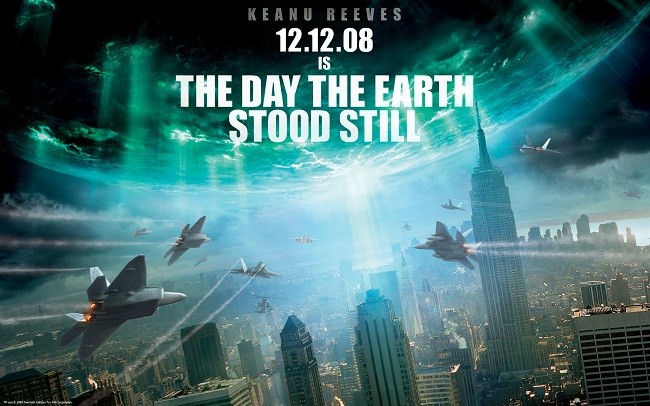
Fellow blogger and all round good guy Murf, posted an ode to Bill & Ted’s Excellent Adventure today. It is clearly a movie that he enjoys (Go read his review). He references how due to this movie (along with others), as well as being a decent person in real life, that actor Keanu Reeves enjoys a great deal of goodwill from fans and pop culture cognoscenti. Which is a good thing for Mr Reeves, because goodwill often means that folk are prepared to overlook past transgressions and misdemeanours. And in cinematic terms, Keanu has had a few. The Day the Earth Stood Still is definitely one of them. Now I’ve questioned before the wisdom and merits of writing a predominantly negative film review and believe me my thoughts on The Day the Earth Stood Still are most definitely so. However, I think that something positive can still be gained from scrutinising this film. It can be held up as a textbook example of how not to remake a classic.
Fellow blogger and all round good guy Murf, posted an ode to Bill & Ted’s Excellent Adventure today. It is clearly a movie that he enjoys (Go read his review). He references how due to this movie (along with others), as well as being a decent person in real life, that actor Keanu Reeves enjoys a great deal of goodwill from fans and pop culture cognoscenti. Which is a good thing for Mr Reeves, because goodwill often means that folk are prepared to overlook past transgressions and misdemeanours. And in cinematic terms, Keanu has had a few. The Day the Earth Stood Still is definitely one of them. Now I’ve questioned before the wisdom and merits of writing a predominantly negative film review and believe me my thoughts on The Day the Earth Stood Still are most definitely so. However, I think that something positive can still be gained from scrutinising this film. It can be held up as a textbook example of how not to remake a classic.
In a prologue sequence set in 1928, a solitary mountaineer encounters a glowing sphere. He loses consciousness after touching it and upon waking, he notices a scar on his hand where a sample of his DNA has been taken. Moving on to the present day, Dr. Helen Benson (Jennifer Connelly) is summoned to a military facility along with several other scientists when an alien spacecraft arrives in New York City. Aboard is a human-like alien (who looks like the earlier mountaineer) and a giant robot of immense size and power called Gort. The alien identifies himself as Klaatu (Keanu Reeves) and states he has “come to save the Earth”. The US Secretary of Defense Regina Jackson (Kathy Bates) sees him as a threat decides to have him interrogated more robustly. Dr. Benson considers this unethical and decides to facilitate Klaatu’s escape. However, when she learns exactly what his words mean, she tries to convince him to rethink his views on humanities iniquities and change his intentions.
When you consider this production’s budget, the quality of the support cast, along with the advances in visual effects, this movie could have been so much better. Director Scott Derrickson is far from a genre hack and I consider his previous work on The Exorcism of Emily Rose, Sinister, Doctor Strange to be of interest. I think his concept of retelling Robert Wise’s classic 1951 movie as a more benevolent tale, rather than an imperious threat, is a valid idea. Yet all these good intentions are lost due to a woefully inept screenplay by David Scarpa. One can’t help but feel that the narrative scope of the film tries too hard and that several well-intentioned casting decisions were ultimately a bad choice. Dr Benson’s stepson, played by Jaden Smith, is supposed to be conflicted due to the premature death of his father but comes off as simply intransigent and annoying. And then there is Keanu Reeves decision to try and play Klaatu in a similar disconnected idiom to David Bowie, in The Man Who Fell to Earth. Instead of being an understated performance it simply fails to convey any depth and conviction.
I’m a fan of unconventional casting when it works but Professor Barnhardt, played by a curiously deadpan John Cleese, whose character has won a Nobel prize for his work on "biological altruism” is too much of a stretch. As for the plot device of paranoid politicians, well if you want it to have any semblance of dramatic impact, then you really have to try and do something different with it. Sadly, such inspiration is sadly lacking and we’re just presented with the usual paranoid clichés about the military and our elected officials. Hence by the time the movie reaches its finale and the Robot Gort, transforms into a swarm of all consuming insect like nano-machines, the spectacular denouement lacks any emotional impact. Given what the audience has witnessed over the proceeding hour, I’m sure most right-minded people would say “fuck it, let humanity die, the bastards”. But at the last moment, Klaatu reverses his decision and sacrifices himself for the sake of humanity, thus ending an emotionally lacklustre and tonally deaf film.
The Day the Earth Stood Still lacks the portentous quality of its predecessor. Klaatu is no longer a biblical judge but a vaguely indifferent administrator, who is inconvenienced by humanity as he vacuum packs earth’s wildlife. Gort is robbed of his metaphorical status and is simply relegated to a MacGuffin designed to facilitate a spectacular ending. And the screenplay, instead of making the audience reflect upon the consequences of mankind’s propensity for violence and destruction, simply pays lip service to the environmental crisis and a few other token social issues. There is no conviction or gravitas present. Nor is there a soundtrack comparable to that of the original by Bernard Herrmann. This is big budget Hollywood science fiction, trying to be politically and socially relevant but refracted though the prism of a big studio that doesn’t really grasp either of those things. But returning to the original point, Keanu Reeves has firmly put this behind him and risen above it, thanks to impart to the John Wick Trilogy. Movies such as this have indefinitely stalled less fortunate actors’ careers.








Classic Movie Themes: The Day the Earth Stood Still
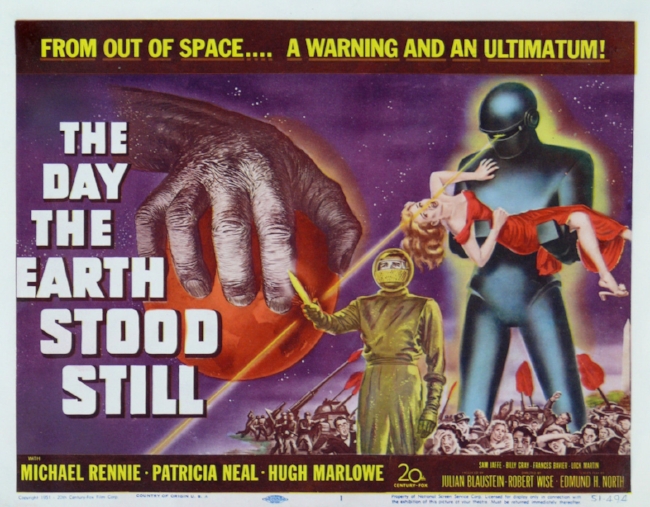
Film producer Julian Blaustein had a long-standing desire to make a film that addressed the fears and concerns of the post war Atomic Age. With the backing from Fox Studio Executive Darryl F. Zanuck, he hired screenwriter Edmund North to adapt the short story Farewell to the Master by Harry Bates. The screenplay provided a moral commentary about the ongoing arms race and featured an alien visitor with Christ like qualities who delivers an apocalyptic message. Veteran director Robert Wise was brought in head the project and a fine cast of established characters actors such as Michael Rennie, Patricia Neal Hugh Marlowe and Sam Jaffe was assembled. The finished movie has proven to be one of the greatest science fiction movies ever; it is The Day the Earth Stood Still made in 1951.
Film producer Julian Blaustein had a long-standing desire to make a film that addressed the fears and concerns of the post war Atomic Age. With the backing from Fox Studio Executive Darryl F. Zanuck, he hired screenwriter Edmund North to adapt the short story Farewell to the Master by Harry Bates. The screenplay provided a moral commentary about the ongoing arms race and featured an alien visitor with Christ like qualities who delivers an apocalyptic message. Veteran director Robert Wise was brought in head the project and a fine cast of established characters actors such as Michael Rennie, Patricia Neal Hugh Marlowe and Sam Jaffe was assembled. The finished movie has proven to be one of the greatest science fiction movies ever; it is The Day the Earth Stood Still made in 1951.
Alfred Newman was Director of Music at 20th Century Fox at the time and decided to assign the project to Bernard Herrmann, who has recently relocated to Los Angeles. Director Robert Wise had worked previously with Herrmann on The Magnificent Ambersons in 1942 and the pair had a good working relationship. So, he effectively gave him an open remit to create something different and special. Herrmann was far from a musical traditionalist and chose to craft an innovative soundscape to highlight the differences between the Alien Klaatu the bellicose and bombastic nature of humanity. He therefore elected to remove acoustic string and woodwind instruments from the orchestra and expanded the horn section. He then further embellished the sound of the film by adding such diverse instruments as an electric violin, Theremins, Hammond organs, vibraphones, and a celesta.
“Prelude and Outer Space” is a magnificent opening cue which highlights Herrmann genius in capturing the narratives emotional essence. The opening credits roll against a shifting panorama of stars and the sumptuously eerie main motif, featuring multi-tracked Theremin and tuba, juxtaposed by piano arpeggios, horns and crystalline harp. Herrmann further embellishes this portentous theme with a vibraphone played backwards. This cue is a masterpiece in both conception and execution. “Radar” offers another incredible track, which demonstrates Herrmann’s compositional aptitude. As the world watches on at the alien space ship, a harp glissando preludes a rapid duet between two pianos, one with bass and the other with vibraphone, which are octaves apart.
Bernard Herrmann was one of the most innovative composers of his generation who endeavoured to bring new and dynamic methods to the process of film scoring. His decision to remove the acoustic instruments from the string and woodwind sections of the orchestra and to augment his score with the abstract otherworldly sounds of the Theremin, vibraphone, and celesta was a bold move. Yet it proved to be a genre defining decision and adds another layer of subtlety to the storytelling. Over the years, many of the unique aspects of the film score have become standard genre tropes. You only have to listen to Danny Elfman’s main them for the 1996 Tim Burton movie, Mars Attacks to hear the reach of Herrmann’s influence.