
Yet More Cult Movie Soundtracks
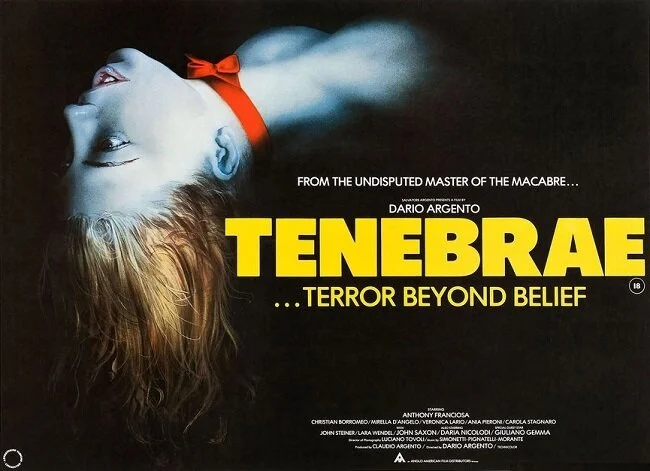
Tenebrae (1982) is probably Dario Argento’s most accessible “giallo” for mainstream audiences. Although violent, it is not as narratively complex as Deep Red (1975) or as bat shit crazy as Phenomena (1985). The story centres on popular American novelist Peter Neal (Anthony Fanciosa) who is in Rome to promote his latest book. Events take a turn for the worst when a series of murders appear to have been inspired by his work. The plot twists and turns, the director explores themes such as dualism along with sexual aberration and blood is copiously spattered across the white walled interiors of modernist buildings. It is slick, disturbing and has a pounding synth and rock score by former Goblin members, Claudio Simonetti, Fabio Pignatelli, and Massimo Morante.
Tenebrae (1982) is probably Dario Argento’s most accessible “giallo” for mainstream audiences. Although violent, it is not as narratively complex as Deep Red (1975) or as bat shit crazy as Phenomena (1985). The story centres on popular American novelist Peter Neal (Anthony Fanciosa) who is in Rome to promote his latest book. Events take a turn for the worst when a series of murders appear to have been inspired by his work. The plot twists and turns, the director explores themes such as dualism along with sexual aberration and blood is copiously spattered across the white walled interiors of modernist buildings. It is slick, disturbing and has a pounding synth and rock score by former Goblin members, Claudio Simonetti, Fabio Pignatelli, and Massimo Morante.
One Million Years B.C. (1966) is a delightful collaboration between Hammer Studios and stop motion animation legend Ray Harryhausen. It is the tale of how caveman Tumak (John Richardson) is banished from his native Rock tribe and after a long journey encounters the Shell tribe who live on the shores of the sea. It’s historically inaccurate, with dinosaurs, faux prehistoric languages and Raquel Welch in a fur bikini. It is also great fun and features a superbly percussive and quasi-biblical themed score by Italian composer Mario Nascimbene. Nascimbene was an innovator and often incorporated non-orchestral instruments and random noises, such as objects being banged together or clockwork mechanisms, into his music to underpin the stories it was telling. There is a portentous quality to his main opening theme as the earth is created and primitive man emerges.
Get Carter (1971) is a classic, iconic British gangster film featuring a smoldering performance by Michae Caine. The musical score was composed and performed by Roy Budd and the other members of his jazz trio, Jeff Clyne (double bass) and Chris Karan (percussion). The musicians recorded the soundtrack live, direct to picture, playing along with the film. Budd did not use overdubs, simultaneously playing a real harpsichord, a Wurlitzer electric piano and a grand piano. The opening theme tune, which plays out as Caine travels to Newcastle by train, is extremely evocative and enigmatic with its catchy baseline, pumping tabla and echoing keyboards. The music is innovative and a radical change from the established genre formula of the previous decade which often featured a full orchestral score.
Witchfinder General (1968) is an bleak and harrowing exploration of man’s inhumanity to man, presented in a very dispassionate fashion. Matthew Hopkins (Vincent Price) is an opportunistic “witch-hunter”, who plays upon the superstitions of local villagers in remote East Anglia and takes advantage of the lawless times, brought about by the English Civil War. Price’s performance is extremely menacing and his usual camp demeanour is conspicuously absent. Director Michael Reeves paints a stark picture of the treatment of women in the 17th century. Yet despite the beatings, torture and rape, composer Paul Ferris crafts a charming and melancholic soundtrack. There is a gentle love theme that has subsequently been used in the low budget Vietnam War film How Sleep the Brave (1981) and even featured an advert for Vaseline Intensive Care hand lotion in the late seventies.
Journey to the Far Side of the Sun AKA Doppelgänger (1969) is the only live action feature film that Thunderbirds creator, Gerry Anderson, produced. It is an intriguing, cerebral science fiction film in which a new planet is discovered in an identical orbit to that of earth but on the exact opposite side of the sun. A joint manned mission is hastily arranged by EUROSEC and NASA to send astronauts Colonel Glenn Ross (Roy Thinnes) and Dr John Kane (Ian Hendry) to investigate. Upon arrival the pair crash on the new planet in a remote and barren region. Ross subsequently awakes to find himself back on earth in a EUROSEC hospital. Exactly what happened and how is he back home? Journey to the Far Side of the Sun is like an expanded episode of the Twilight Zone and boasts great production design by Century 21 Studios under the direction of special effects genius Derek Meddings. The miniature work is outstanding. There is also a rousing score by longtime Anderson collaborator Barry Gray. Gray always expressed what was happening on screen quite clearly in his music, scoring in a very narrative fashion. The highlight of the film is a pre-credit sequence where scientist and spy Dr Hassler (Herbert Lom) removes a camera hidden in his glass eye and develops photographs of secret files. Gray’s flamboyant score featuring an Ondes Martenot works perfectly with the onscreen gadgetry and red light illumination of the dark room.
For further thoughts on cult movie music, please see previous posts Cult Movie Soundtracks and More Cult Movie Soundtracks.








More Cult Movie Soundtracks
A few years ago, I wrote a post about cult movie soundtracks and how many of these movies are often blessed with a high quality score from an established composer. The subject came up again recently when I was visiting the British Film Institute with friends, and several other examples were discussed. Hence, I thought it would be prudent to write a follow up post with another selection of material, as it continues to amaze me how often the most appalling films can still have outstanding soundtracks. With this idea in mind I've collated five films that are for various reasons are labelled “cult” and have suffered the “slings and arrows of outrageous fortune” over the years. All have scores of interests and note, though for different reasons. I have chosen a track from each soundtrack which I think highlights the musical excellence and integrity of the composers involved. The genres are varied as are the musical styles and nuances of each piece. All clearly demonstrate how a well-conceived score can embellish and enhance a movie, effectively becoming a character in its own right.
A few years ago, I wrote a post about cult movie soundtracks and how many of these movies are often blessed with a high quality score from an established composer. The subject came up again recently when I was visiting the British Film Institute with friends, and several other examples were discussed. Hence, I thought it would be prudent to write a follow up post with another selection of material, as it continues to amaze me how often the most appalling films can still have outstanding soundtracks. With this idea in mind I've collated five films that are for various reasons are labelled “cult” and have suffered the “slings and arrows of outrageous fortune” over the years. All have scores of interests and note, though for different reasons. I have chosen a track from each soundtrack which I think highlights the musical excellence and integrity of the composers involved. The genres are varied as are the musical styles and nuances of each piece. All clearly demonstrate how a well-conceived score can embellish and enhance a movie, effectively becoming a character in its own right.
I've always found it paradoxical that a movie such as Ruggero Deodato's notorious Cannibal Holocaust (1980), features such a haunting score by Riz Ortolani. I won't debate the merits of Cannibal Holocaust here but it’s a very morally ambiguous and controversial piece of cinema. It’s certainly not for those who are easily shocked. Yet its soundtrack underpins the narrative superbly. The opening theme, set against aerial shots of the Amazon rain forest, features a very gentle and haunting refrain. You would think such a piece would be more at home in a romantic drama or even a late seventies commercial. However, it is further repeated at various times during the film, often juxtaposed against scenes of abject barbarity.
Solomon Kane (2009), based on Robert E. Howard’s fictional "dour English Puritan and redresser of wrongs", is an underrated action horror movie. It manages to bely its modest production values to blend atmospheric European locations with a strong cast. The action is robust and James Purefoy carries the story forward and compensates for some of the film’s logistical failings. The tone and spirit of the proceedings is very much in the idiom of Hammer movies such as Captain Kronos. The score by German composer Klaus Badelt is grandiose and focuses on the central character of Kane. The main theme is used with suitable variations to reflect both the bombastic fights sequences and the moments of quiet religious reflection.
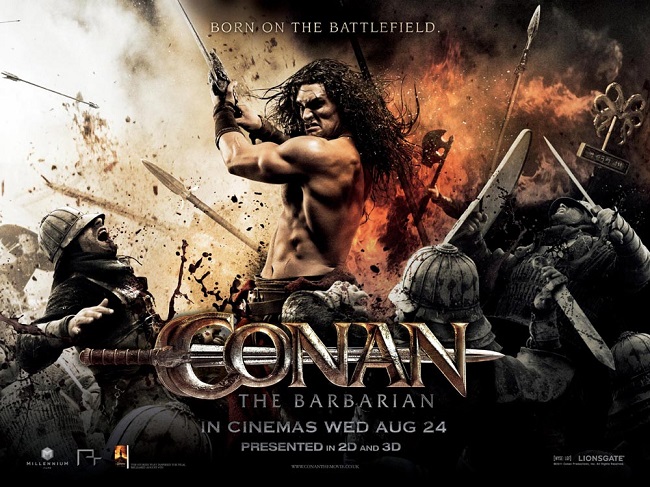
How can I possibly write about cult, obscure and trash movie soundtracks without at least one piece by the legendary Ennio Morricone. The maestro seems to have a knack of writing quality material for some awful films. Hundra (1984) is an Italian-Spanish fantasy film co-written and directed by Matt Cimber and starring Laurene Landon. It’s a kind of female Conaneque, sword and sorcery movie with a bogus feminist agenda. Beneath a wafer-thin veneer of gender politics is a generic exploitation movie. The actions scenes are weak, the story is formulaic and the performances are negligible due to the ADR inherent in such international co-productions. Yet the Morricone score stands out. Hundra’s main theme is simple and effective and there’s a chase scene with a whimsical accompaniment.
Lucio Fulci’s first instalment of his “Gates of Hell” trilogy is an atmospheric, off kilter horror outing. City of the Living Dead (1980) features his hallmark excessive gore but unlike his previous movie Zombie 2, the linear narrative is replace with a more dream like story line. Many scenes are visually striking but the plot doesn’t really make logical sense. However there are sufficient maggots raining from the ceiling and actors vomiting up their intestines to keep the audience focused elsewhere. The soundtrack by Italian composer Fabio Frizzi is creepy and uniquely European. The scene in the crypt at the climax of the movie has a great cue that plays as zombies stagger around burning.
If you are not familiar with Michael Mann’s The Keep (1983), then it’s difficult to know where to start. The film is based upon a gothic horror novel by F. Paul Wilson about a group on German soldiers based in a Romanian fortress during World War II, who are picked off one by one by a vampire like creature. Mann’s second feature film took this tale and adapted it into a curious science fiction horror movie. The production was “difficult”, ran over budget and studio executives panicked at the kind of experimental film making that ensued. The movie was taken away from the director, re-edited and released in a very truncated form. It failed at the box office and Mann has subsequently disowned it. It boasts a sophisticated soundtrack by German electronic music band Tangerine Dream. Like the film itself, the score just has to be experienced and digested to be fully appreciated. Similarly, the score has had a troubled life and there has never been an official release that contains all music used. But what remains is intriguing even when listened to outside of the context of the film itself.
The Boondock Saints Unrated Director's Cut (1999)
Writer and director Troy Duffy obviously set out to make The Boondock Saints a "cult" movie and to find a niche market audience that would champion it. Every thematic and cinematic attribute you associate with contemporary, "hip", independent film making is duly trotted out and used in an arbitrary fashion. The Boondock Saints is violent (in that very stylised Tarantino sense of the word), slick, contrived and deliberately controversial. It also perpetuates every possible cliché about the Irish as a race and the Roman Catholic church that you can think of. Yet despite these facts, there is still the germ of a good film at its core. Vigilanteism has always been an intriguing and emotive subject that can make for challenging cinema. Populist content such as this can also be the key to box office success.
Writer and director Troy Duffy obviously set out to make The Boondock Saints a "cult" movie and to find a niche market audience that would champion it. Every thematic and cinematic attribute you associate with contemporary, "hip", independent film making is duly trotted out and used in an arbitrary fashion. The Boondock Saints is violent (in that very stylised Tarantino sense of the word), slick, contrived and deliberately controversial. It also perpetuates every possible cliché about the Irish as a race and the Roman Catholic church that you can think of. Yet despite these facts, there is still the germ of a good film at its core. Vigilanteism has always been an intriguing and emotive subject that can make for challenging cinema. Populist content such as this can also be the key to box office success.
Two Irish Boston brothers, Connor and Murphy MacManus (Sean Patrick Flanery and Norman Reedus) fall foul of the Russian Mafia. After a questionable act of self-defence is "overlooked" by the local Police, the brothers conclude that they’re doing God's work and decide to clean up the town. Aided by a minor foot soldier of the local Mafia (David Della Rocco), who sees their crusade as a way to settle personal scores, the body count starts to increase. Enter FBI profiler Paul Smecker (Willem Dafoe), who after a time starts questioning his profession and sympathising with the murderous trio. The various conflicts of interest and upsetting of the criminal status quo, eventually leads to a standoff that seems to have an inevitable conclusion.
The Boondock Saints lurches from scene to scene with a lumbering sense of momentum, leaving occasional interesting ideas only partially explored. The opening half of the film is the most satisfactory as the story provides sufficient motive for the two brothers to pursue their killing spree. The proceeding become somewhat derailed once Rocco joins the team, as this contrived plot devices finally put pay to any originality. The introduction of an openly gay FBI agent embodies invokes possible stereotype and really does beggars belief. Profanities fly at unprecedented levels and the comic relief, such as the accidental shooting of a household pet, is unsubtle and crass. The gun battles are lovingly shot in slow motion and edited to a quasi-Irish folk, post-modern soundtrack. Mr. Duffy really wanted this film to be remembered by those enamoured with "cult" cinema and does everything he possibly can to achieve this.
Much has been made of the films violent content. The Director’s Cut of The Boondock Saints replaces all the death scenes from the theatrical version with alternative takes. One bullet hit becomes three and there is noticeably more blood splatter and injury detail. Even so, this is not anything ground breaking. We have all been here before and seen far more graphic material framed against far better narratives. There is also an attempt to imbue the action scenes with an artistic sense of style, of the "Peckinpah" idiom. There’s copious use of slow motion and cross cutting of subjects matters. However, as the overall film lacks the intellectual and emotional content The Wild Bunch or Bring Me the Head of Alfredo Garcia, then most of this visual posturing fall upon stony ground.
But despite all these faults, this chaotic mess still manages to entertain at some level. The ending is left conspicuously open and the credits roll over bogus news reports, conducting a vox pop relating to "the saints" activities. Regardless of the respective merits of this film, it garnered a big enough following via word of mouth and the internet for the director to make a sequel a decade later. Therefore, only watch The Boondock Saints if you are in a particularly forgiving mood and tolerant of fan boyish enthusiasm masquerading as genuine film making skill. Scholars of cinema may be curious just to see all the possible school boy mistakes that can be made during the course of one single action film.







Cult Movie Soundtracks
There is a common consensus that a cult movie doesn’t necessarily have to be a good one. Badly written scripts, low budgets and curious casting are just some of the things that can contribute to making a film a cult classic. Many movies of this idiom have showcased talent that subsequently went on to better things. Sometimes films that are hailed as complete turkeys or financial disasters upon release are retrospectively deemed of merit. Often it is films soundtrack that can be its one saving grace. Take for example Ennio Morricone’s prodigious body of work. He is considered by many to be one of the finest (if not the finest) film composer alive. Yet some of his best work has been for incredibly poor, flawed or indifferent films. Consider Hundra, Treasure of the Four Crowns or Orca for example.
There is a common consensus that a cult movie doesn’t necessarily have to be a good one. Badly written scripts, low budgets and curious casting are just some of the things that can contribute to making a film a cult classic. Many movies of this idiom have showcased talent that subsequently went on to better things. Sometimes films that are hailed as complete turkeys or financial disasters upon release are retrospectively deemed of merit. Often it is films soundtrack that can be its one saving grace. Take for example Ennio Morricone’s prodigious body of work. He is considered by many to be one of the finest (if not the finest) film composer alive. Yet some of his best work has been for incredibly poor, flawed or indifferent films. Consider Hundra, Treasure of the Four Crowns or Orca for example.
With this idea in mind I've collated five films that are for various reasons are labelled “cult” and have suffered the “slings and arrows of outrageous fortune” over the years. All have scores of interest and note, though for different reasons. I have chosen a track from each soundtrack which I think highlights the musical excellence and integrity of the composers involved. The genres are varied as are the musical styles and nuances of each piece. All clearly demonstrate how a well-conceived score can embellish and enhance a movie, effectively becoming a character in its own right.
Much has been written about Sir Lew Grade’s 1980 adaptation of the popular Clive Cussler’s novel, Raise the Titanic and precious little is complimentary. Yet despite the films faults which mainly came from multiple script re-writes, the soundtrack by the late John Barry is an outstanding piece of work. It captures the mood of the film perfectly, especially during the underwater sequences. Often it is played against extensive miniature work with little human interaction, yet it vividly enhances these sequences and conveys sense of urgency and risk associated with undersea exploration. I have chosen the cue when the submersible Deep Quest finally locates the wreck of the Titanic. The music changes from the sombre themes of the search to one of elation. This is vintage John Barry at his best.
The Beastmaster is the embodiment of a cult movie. A low budget, independent production from the early eighties designed to cash-in on the sword and sorcery boom of the time, it features a quality score by Lee Holdridge. Holdridge is primarily known for his work on television on such shows as Moonlighting and Beauty and the Beast. His forays into the world of cinema are less frequent but often of note. The Beastmaster is the story of Dar, who by a quirk of his birth has gained the power to communicate with beasts. The fact that his Black Panther sidekick is in fact a Tiger that’s been dyed is neither here nor there. The main theme for the movie is rousing and of a standard seldom seen in movies of this genre.
I make no bones about the fact that I utterly love this car crash of a movie. Lifeforce is a text book example of a movie that endured a tumultuous production and a last minute re-edit. There are vast differences between the US release of the film and the international version. The Shorter American print features a re-scored soundtrack by Michael Kamen, a very popular composer at the time. The lengthier, more coherent and marginally better European cut included the full original soundtrack by none other than the great Henry Mancini. It's not a name that you immediately associate with the Sci-Fi genre. However Mancini manages to bring gravitas to the proceedings with several finely polished cues that nearly make you forget the preposterous nature of the film. The main theme is a sweeping orchestral piece that really should belong to a better film.
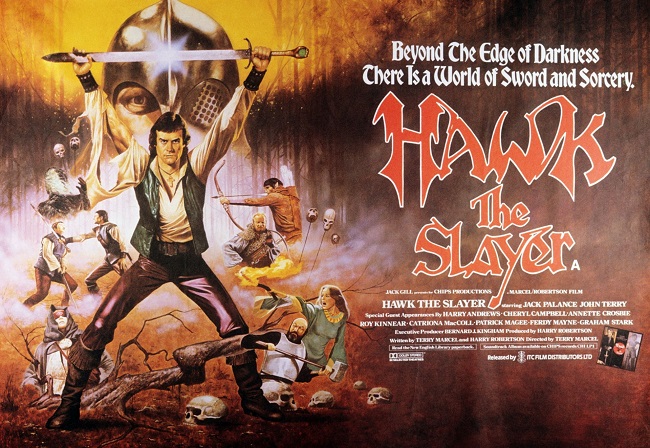
Any film that features a repeating crossbow, death by silly string and Bernard Bresslaw cannot be all bad. Hawk the Slayer is a wonderful piece of low budget, sword and sorcery hokum. It is also very British. Producer Harry Robertson also wrote the film score and it is the embodiment of early eighties UK synth-pop. Drawing upon such diverse influences as Jeff Wayne’s musical version of War of the Worlds and the work of Ennio Morricone (specifically Westerns) it’s kitsch yet an engaging score. It utterly suits the idiom of the film and is immense fun although possibly for all the wrong reasons. The cue below is re-iterated through the early stages of the film as Hawk gathers his band of warriors.
Finally Battle Beyond the Stars was one of James Horner’s earliest scores. Considering the low budget of the film, it was extremely ambitious for the producers to pursue a full orchestral soundtrack arrangement. Many others would have opted for an electronic score. Yet Horner’s iconic main theme is incredibly accomplished and imbues the film with a quality and ambience beyond its humbled origins. It was this score that caught the notice of Paramount studios and subsequently led to James Horner composing the soundtrack for Star Trek II: The wrath of Khan. The title theme of Battle Beyond the Stars contains all the hallmarks of Horner’s style. Its use of brass and rhythmic cadence are instantly captivating and convey the spirit of the narrative.