
Waiting for the New Middle-earth MMO
In late 2018 it was announced that Amazon Game Studios and Leyou were collaborating on massively multiplayer online game for PC and consoles set in Middle-earth. Ongoing development is being handled by Athlon Games, a global developer and publisher of free-to-play console and PC games. The studio is a subsidiary of Leyou Technologies Holdings Limited. But beyond the fairly vague press releases that can be found on the Athlon Games website (the last was posted in July 2019), little detail has emerged about the project. There has been unsubstantiated rumours that the project may well tie-in with the forthcoming Amazon Prime TV show that is set in the Second Age of Middle Earth. However, there is little information at present in the public domain to fully substantiate this or any of the other ongoing speculation. Hence, the entire situation raises some interesting questions and I’m sure like me, you have probably pondered some of them. Here are just a few that have crossed my mind.
In late 2018 it was announced that Amazon Game Studios and Leyou were collaborating on massively multiplayer online game for PC and consoles set in Middle-earth. Ongoing development is being handled by Athlon Games, a global developer and publisher of free-to-play console and PC games. The studio is a subsidiary of Leyou Technologies Holdings Limited. But beyond the fairly vague press releases that can be found on the Athlon Games website (the last was posted in July 2019), little detail has emerged about the project. There has been unsubstantiated rumours that the project may well tie-in with the forthcoming Amazon Prime TV show that is set in the Second Age of Middle Earth. However, there is little information at present in the public domain to fully substantiate this or any of the other ongoing speculation. Hence, the entire situation raises some interesting questions and I’m sure like me, you have probably pondered some of them. Here are just a few that have crossed my mind.
Will this title be directly competing with Standing Stone Games MMORPG The Lord of the Rings Online?
Exactly what sort of MMO will this new LOTR based game be, as the very term MMO is extremely elastic these days.
Will the appropriate licensing body allow two games from the same genre to exist simultaneously?
Exactly what business model will this new MMO have?
What iteration of the franchise will this game be based upon? Will it draw directly from the Peter Jackson movies (like games such as Middle-earth: Shadow of Mordor and Middle-earth: Shadow of War) or will it create a unique vision of Middle Earth as with SSG’s LOTRO?
Due to the lack of any definitive information, all we can presently do is speculate about the answers to these questions. Firstly, as to “do we need another The Lord of the Rings themed MMO”, I certainly think the market can sustain one. Competition can be a healthy thing and it is nice as a consumer to have choice. Products can co-exist harmoniously if they provide different experiences. I am always interested in seeing different people’s visions of Professor Tolkien's work, such as artists like Alan Lee, John Howe and Ted Nasmith, so for me a new game would be welcome purely from an creative and aesthetic perspective. There is also a wealth of lore that is available to be developed into new storylines. This is something that Turbine and Standing Stone Games have managed to do successfully over the past thirteen years. Any new game can easily explore an aspect of Tolkien’s work that hasn’t been touched by any previous product. There is no need to simply tread old ground.
Now if this new The Lord of the Rings themed MMO is marketed in direct competition to LOTRO, then I would expect it to be a very different beast, based around the mechanics and systems that are currently popular within the genre. I do not see any benefit in simply creating an MMO that replicates what exactly LOTRO does. I would not be surprised if this new MMO was closer to The Elder Scrolls Online in its systems design. It is also worth considering licensing arrangements. When Star Wars: The Old Republic was released in late 2011, a decision was made to close the older MMO Star Wars Galaxies. Exactly why this happened has never been officially discussed, so we do not know if this was solely about concerns over competition. However, the legal rights for Tolkien’s work are administered by a completely different body, so it doesn’t mean that a similar fate necessarily awaits LOTRO. But it is prudent to at least reflect upon what happened to SWG.
Personally, I would like to see a less linear game with a far more open world environment, dynamic content that is proximity based and the chance to develop charterers that aren't solely based around combat. To be able to lose oneself in a virtual Middle Earth, where you are free to explore, craft, farm, trade or simply aimlessly meander, would be a massive step forward for fans of the IP. But I am fully aware that what delights me may well deter other gamers and that ultimately any game is going to have to find a balance between the new and established systems that are economically viable. The development costs required to create a truly open world version of Middle-earth would be substantial and more importantly, the risk of such an experimental project would potentially be the biggest obstacle. Conversely, just using Tolkien’s world for yet another PVP or Battle Royale game would in my view be a waste of the franchise.
I'm sure that many interested parties will be keeping an eye on Athlon Games over the next year to see how this new MMO pans out. Let us hope that further information is forthcoming regarding its development and its specific nature. However, a quality MMO is not made overnight and so I’m not optimistic that I’ll be playing this new game any time soon. If it is tied to the Amazon Prime TV show, then the games launch may also depend on whether that show gains any traction. Furthermore, the TV show may well be intended to run over numerous seasons and try and emulate the sustained success of Game of Thrones. If that's the case then this new MMO may not appear until the TV show has hit its peak popularity. And if the show is not well received the game could well be cancelled before release. Therefore, it may well be best for Tolkien fans to simply just keep an eye on this project and continue to focus on those games such as LOTRO that do currently exist and provide a specific service.





LOTRO: The Maps of Middle-earth
I logged into the third preview of Update 23 on Bullroarer test server this evening and perused the various changes that Standing Stone Games have made. For a lot of the “serious” LOTRO players, the focus of this latest build are the statistical changes to all the various classes. As I am not so au fait with this aspect of the game, I shall leave the matter until it is finalised then discuss it with my kinship who are more learned in these matters. My primary motivation for using the preview server is to get an advance look at any new region and to explore the environment. Standing Stone Games continue to do a sound job of realising the Third Age of Middle-earth and I enjoy the attention to detail they provide along with their adherence to the lore. One of the aspects of LOTRO that I’ve always enjoyed are the regional maps. In this latest preview build, all maps for the new region of Ered Mithrin are now available and the temporary placeholders for Erebor and The Steel Keep have been removed.
I logged into the third preview of Update 23 on Bullroarer test server this evening and perused the various changes that Standing Stone Games have made. For a lot of the “serious” LOTRO players, the focus of this latest build are the statistical changes to all the various classes. As I am not so au fait with this aspect of the game, I shall leave the matter until it is finalised then discuss it with my kinship who are more learned in these matters. My primary motivation for using the preview server is to get an advance look at any new region and to explore the environment. Standing Stone Games continue to do a sound job of realising the Third Age of Middle-earth and I enjoy the attention to detail they provide along with their adherence to the lore. One of the aspects of LOTRO that I’ve always enjoyed are the regional maps. In this latest preview build, all maps for the new region of Ered Mithrin are now available and the temporary placeholders for Erebor and The Steel Keep have been removed.
One of the things that attracted me to The Lord of the Rings when I first read it in the early eighties was the fact that the books came with maps. The hardback editions that I read via my local library had sumptuous fold out maps that clearly detailed the various regions. They help convey the sense of history of Middle-earth and depth of culture and lore that existed. The maps also gave a sense of scale to the Fellowship’s journey as well as context. They were integral to maintaining the illusion that Middle-earth was a living and ancient world. Hence the maps that feature in LOTRO serve a similar purpose beyond their immediate practical functionality. They don’t just provide a means of navigating from point A to point B but further embellish the games sense of immersion by showing a world populated by people in a broad variety of geographical locations. They also often reflect interesting details of lore, or minor comments from the source text.
Over the years, due to changes in the game and the streamlining of earlier zones, some maps have been replaced resulting in two distinct art styles. The contrast can be quite jarring at times. For example, the Bree-land map is one of the oldest in the game and is somewhat cluttered. However, if you then cross into the Barrow-downs the map was redesigned and sports a clearer style and breaks the zone up into two. As new content is added to the game, the newer map style naturally prevails. From an aesthetic point of view, I prefer the this to old. The maps are more functional and convey their respective information efficiently. Overall, I think they are an improvement, although I do still think they have some flaws. As to whether SSG intends to standardise all maps and thus replace those that have the older design remains to be scene.
Although the more contemporary LOTRO maps exude an appropriate art style and are easier to read, some still have a flaw with regard to conveying navigational data. Some of the maps do not always clearly show what route a player should take to enter a specific region. The other day, I decided on a whim to do some of the quests in Entwood. From memory I vaguely knew I could access the region from either Broadacres or Stonedean in West Rohan. Sadly, the maps lacked sufficient detail to give me a clear course to follow. Thus, I had to spend some time riding around the various hills that separate zones, until I found the right route. I believe access to Wildermore is similarly esoteric. Another problem are instance maps. They only become fully visible as you explore. If you leave and subsequently return to an instance, the process has to be repeated. Surely the logical thing would be to make it permanently available once the player had initially unlocked it.
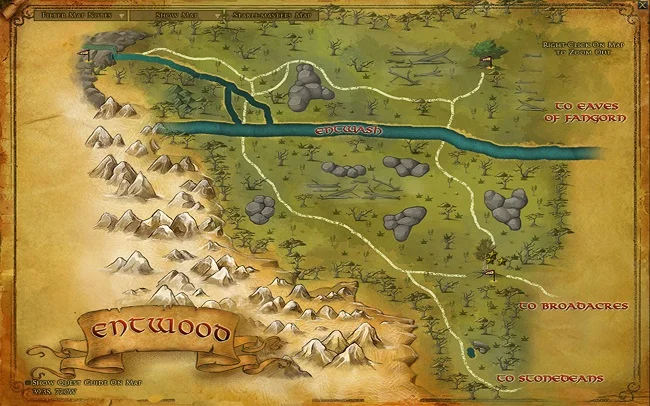
The maps in LOTRO are also poor at conveying data for regions that are set on multiple levels. Top down representations do not adequately express three-dimensional data, which can lead to confusion and frustration, especially in instances such as the Grand Stair in Moria. In the past when running this instance, I would have to rely on third party diagrams, outside of the game itself. Another map within LOTRO that is notoriously unintuitive when it comes to travelling around is the Misty Mountains. It displays what appear to be clear linear routes between key locations but fails to convey the topographical features that will impede you. Again, it is steep slopes or crevasses that bar your way. Now there may well be players who will take the view that these maps are not supposed to make things that easy for you and that their deliberate vagaries are designed to force the player to explore. That may well be true, but I find premeditated inconvenience to be poor game design choice. A map that doesn’t impart the necessary data you need to successfully navigate the area it represents, has fundamentally failed in its purpose as far as I’m concerned.
The key to success in getting the most out of the various regional maps in LOTRO is to familiarise yourself with both the pictorial representation of each zone and cross reference that with practical first-hand experience. Basically, learn your way around the physical foibles of an area and use that knowledge in conjunction with the map. The only downside of this strategy is that LOTRO is a big game so that’s a lot of information to commit to memory. Overall, I’m mainly familiar with the zone I’m currently questing through or those that I have a special affinity to. I haven’t really spent any time in South Mirkwood or parts of Rohan since those regions were released. Therefore, I often cannot immediately recall their subtleties or quirks. May be this is something else that can be added to the list of “bug” fixes and “quality of life improvements that SSG need to address. Clearer, more intuitive maps are only going to become more essential as the game continues to expand.
Desolation of Mordor and the Blade of Galadriel
Today the latest story DLC unlocked for Middle-earth: Shadow of War. The Desolation of Mordor allows you to play as Captain Baranor, who we now find adventuring in the deserts wastes of Lithlad in Eastern Mordor. Unlike Talion and Eltariel, Baranor does not have any Wraith Powers or the innate gifts and talents of the first born. He is merely a mortal man which subsequently adds an interesting dynamic to the game play. However, Baranor quickly meets up with Dwarven Hunter Torvin, who provides him with a several usefully Numenorean artefacts which fill his “skills gap”. These include a Gauntlet that expands to become a buckler. It also houses a crossbow that fires a variety bolts as well as a grappling hook, thus aiding Baranor with climbing. The other artefact is a kite that is stowed in a back pack. This acts as a parachute and can also be used via the hot thermal vents that litter the landscape, to ascend to vertical vantage points.
Today the latest story DLC unlocked for Middle-earth: Shadow of War. The Desolation of Mordor allows you to play as Captain Baranor, who we now find adventuring in the deserts wastes of Lithlad in Eastern Mordor. Unlike Talion and Eltariel, Baranor does not have any Wraith Powers or the innate gifts and talents of the first born. He is merely a mortal man which subsequently adds an interesting dynamic to the game play. However, Baranor quickly meets up with Dwarven Hunter Torvin, who provides him with a several usefully Numenorean artefacts which fill his “skills gap”. These include a Gauntlet that expands to become a buckler. It also houses a crossbow that fires a variety bolts as well as a grappling hook, thus aiding Baranor with climbing. The other artefact is a kite that is stowed in a back pack. This acts as a parachute and can also be used via the hot thermal vents that litter the landscape, to ascend to vertical vantage points.
The story is relatively straightforward, with Baranor hiring the Easterling mercenary army, The Vanishing Sons and seeking to conquer the regional fortress of Shindram. Due to a quirk of fate (and narrative requirements) The Vanishing Sons are led by Baranor’s older brother Serka. It is the dialogue between the two which makes this story better than average. Both characters are well voice acted respectively by Ike Amadi and Usman Ally. There is a good chemistry between both actors and the narrative strikes the right tone with equal helpings of high adventure and ironic humorous dialogue. It a pleasant surprise to see the Dwarf Torvin return, although his role this time is more of a functional NPC, rather than a major character. The desert environment is a welcome change from the existing Mordor zones, and the Numenorean Fortress that is occupied by Orcs is strikingly different in its architectural style.
All things considered I found Desolation of Mordor to be a superior story expansion than the previous DLC, the Blade of Galadriel. The story of Eltariel is adequate but hardly offers any major difference from playing as Talion. Instead of dominating Orcs, Eltariel destroys them using the Light of Galadriel, although several Uruks do ally themselves with her as they have common goals. In fact, the character of Galadriel come across as martinet in this story and I felt somewhat sorry for Eltariel as she struggles to please such a hard taskmaster. However, Eltariel’s fighting style with twin blades does offer some interesting variations in technique compared to Talion and her quickshot archery ability often proves invaluable. It is the story that is the weakest aspect of this DLC and it is somewhat incredulous even by Middle-earth: Shadow of War standards. There seems to be a never-ending supply of unknown, non-canonical Nazgûl waiting in the wings to act as convenient plot devices. The crowbarring of an Eastern aesthetic into the proceedings is interesting but I’m sure hardcore purists will be having kittens.
If you set aside the biggest weakness of Middle-earth: Shadow of War, which is its loot box and market which somewhat undermines the Nemesis system, you still have an enjoyable RPG which blends a variety of action and stealth gaming mechanics. Developers Monolith Production recently announced that the market would be closing and ultimately removed from the game. As of today, players can no longer buy gold and a later patch will restructure the acquisition of Orcs. No doubt all of this will be done in time for the release of the Game of the Year Edition. However, I do not regret my decision to buy the Gold Edition of Middle-earth: Shadow of War upon its release last October. Irrespective of the games business model flaws, I do feel that I’ve had good value from the entire game. I prefer the Desolation of Mordor to the other DLC and felt that it was wise to release this one last of all, thus ending the game on a high point. It will be interesting to see if this franchise will continue or whether Warner Bros. will create any similar games based on the works of JRR Tolkien.



Classic Game Themes: Shadow of War
The soundtrack for Middle-earth: Shadow of Mordor by Gary Schyman and Nathan Grigg was a dark and brooding affair, reflecting the tragedy of its central characters. It was a score based upon haunting strings, low vocals and ominous tones. However, both composers have crafted a somewhat different soundscape for the sequel Middle-earth: Shadow of War. It should be noted that if you are an ardent fan of Howard Shores scores for Peter Jackson’s movies, that Gary Schyman and Nathan Grigg’s approach to Middle-earth is quite different, although both are orchestral works. Shores grandiose themes often reflected the enormity and history of Middle-earth. Here the music is more personal, channelling the emotions of those who stories unfold against such momentous events.
The soundtrack for Middle-earth: Shadow of Mordor by Gary Schyman and Nathan Grigg was a dark and brooding affair, reflecting the tragedy of its central characters. It was a score based upon haunting strings, low vocals and ominous tones. However, both composers have crafted a somewhat different soundscape for the sequel Middle-earth: Shadow of War. It should be noted that if you are an ardent fan of Howard Shores scores for Peter Jackson’s movies, that Gary Schyman and Nathan Grigg’s approach to Middle-earth is quite different, although both are orchestral works. Shores grandiose themes often reflected the enormity and history of Middle-earth. Here the music is more personal, channelling the emotions of those who stories unfold against such momentous events.
The first theme we encounter is with the games main menu. It is in fact an instrumental version of the song Fires of War which later plays across the end credits. This time round the music takes a different approach with a more positive and uplifting undercurrent. The stygian darkness of Mordor has been swapped for a more stoical mood and opening theme features swelling staccato strings. The central melody does still feature the high overtone along with the violins that were present in the first game but it feels very different this time, with a more optimistic spin. Talion is no longer seeking revenge but to over throw Sauron himself and this driving passion is reflected in the soundtrack.
Once you start following the narrative of the central story and move beyond Minas Ithil, the soundtrack feels much closer to the tense and portentous ambience of the original title, with choral parts and low register piano interludes. There are not so many leitmotifs used this time round and the score is more of an evolving soundscape. This suits the game play far more appropriately. For the sake of continuity, many of the themes associated with Talion’s specific abilities are used again. This includes the magnificent Caragor Riding with its off-kilter beat, Cello and vocalisation of the Ring Lore. Overall Middle-earth: Shadow of War boasts a very accomplished soundtrack and a worthy successor to its predecessor.






Middle-earth: Shadow of War
I was sceptical about Middle-earth: Shadow of Mordor when it was first announced back in 2014. Let it suffice to say that despite the hype and the marketing controversy that ensued, the game was surprisingly good, especially the nemesis system. The "extrapolation" of the lore was also quite intriguing and although I tend to be a Tolkien purist at heart, I really liked the narrative and the overall aesthetic of the game. The look and feel of Middle-earth: Shadow of Mordor was very much based on Peter Jackson's movies. At the time of the games launch, I managed to purchase a discounted steam code via a CD key seller and also received the "Dark Ranger" cosmetic skin as a bonus. Overall, I spent about one hundred and forty hours playing Middle-earth: Shadow of Mordor which was good value for money.
I was sceptical about Middle-earth: Shadow of Mordor when it was first announced back in 2014. Let it suffice to say that despite the hype and the marketing controversy that ensued, the game was surprisingly good, especially the nemesis system. The "extrapolation" of the lore was also quite intriguing and although I tend to be a Tolkien purist at heart, I really liked the narrative and the overall aesthetic of the game. The look and feel of Middle-earth: Shadow of Mordor was very much based on Peter Jackson's movies. At the time of the games launch, I managed to purchase a discounted steam code via a CD key seller and also received the "Dark Ranger" cosmetic skin as a bonus. Overall, I spent about one hundred and forty hours playing Middle-earth: Shadow of Mordor which was good value for money.
Considering both the critical and commercial success of the game, it’s hardly surprising that a sequel has been developed. Last year, there were several hints that a follow up game was in production. The most notable of which was when an accomplished stunt and motion capture performer, Lauren Mary Kim accidently cited working on the sequel on her resume. However, the rumours have finally been validated as US retailer Target prematurely posted pre-orders for Middle-earth: Shadow of War, on all major gaming platforms. The listing has subsequently been removed but the game developers, Monolith Productions, have confirmed their involvement in the project. According to a further report on Kotaku, Middle-earth: Shadow of War will continue the story of Talion and Celebrimbor, as they work together to forge their own Ring of Power to battle Sauron.
I am pleased that this franchise will continue and am hoping that it will expand upon the systems and game mechanics that were showcased in the prequel. I also have a curious interest in the narrative as it is such a bold gambit do something so demonstrably non- canonical. It would appear that Middle-earth: Shadow of War will feature two Nemesis expansions, two story expansions, and a "Gold War Chest” over the course of its life cycle. The Nemesis expansions will include a new Orc tribe, enemies, missions, and more, while the story expansions will introduce a new campaign and playable character. Early adopters and pre-order junkies can expect to pay $100 up front for access to all content on 22nd August. I may well wait to the end of the year when a Game of the Year edition is inevitable.
Update:
A cinematic trailer has now been released. It does not feature any in-game footage but does set up the narrative for Middle-earth: Shadow of War. A further trailer coming in march will showcase actual footage from the RPG. Pre-orders are now available on all platforms.