Midsommar (2019)
There are numerous visual and narrative clues that telegraph both the plot and themes of Misdommar. A painting seen in the protagonist’s apartment offers a clear indication as to what is to come. Director Ari Aster deliberately and painstakingly creates a cinematic metaphor in which the emotional turmoil and distress of the lead character brought about by her disintegrating personal life, are mirrored in the real-world events that overtake her. However, this is far from a traditional horror movie with jump scares but more of a psychological thriller with a growing sense of disquiet and helplessness. The audience are presented with a fait accompli in so far as its clear that things are going to turn bad for all concerned and there is no deeper explanation for events other than what we are presented with. And therein lies the rub. Midsommar goes all in on “the journey” and it is down to the viewer as to whether that is an enthralling experience or not.
There are numerous visual and narrative clues that telegraph both the plot and themes of Misdommar. A painting seen in the protagonist’s apartment offers a clear indication as to what is to come. Director Ari Aster deliberately and painstakingly creates a cinematic metaphor in which the emotional turmoil and distress of the lead character brought about by her disintegrating personal life, are mirrored in the real-world events that overtake her. However, this is far from a traditional horror movie with jump scares but more of a psychological thriller with a growing sense of disquiet and helplessness. The audience are presented with a fait accompli in so far as its clear that things are going to turn bad for all concerned and there is no deeper explanation for events other than what we are presented with. And therein lies the rub. Midsommar goes all in on “the journey” and it is down to the viewer as to whether that is an enthralling experience or not.
College student Dani Ardor (Florence Pugh) four-year relationship with anthropology student Christian (Jack Reynor) is in serious decline due to the emotional trauma of her parents’ murder at the hands of her bi-polar sister. Dani is grudgingly invited by Christian to attend a nine-day festival celebrating midsummer in rural Sweden. Along with three mutual friends, Josh (William Jackson Harper), Mark (Will Poulter) and Pelle (Vilhelm Blomgren) whose family comes from the region, they travel to Hälsingland. The Hårga community greet them and it initially seems to be a very traditional event, complete with white linen garments, floral motifs and copious amounts of folk music played on woodwind instruments. But the imbibing of hallucinogenic mushroom tea results in a bad trip for Dani and then a ritual takes very dramatic turn for the worse. The group try to rationalise events and Josh advocates staying as the festival is integral to his thesis. Yet matters continue to take a more sinister course and as they do Dani’s mental state becomes increasingly unsettled.
The second act of Midsommar in which the Hårga slowly become exactly what the audience suspected, is a long slow burn. The film is 147 minutes and revels in its languid pace. The clean, crisp beauty of the region is vividly capture by director of photography, Pawel Pogorzelski. The production is filled with geometric patterns, pagan symbolism and sun-drenched scenery. Often murals, artwork and the cultural history of the Hårga clearly indicate that our cast are doomed. Depending how you approach the film and your perception of the characters, dictates how quickly you start questioning the logic of their staying. You will either accept the western cultural propensity for people to eschew the bizarre and cling to the normalities of society. Or you will start yelling at the screen soon after the CGI drug trip. The dread and tension that is usually inherent in the way a genre movie is crafted, is optional here and dependent here on whether you choose to supply it yourself.
Regardless how you feel about some element of Midsommar, Florence Pugh is compelling as a woman trying to master her emotions as her mind and events spiral out of control. But the question remains as to whether this is really a horror movie or drama about mental health. The screenplay, also written by Ari Aster, manages to explore several cultural themes. It considers how commercial tourism commodifies and feeds off other countries culture. The central story of Dani and Christian is ultimately a rather vindictive breakup drama and is honest in showing that most relationships do not end “on good terms”, despite the pop culture narrative to the contrary. Ultimately, the Hårga community and its festival are simply a Hitchcockian "MacGuffin" to hang a series of contemporary social talking points upon. As mentioned, this is not a study of the pagan world versus modern society nor is it a traditional story with all the associated cinematic trappings. Midsommar paints a protracted vignette for your consideration and then ends.
Once again I find myself returning to a subject I have referenced before; my own overfamiliarity with not only the horror genre but cinema per se. For me Midsommar is a modern variation on a classic theme, presented in a semi-arthouse fashion. If you have not experienced anything like it before then it’s style, attitude and candour may well leave a marked impression. It certainly doesn’t pull its punches and it is also happy to provide a suitably bleak conclusion. But if you have a wider familiarity with the folk horror genre then it lacks the impact that some critics and fans are lauding. Naturally, the shadow of Robin Hardy’s The Wicker Man looms large and one cannot watch Midsommar without referencing that movie at some point in the proceedings. For me the film is an interesting curiosity. I was impressed by aspects of the production but also critical of its length and the indulgences of the director. Like his previous movie Hereditary, the enthusiasm and excitement of vocal genre fans has generated an expectation that is not necessarily going to be met among casual viewers. Horror movies have always been successful at the box office but the press is hellbent on claiming that there’s a genre renaissance at present. If you like the meat and two veg approach of the recent Pet Sematary remake, don’t watch Midsommar expecting the same. It is a nuanced and acquired taste that will not be to everyone’s liking. I don’t believe it was to mine.









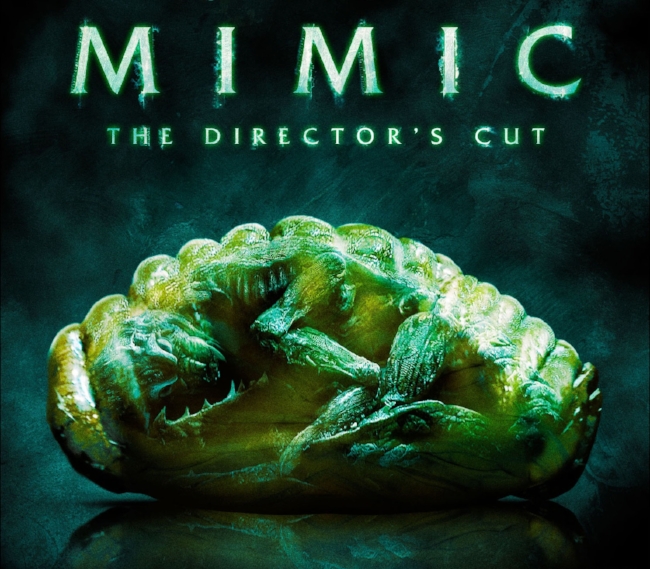
Hellboy (2019)
Hellboy begins with a pre-credits prologue, set in the Dark Ages and establishing the basic premise of the movie. Milla Jovovich plays the Blood Queen Vivian Nimue who unleashes a plague upon England (for some particular reason). She is defeated by King Arthur, dismembered and her body parts scattered to the four corners of the isle. It’s a graphic opening that clearly states the movies intent to be different to its predecessor. This reboot of the franchise aims to be gritty with liberal helpings of ironic banter and dry humour to offset the grim world the characters traverse. For those familiar with Mike Mignola’s work, this vision of Hellboy tries to embrace many aspects of established canon. The story broadly follows the comic books Darkness Calls, The Wild Hunt, The Storm and the Fury. There’s also an attempt to reflect the aesthetic of Mignola’s style. Yet all of this, along with the patent desire to be a R rated movie and to set itself apart from Guillermo del Toro’s versions, makes for a sprawling film that sadly over reaches itself.
Hellboy begins with a pre-credits prologue, set in the Dark Ages and establishing the basic premise of the movie. Milla Jovovich plays the Blood Queen Vivian Nimue who unleashes a plague upon England (for some particular reason). She is defeated by King Arthur, dismembered and her body parts scattered to the four corners of the isle. It’s a graphic opening that clearly states the movies intent to be different to its predecessor. This reboot of the franchise aims to be gritty with liberal helpings of ironic banter and dry humour to offset the grim world the characters traverse. For those familiar with Mike Mignola’s work, this vision of Hellboy tries to embrace many aspects of established canon. The story broadly follows the comic books Darkness Calls, The Wild Hunt, The Storm and the Fury. There’s also an attempt to reflect the aesthetic of Mignola’s style. Yet all of this, along with the patent desire to be a R rated movie and to set itself apart from Guillermo del Toro’s versions, makes for a sprawling film that sadly over reaches itself.
Although Hellboy has clear faults, the casting of David Harbour is not one of them. Contrary to what a lot of people expected; he does handle the role well. He clearly grasps the stoical, everyman quality of the character and the way these personality foibles contradict the arcane fantasy world in which he exists. But where Harbour excels, the rest of the cast tend to tread water. Ian McShane steps into John Hurt’s shoes as Trevor Bruttenholm, Hellboy’s adopted father, but the role is hardly taxing for him and the screenplay offers his little to do beyond the arbitrary and expositionary. Milla Jovovich similarly is a very generic villain as Blood Queen Nimue. Her character wants revenge for her summary execution and the disruption of her plans but beyond this, there is no depth to her motivations. Ed Skrein was originally cast as Ben Daimio, but then stood down as he was cognisant of the controversy surrounding changing of the character's ethnicity. He was replaced by Daniel Dae Kim but after all the fuss, the role is still somewhat bland and is nothing more than functional.
The screenplay by comic book creator, film producer, and screenwriter Andrew Cosby, encompasses multiple elements from the comic books. This does lend itself to some enjoyable set pieces but it also results in a story that rapidly moves between multiple locations and characters, resulting in many plot strands simply vanishing from the story. The desire to do so much means that the core relationships which are the foundation of this franchise and whichwere so robust in del Toro’s films, are underdeveloped. And then there are the film’s visual effects which favour the digital over the physical. As ever with modern productions, numerous studios have been contracted to provide work, including Mr. X, Rhythm & Hues, Rise FX and Worldwide FX. Luminaries such as Steve Begg feature in the credits. However the results are varied and somewhat impersonal. Violence without context or emotional content, is often just a spectacle devoid of any cinematic impact.
I have enjoyed director Neil Marshall’s previous work. Dog Soldiers and The Descent were above average genre outings that showed a greater intelligence than their rivals. His absence from cinema in recent years has been due to him working in television and such shows as Game of Thrones, Black Sails and Westworld. Hence a lot of genre fans were quite excited when they learned that he’d be helming the Hellboy reboot. Yet, it would appear that Marshall was not given final edit over his movie and the film has the air of a production that has been continuously “tweaked” throughout its development. The involvement of five production companies may well be the reason for this. It’s a real shame because during the course of its 120-minute running time, there are hints that Hellboy could have been much better. Fantasy as a genre and super hero franchises often explore issues of “difference” and use their tropes as metaphors to scrutinise discrimination, or the difficulty of straddling two cultures. Such ideas are referenced in Hellboy but sadly sidelined in favour of action scenes. I have no problem with the idea of making Hellboy darker and more palatable for adult audiences but not at the expense of the characters soul. But that is sadly what has happened.
Changeling (2008)
Los Angeles, 1928. A single mother Christine Collins (Angelina Jolie) returns from work to find her nine-year-old son gone. She calls the LAPD who initiate a search. Reverend Gustav Briegleb (John Malkovitch) champions Mrs Collins cause and publicly criticises the LAPD for its endemic corruption and incompetence. Five months later, a boy is found in Illinois who fits the description of the missing boy, Walter. Captain J. J. Jones (Jeffrey Donovan), the head of the LAPD's Juvenile Division, hoping to capitalise on a successful resolution to the case, organises a press conference when reuniting the Mrs Collins with her son. However, Christine quickly denies that the boy is Walter, stating that this child is three inches shorter than her own son. The authorities dismiss her claims and label her hysterical. Matters are further compounded when Mrs Collins joins Reverend Gustav in his public criticism of the police. The establishment subsequently closes ranks and attempts to intimidate and silence her.
Los Angeles, 1928. A single mother Christine Collins (Angelina Jolie) returns from work to find her nine-year-old son gone. She calls the LAPD who initiate a search. Reverend Gustav Briegleb (John Malkovitch) champions Mrs Collins cause and publicly criticises the LAPD for its endemic corruption and incompetence. Five months later, a boy is found in Illinois who fits the description of the missing boy, Walter. Captain J. J. Jones (Jeffrey Donovan), the head of the LAPD's Juvenile Division, hoping to capitalise on a successful resolution to the case, organises a press conference when reuniting the Mrs Collins with her son. However, Christine quickly denies that the boy is Walter, stating that this child is three inches shorter than her own son. The authorities dismiss her claims and label her hysterical. Matters are further compounded when Mrs Collins joins Reverend Gustav in his public criticism of the police. The establishment subsequently closes ranks and attempts to intimidate and silence her.
Clint Eastwood's Changeling is a finely crafted, no-nonsense, concise telling of an extraordinary true story. This is hardly surprising when you consider Mr. Eastwood's career and the cinematic greats he learnt his trade from. The influences of the likes of Don Siegal are often evident in his work. In the hands of a lesser director, it would have been so easy for the more sensational aspects of the plot to have turned Changeling into a melodrama. Yet Eastwood’s minimalistic style actually creates a sense of docu-drama and certainly allows for a greater focus upon honest and credible performances from all concerned. The production design by James J. Murakami and minimal use of digital effects does well in capturing the aesthetic of the period and there is a strong sense of atmosphere. Yet these embellish the film and do not get in the way of the story telling.
Angelina Jolie excels in her role as Christine Collins and her performance really should have garnered greater attention at the time. The cast of character actors including John Malkovitch, Michael Kelly and Colm Feore all acquit themselves well. The screenplay by J. Michael Straczynski is focused and credible. It accurately portrays a Mother’s desperation to find her child as well as her shock when the very authorities she trusts to help, turn upon her. It is also interesting to note that the tangential story of the Northcott Murder’s is kept in the background and is not a key focus of the film. This is very much the story of Christine Collins and how she fell victim to a corrupt system, as opposed to an exploration of a “sensational and lurid” child murder case. Eastwood does well in keeping the story within very clear parameters and not casting his net too wide.
Changeling takes an interesting stance with regard to capital punishment and contains a rather clinical depiction of a hanging. Whatever your own personal views on the death penalty, this scene is very powerful and is certainly food for thought. Clint Eastwood has once again proven that he is a director of note and that he has a strong grasp of what constitutes a good story. He has crafted a film that maintains intellectual integrity and doesn't concede to melodrama, despite the “based on real events” moniker that prefixes the film. This is lean, well written, well-acted and focused film making and it not only provides a solid evenings entertainment, but a succinct example of how you make a quality drama.
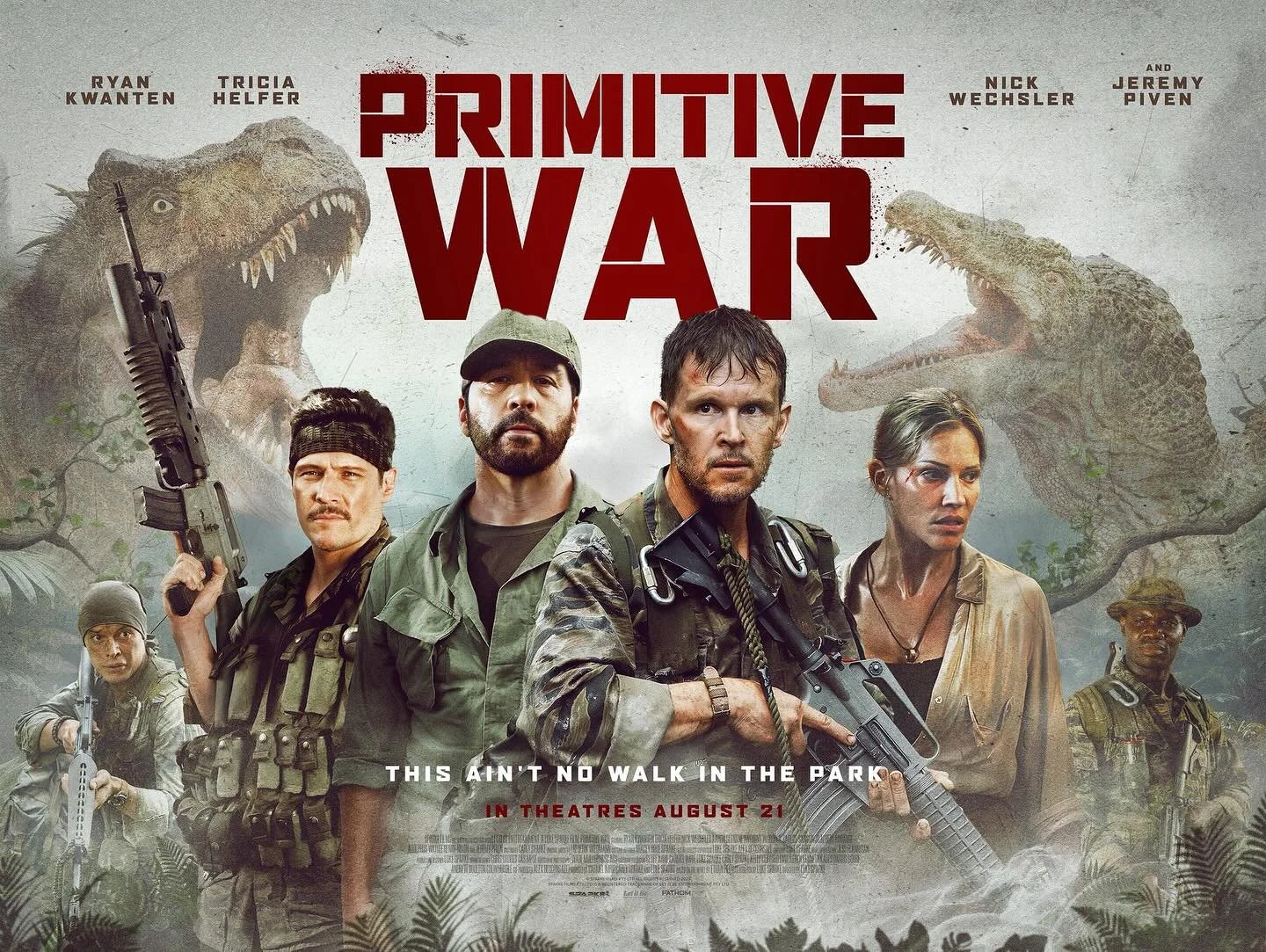
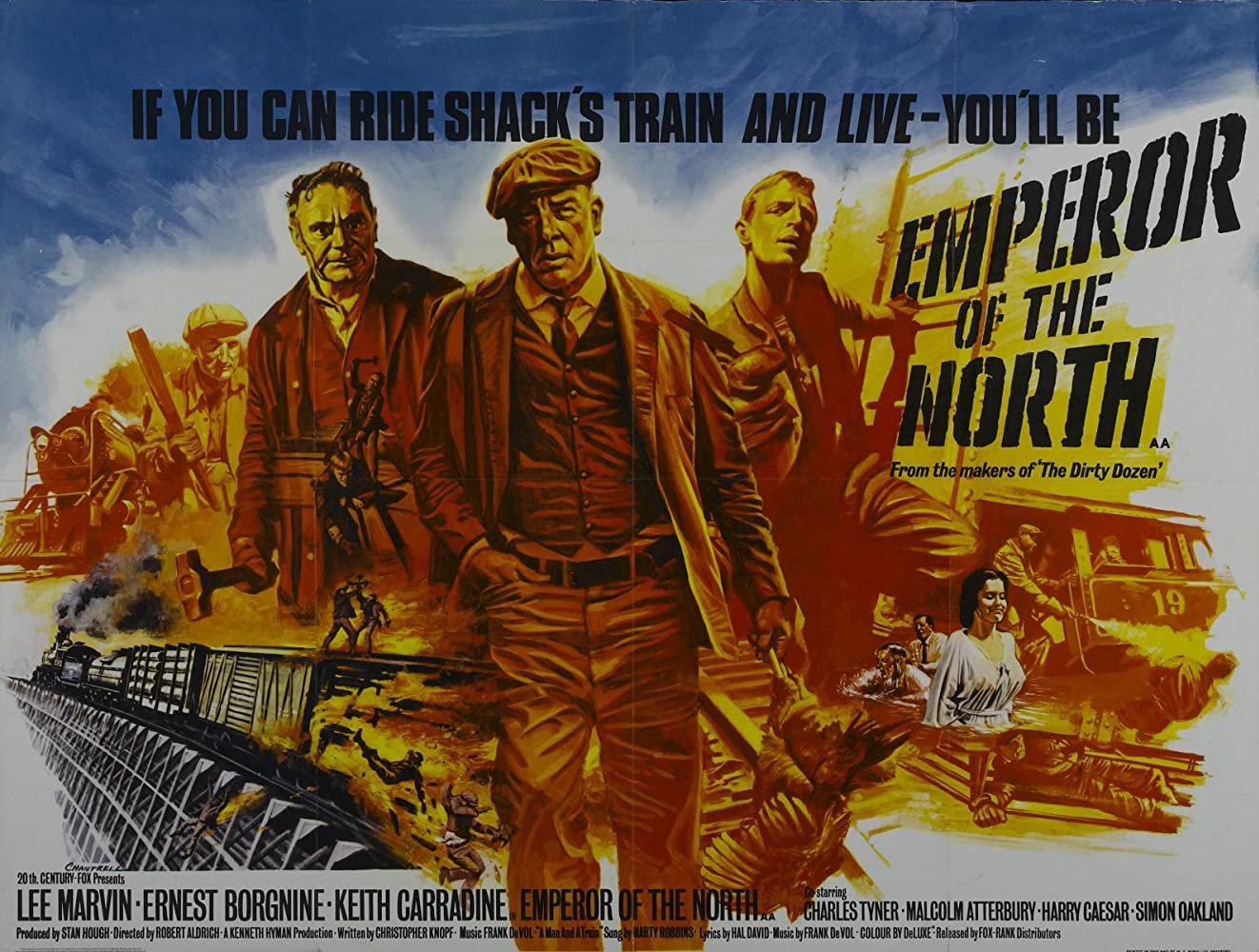
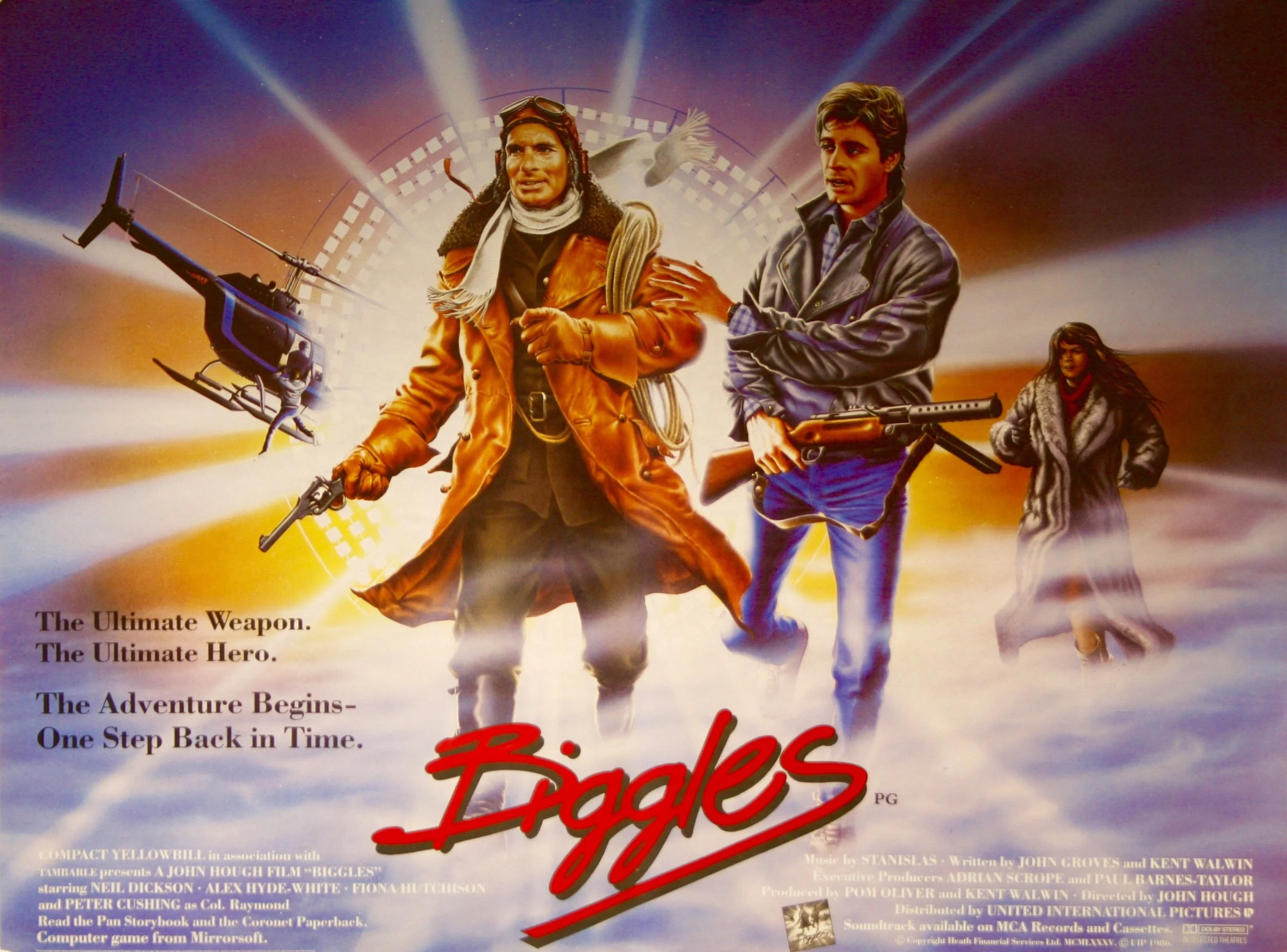




The Standoff at Sparrow Creek (2018)
Inside a dark, remote warehouse, seven members of an unnamed midwestern militia meet. They’ve all heard via radio or police scanners that an unnamed, armed shooter armed with a modified AR-15 has opened fire on a police funeral. The assailant also plant IEDs and the casualty rate is therefore very high. This means the authorities will be scouring the countryside, raiding all known militia groups and their affiliates in the region. The men’s concern quickly turns to panic when they discover that one of their AR-15 is missing from their weapons cache, along with body armour and explosives. Is one of their own the shooter? Ford (Chris Mulkey), the group’s no-nonsense leader, asks fellow member Gannon (James Badge Dale), a former police interrogator, to question all the men and determine who is responsible. However, matters prove more complicated as Gannon knows that one other member, Noah (Brian Geraghty), is an undercover cop. Can a solution be found before the police inevitably come calling?
Inside a dark, remote warehouse, seven members of an unnamed midwestern militia meet. They’ve all heard via radio or police scanners that an unnamed, armed shooter armed with a modified AR-15 has opened fire on a police funeral. The assailant also plant IEDs and the casualty rate is therefore very high. This means the authorities will be scouring the countryside, raiding all known militia groups and their affiliates in the region. The men’s concern quickly turns to panic when they discover that one of their AR-15 is missing from their weapons cache, along with body armour and explosives. Is one of their own the shooter? Ford (Chris Mulkey), the group’s no-nonsense leader, asks fellow member Gannon (James Badge Dale), a former police interrogator, to question all the men and determine who is responsible. However, matters prove more complicated as Gannon knows that one other member, Noah (Brian Geraghty), is an undercover cop. Can a solution be found before the police inevitably come calling?
The Standoff at Sparrow Creek is a rather unique variation on a what is essentially a Reservoir Dogs scenario, which is in itself is just a modern riff on an Agatha Christie plot. The movie is a claustrophobic, sombre and dialogue driven slow burn. Director Henry Dunham’s presents a series of mind games,bluffs and double bluffs, all of which have a basis in psychology and police interrogation techniques. Gannon explores the men’s pasts and uses different tactics with each one. Morris (Happy Anderson), has a chip on his shoulder about the police, which as Gannon discovers, may be justifiable. Meanwhile Keating (Robert Aramayo), a hyper-intelligent young man who chooses not to speak has an annotated copy of The Catcher in the Rye among his possession. Something that Gannon feels may indicate repressed feelings of superiority. And as these frantic cross examinations play out police band radio indicates that the local attack has inspired other militia groups around the country and that a potential uprising is underway. Should the group try to distance themselves from events or simply embrace what is happening. It is after all what they’ve been preparing for.
The underlying strength of The Standoff at Sparrow Creek is in its central performances from seven distinct character actors. James Badge Dale provides a strong intensity to Gannon yet manages to remain ambiguous in his motivations. Morris (Happy Anderson) is belligerent and bellicose yet has a deeper story to tell when pushed. Hubbel (Gene Jones) also has a tale to tell of an everyday life that slipped out of control over a logistical tragedy. Patrick Fischler is interesting as the technically literate Beckmann, who handles most of the group’s radio communications. This expositionary role provides information from the outside world and is used as a means to up the ante within the sealed warehouse. Writer and director Dunham films the environment effectively, creating atmosphere with backlit wide shots, and cavernous corridors with occasional patches of light. Not only is this an aesthetic choice, possibly driven by the film budget, it contributes to the oppressive themes.
Because the acting is solid and the scenario absorbing, viewers are draw attention away from some of the screenplay’s weaker elements. The director clearly want to make metaphorical point and maintain the movies allegorical quality. Hence the politics of the militia and its members are not fully explored, beyond establishing the narrative. These are disillusioned men, but their wider goals and motivations are left ambiguous. As the plot clearly focuses on the need to protect the group there is naturally a strong bond between them, irrespective of their superficial dislike of each other. Yet this is put aside to make room for the films philosophical point, which comes at the story’s climax. However, irrespective of this deliberate choice by director Henry Dunham, The Standoff at Sparrow Creek remains a memorable directing debut offering a strong, thoughtful and well-acted ninety minutes of drama.
In Time (2011)
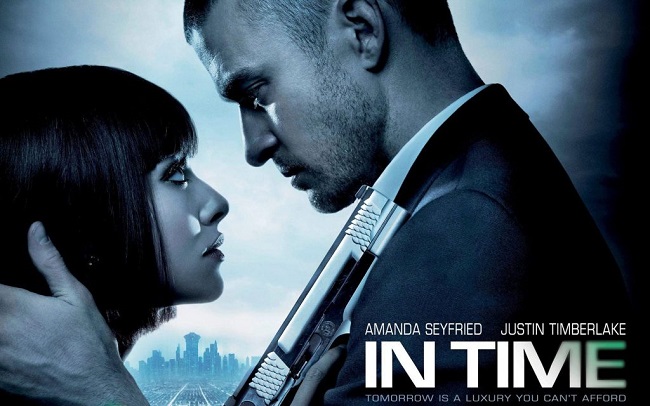
Time is quite literally money in the movie In Time, starring Amanda Seyfried and Justin Timberlake. Written and directed by Andrew Niccol, who previously wrote Gattaca and S1m0ne which both had similar dystopian themes, we are presented with a chilling scenario. What if you had to spend minutes or hours or perhaps days of your life in the same way you spend money? The movie offers a future where the population is genetically programmed to stop aging at twenty-five. If you're rich enough, you can purchase and trade this commodity, adding time to your life, making you effectively immortal. For the poor, the future is a far bleaker with most dying within a year of this hardcoded end date. Every transaction comes with a price in minutes and seconds.
Time is quite literally money in the movie In Time, starring Amanda Seyfried and Justin Timberlake. Written and directed by Andrew Niccol, who previously wrote Gattaca and S1m0ne which both had similar dystopian themes, we are presented with a chilling scenario. What if you had to spend minutes or hours or perhaps days of your life in the same way you spend money? The movie offers a future where the population is genetically programmed to stop aging at twenty-five. If you're rich enough, you can purchase and trade this commodity, adding time to your life, making you effectively immortal. For the poor, the future is a far bleaker with most dying within a year of this hardcoded end date. Every transaction comes with a price in minutes and seconds.
The beginning of In Time establishes a very bleak and divided world which reminded me of Alfonso Cuarón's Children of Men. Director Niccol competently establishes the Timekeepers, the police who enforce time management, as well as Minutemen, thugs who rob you of precious minutes. There are plenty of promising ideas referenced in the first act of the film. However, like so many high concept movies these days, In Time simply fails to develop these themes and elects to pursue a more traditional “chase and romance” approach to its narrative. It is this marked change of direction which derails the movie from its promising start. Viewers au fait with the genre classic Logan’s Run are will quickly predict the direction the film is taking and guess its respective outcome.
This change of gear is not sufficient to rob In Time of all its virtue. There are still some intersecting ideas to be had such as our hero redistributing time among the needy. It’s a minor nod towards the current social trend towards criticising capitalism, but it isn't explored sufficiently. Performances are also surprisingly better than expected. Mr Timberlake is not excessively wooden and has a reliable nemesis in Cillian Murphy. The action is adequately managed within the parameters of a PG-13 rated movie. In Time, like so many recent films, is a production pitched at a specific demographic by film makers. One they think is not that demanding. Thus we have a film that is somewhat superficial and light on content. It may warrant a casual viewing but does not require any in-depth analysis or further consideration.





The Mule (2018)
Clint Eastwood is 88 years old and has a successful career spanning over six decades. During that time he has proved to be one of America’s most bankable box office stars and established himself as an actor and director of note among his peers. If The Mule turns out to be his swansong, then it is certainly a fitting end to a prestigious career. Because in many respects The Mule is a distillation of many of the themes and concepts, we’ve seen in previous Eastwood movies such as Gran Torino and The Unforgiven. Perhaps the core story of an ageing man trying to reconcile himself to a modern world and make peace with it, is in some way Eastwood commenting on the movie industry himself. It is very much his film and his performance underpins the proceedings.
Clint Eastwood is 88 years old and has a successful career spanning over six decades. During that time he has proved to be one of America’s most bankable box office stars and established himself as an actor and director of note among his peers. If The Mule turns out to be his swansong, then it is certainly a fitting end to a prestigious career. Because in many respects The Mule is a distillation of many of the themes and concepts, we’ve seen in previous Eastwood movies such as Gran Torino and The Unforgiven. Perhaps the core story of an ageing man trying to reconcile himself to a modern world and make peace with it, is in some way Eastwood commenting on the movie industry himself. It is very much his film and his performance underpins the proceedings.
Earl Stone (Clint Eastwood) is a dedicated horticulturalist who has spent his life putting work before his family. While competing in a flower show he misses his daughter’s wedding which further strains family ties. However online sales soon take a toll on his cottage industry and Earl finds himself in danger of the bank foreclosing on his house. “The internet has ruined everything” he grumbles. Only his granddaughter Ginny (Taissa Farmiga) has any time for him. After a row with his ex-wife Mary (Dianne Weist) at a family function, Early is approached by one of the guests who suggests that he can get paid for “just driving”. His spotless record, along with his age and ethnicity, make him potentially very useful to the local drug cartel. Caught between a rock and hard place Earl agrees to do just one job and becomes a drug mule.
The Mule is a leisurely movie and despite being set in the violent world of international drugs trafficking, is not steeped in action or mayhem. It is a character driven film in which Eastwood’s performance dominates. Earl is a microcosm of the ongoing societal age divide. He is polite, traditional and struggles with contemporary etiquette. In one scene he helps a stranded African American family whose car has a puncture and clumsily refers to them as “negros”. It’s not something done out of malice and highlights how he’s just a product of his generation. Earl also builds a rapport with the minor foot soldiers of the cartel who he meats when collecting and dropping off his shipments. He asks after their families and discusses trivial everyday things, revealing that for these men are just doing “a job”, often in default of anything else.
Beyond Eastwood’s charismatic performance, some of the other plot elements of The Mule are somewhat perfunctory. The parallel story that sees DEA Agent Colin Bates (Bradley Cooper) tracking the cartel and slowly closing in on its mules is functional but nothing more. The brief scene that Cooper and Eastwood share in a diner where they unwittingly swap homespun philosophy, is a little contrived. Also the machinations of the drug cartel and its internal power struggle is also just a functional plot device. However, the narrative does pick up in the third act where Eastwood and Wiest share several scenes together and reflect upon their failed marriage. It flirts dangerously with excessive sentimentality but mercifully stays on the right side of the line, due to solid acting and an air of earnestness.
The Mule lends itself to comparison with Robert Redford’s recent movie, The Old Man & the Gun. The latter is the better of the two, having a more nuanced plot and allowing the cast to contribute more to the proceedings. But because of the viewing public’s esteem for Clint Eastwood, I’m sure they will overlook the short comings of The Mule. As for the moral lesson that Earl is a “late bloomer” who finally learns that he needs to devote as much time to his family as to his flowers, it is a lesson that we can all reflect upon in todays busy world. Overall, despite a slow pace and numerous narrative digressions along the way, The Mule is a very accessible movie with the usually dour and grouchy Eastwood showing a far more amiable side to his persona. If it were any other actor, this would be a distinctly average movie.
Safe House (2012)
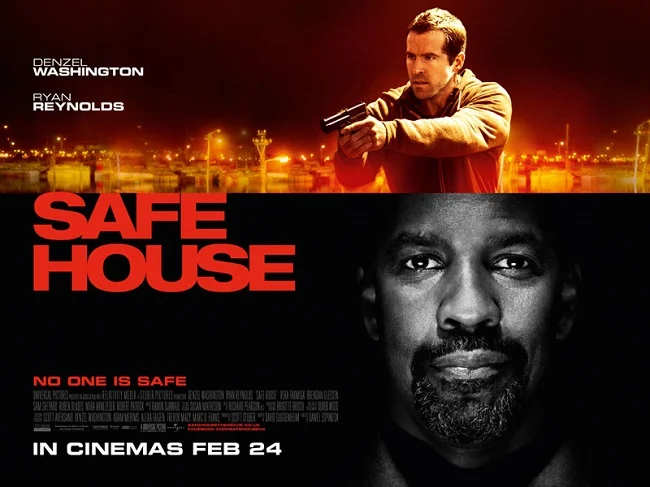
Before we start, I recollect that one well known UK critic described Safe House as sub-Tony Scott, upon its release. Now I’ve always been conflicted over Scott’s back catalogue, as I’ve always found his movies to be hampered by their own unique style. The subtleties of his characters and depth of his themes are all too often drowned out by his frenetic style and fast paced editing. Therefore a comment such as this really sets off alarm bells for me. Having recently watched The Equalizer 2, I wanted a further fix of Denzel Washington in a similar action vehicle. As Safe House was available on Netflix UK, I decided to kill a couple of hours and see what actually constitutes as “sub-Tony Scott”.
Before we start, I recollect that one well known UK critic described Safe House as sub-Tony Scott, upon its release. Now I’ve always been conflicted over Scott’s back catalogue, as I’ve always found his movies to be hampered by their own unique style. The subtleties of his characters and depth of his themes are all too often drowned out by his frenetic style and fast paced editing. Therefore a comment such as this really sets off alarm bells for me. Having recently watched The Equalizer 2, I wanted a further fix of Denzel Washington in a similar action vehicle. As Safe House was available on Netflix UK, I decided to kill a couple of hours and see what actually constitutes as “sub-Tony Scott”.
Frankly it is a mystery to me (and Toyah Wilcox) as to why actors of the calibre of Denzel Washington, Brendan Gleeson and Sam Shepard would deign to grace Daniel Espinosa's distinctly average action thriller, other than because it’s easy money. That is not meant as an insult. Actors have to make a living and regular work in average roles is more practical that infrequent parts in quality dramas. So I understand why generic action fodder such as this can be tempting to good actors. Sadly the presence of such a good cast does little to elevate this film to the standard of Training Day, Man on Fire or The Equalizer.
Rogue ex-CIA operative Tobin Frost (Washington), turns himself into the authorities and is subsequently held in a safe house in Cape Town. Rookie agent Matt Weston (Ryan Reynolds) endures a battle of wits with his enigmatic charge as well as swathes of bad guys queuing to kill Mr Frost. The Cape Town location is interesting initially. I believe the production balked at filming in the Favalas in Rio De Janeiro for security reasons. However, once the story moves to Europe and the US it really does become less engaging and far more formulaic. Denzel Washington is always watchable and brings a degree of gravitas to most pictures he appears in. Reynolds does what he can with a very formulaic role. The remainder of the cast advance the plot in true “Basil Exposition” style.
Safe House provides two hours of car chases, hand-to-hand fighting and sundry mayhem, all courtesy of contemporary film making’s favourite medium; shaky cam and lightning editing. The plot is neither staggeringly crass, nor above average. It simply follows the standard beats that you expect from this genre. For some viewers that is sufficient, providing adequate post-pub home viewing, via video-on-demand. Sadly the allure of the “A” list cast may raise expectations which are ultimately not met. Perhaps Swedish director Daniel Espinosa should have cut one of the more expensive named actors from the production and spent the money into revising the screenplay by David Guggenheim. A twist ending is only really works if you don't see it coming.






American Gangster: Unrated Extended Version (2007)
What is it with director Ridley Scott and his predilection for multiple edits of his films? Is he indecisive and a consummate tinkerer (like George Lucas) or a victim of studio politics? I suspect none of these are true. So how come there are always multiple cuts of his movies? Do his terms of employment always deny him final edit on a movie? I would think not. A film maker of his stature must surely get far more favourable terms when contract to make a film? Whatever the reason it leaves audience with a problem. How is one exactly to determine which is the best version of any of his films to see? For example, Kingdom of Heaven was greatly improved in its extended format. Yet his revised version of Alien is actually inferior to the original theatrical cut. And don’t even get me started on the plethora of versions of Blade Runner. His penchant for multiple edits therefore makes it difficult to debate his work.
What is it with director Ridley Scott and his predilection for multiple edits of his films? Is he indecisive and a consummate tinkerer (like George Lucas) or a victim of studio politics? I suspect none of these are true. So how come there are always multiple cuts of his movies? Do his terms of employment always deny him final edit on a movie? I would think not. A film maker of his stature must surely get far more favourable terms when contract to make a film? Whatever the reason it leaves audience with a problem. How is one exactly to determine which is the best version of any of his films to see? For example, Kingdom of Heaven was greatly improved in its extended format. Yet his revised version of Alien is actually inferior to the original theatrical cut. And don’t even get me started on the plethora of versions of Blade Runner. His penchant for multiple edits therefore makes it difficult to debate his work.
In 1968, Frank Lucas (Denzel Washington) a driver, bouncer and minor collector, witnesses the death of his crime boss and mentor Bumpy Johnson. The loss of leadership causes unrest in Harlem crime circles. Frank decides to import heroin directly from Bangkok, using US military airplanes from Vietnam to USA. The quality of his drugs along with the lower prices makes Frank Lucas the number one distributor of heroin in USA at the time. Meanwhile, in the Essex County, detective Richie Roberts (Russell Crowe) is studying for the Bar Examination. Due to his service record and tough stance on corruption, he is invited to join and head a Federal Investigation Team and set about bringing down all the biggest dealers in the US. Inevitably his path is destined to cross that of Frank Lucas.
I recently viewed the Unrated Extended version of American Gangster. I had not previously seen the theatrical release so can’t make any comments about major differences and which is the superior cut. What I can say is that it’s a well written drama with very strong central performances. Exactly what you would expect from such a director and cast. However, although the core subject is very interesting, American Gangster does not bring anything radical or new to the genre. It is absorbing, rather low key and driven by the two leads. It is not epic in its scope or especially illuminating with regard to the subject matter. Perhaps therein lies the problem. We have reached a point where we always expect the directors work to be visionary in scope and are therefore somewhat wrong footed when he sets his sights lower.
American Gangster doesn’t make the obvious mistake of glamorising the genre. Its portrayal of drug addiction is ugly and harsh, which is exactly as it should be. For a film that focuses on one of the most violent aspects of American culture, it is quite restrained in its depiction. The sub plot relating to Police corruption at times seems the more intriguing of the multiple story lines. The involvement of US Army personnel and the violation of the war dead, whose caskets are used for smuggling heroin could have been explored further. Considering the magnitude of this particular crime and the reverence with which the US public holds veterans, I had hoped this matter would have been played a greater dramatic part in the proceedings. However, the central performances are exemplary from both Denzel Washington and Russell Crowe, exactly as you would expect, although the films ending does somewhat strain one sense of credibility.
The gangster genre has not performed as well with critics in recent years as it has in the past. For example The Departed did not clinch the Best Film Oscar it so desperately wanted in 2006. The most interesting entries in this field of late have mainly been international releases, such as Mesrine and The Baader Meinhof Complex. All of which have brought a new European perspective to a traditional genre. American Gangster strives to be worthy and certainly covers a lot of ground (especially in the 176-minute Unrated Extended version) yet it strays too far from the historical facts and ultimately despite good performances, feels a little too routine and less than the sum of its parts. The story has many wider sub plots that are insufficiently developed and subsequently squandered. In many respects, the viewer is left wanting to know more despite the strong central performances. Overall, American Gangster is by no means a poor way to spend three hours, but viewers should adjust their expectations accordingly.
13 Assassins (2010)
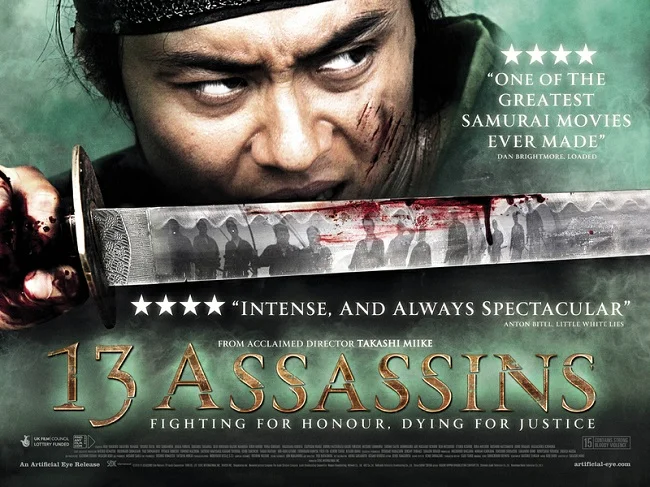
13 Assassins is one of Takashi Miike's most restrained and mature movies. Set in Feudal Japan and based on true events, a venerable clan suffers under the reign of the cruel young Lord Naritsugu (Goro Inagaki), who commits atrocities at will. Unable to break their oaths, the samurai are torn between duty and shame. Some of the masters in the clan even go so far as to commit Seppuku in protest. Unable to endure the status quo, a plan is formed to gather a small team of the deadliest samurai and assassinate Lord Naritsugu while he is travelling between clan territories. The responsibility falls upon Shinzaemon Shimada (Koji Yakusho) to take on this potentially fatal task. The matter is further complicated by Lord Naritsugu’s personal bodyguard (and Shimada’s former rival) master samurai Hanbei (Masachika Ichimura), who is a force to be reckoned with.
13 Assassins is one of Takashi Miike's most restrained and mature movies. Set in Feudal Japan and based on true events, a venerable clan suffers under the reign of the cruel young Lord Naritsugu (Goro Inagaki), who commits atrocities at will. Unable to break their oaths, the samurai are torn between duty and shame. Some of the masters in the clan even go so far as to commit Seppuku in protest. Unable to endure the status quo, a plan is formed to gather a small team of the deadliest samurai and assassinate Lord Naritsugu while he is travelling between clan territories. The responsibility falls upon Shinzaemon Shimada (Koji Yakusho) to take on this potentially fatal task. The matter is further complicated by Lord Naritsugu’s personal bodyguard (and Shimada’s former rival) master samurai Hanbei (Masachika Ichimura), who is a force to be reckoned with.
The storyline of 13 Assassins plays to the strengths its director. Despite the formality and traditional nature of the story, he still manages to imbue scenes and characters with his hallmark quirks and foibles. The first act clearly established Lord Naritsugi's evil credentials and establishes the moral framework within the story to justify his death. Once the violent introduction is complete, the film settles into a measured second act punctuated with a degree of gallows humour. This relies on the formulaic assembling of the titular assassins, and the planning of Lord Naritsugu's demise. The climax is an epic battle that dominates the final third of the films running time. The action is gritty and credible and the fight scenes although technically accurate are not designed to be excessive balletic in their choreography, like some other Samurai movies.
It is to Miike’s credit that he maintains a strong narrative throughout all three acts. His direction is thoughtful, and he does well with managing a large number of protagonists, many of whom are not especially well defined. The cinematography is gorgeous and makes an interesting counterpoint to the unpleasantness that unfold within the story. There is minimal use of CGI and a reliance on traditional physical effects. This combined with the strength of the script and performances ensures that the film never becomes boring or baggy. Overall, 13 Assassins is a very moral film in a perverse way, with a very surprising conclusion. It maintains the right balance between exploring philosophical themes and providing dynamic escapist entertainment. For those not familiar with the work of Takashi Miike, this movie is a very good starting place.
Classic Movie Themes: Alien
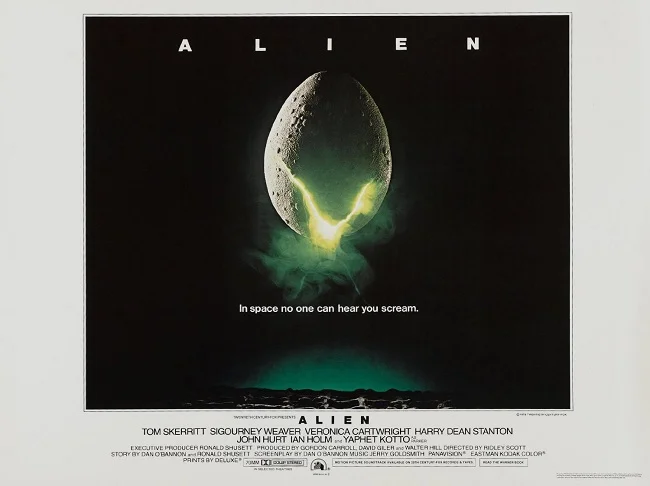
Alien is a unique genre milestone. It challenged the established aesthetic created by 2001: A Space Odyssey of space travel being pristine, clinical and high tech and replaced it with a grimy, industrial quality. The space tug Nostromo is also a conspicuously “blue collar”, civilian venture, underwritten by a large corporation. As for H. R Giger’s xenomorph, it redefined the depiction of extraterrestrial life in movies. Director Ridley Scott brought visual style and atmosphere to particularly unglamorous and dismal setting. He also scared the hell out of audiences at the time with his slow burn story structure and editing style that hints, rather than shows. Overall, Alien is a text book example of how to make a horror movie and put a new spin on a classic and well-trodden concept.
Alien is a unique genre milestone. It challenged the established aesthetic created by 2001: A Space Odyssey of space travel being pristine, clinical and high tech and replaced it with a grimy, industrial quality. The space tug Nostromo is also a conspicuously “blue collar”, civilian venture, underwritten by a large corporation. As for H. R Giger’s xenomorph, it redefined the depiction of extraterrestrial life in movies. Director Ridley Scott brought visual style and atmosphere to particularly unglamorous and dismal setting. He also scared the hell out of audiences at the time with his slow burn story structure and editing style that hints, rather than shows. Overall, Alien is a text book example of how to make a horror movie and put a new spin on a classic and well-trodden concept.
Jerry Goldsmith’s sombre and portentous score is a key ingredient to the film’s brooding and claustrophobic atmosphere. Yet despite the quality of the music, Goldsmith felt that the effectiveness of his work was squandered by Ridley Scott and editor Terry Rawlings who re-edited his work and replaced entire tracks with alternative material. However what was left still did much to create a sense of romanticism and mystery in the opening scenes, then later evolving into eerie, dissonant passages when the alien starts killing the crew. The fully restored score has subsequently been released by specialist label Intrada and has a thorough breakdown of its complete and troubled history.
Perhaps the best track in the entire recording is the triumphant ending and credit sequence, which was sadly removed from the theatrical print of the film and replaced with Howard Hanson's Symphony No. 2 ("Romantic"). This cue reworks the motif from the earlier scene when the Nostromo undocks from the refining facility and lands on the barren planet, LV-426. It builds to a powerful ending which re-enforces Ripley’s surprise defeat of the xenomorph and its death in the shuttles fiery exhaust. Seldom has the horror genre been treated with such respect and given such a sophisticated and intelligent score. Despite its poor handling by the film’s producers, Alien remains one of Jerry Goldsmith’s finest soundtracks from the seventies and yet another example of his immense talent.








Contagion (2011)
Director Steven Soderbergh is no stranger to complex narratives, shot in a near documentary style. And this is exactly this approach that he brings to bear upon Contagion. A movie that beneath its contemporary trappings, still has the air of an all-star disaster movie. Unlike so many current films which suffer from underdeveloped characters due to poor writing, Soderbergh makes conscious decision to focus more upon the mechanics and nature of a global pandemic than the main protagonists. This somewhat detached approach may not be to all viewers liking. But the format starkly scrutinises and catalogues events in an honest fashion and doesn’t shy away from the realities of the situation or get side tracked by the emotional aspects of the ongoing human tragedy.
Director Steven Soderbergh is no stranger to complex narratives, shot in a near documentary style. And this is exactly this approach that he brings to bear upon Contagion. A movie that beneath its contemporary trappings, still has the air of an all-star disaster movie. Unlike so many current films which suffer from underdeveloped characters due to poor writing, Soderbergh makes conscious decision to focus more upon the mechanics and nature of a global pandemic than the main protagonists. This somewhat detached approach may not be to all viewers liking. But the format starkly scrutinises and catalogues events in an honest fashion and doesn’t shy away from the realities of the situation or get side tracked by the emotional aspects of the ongoing human tragedy.
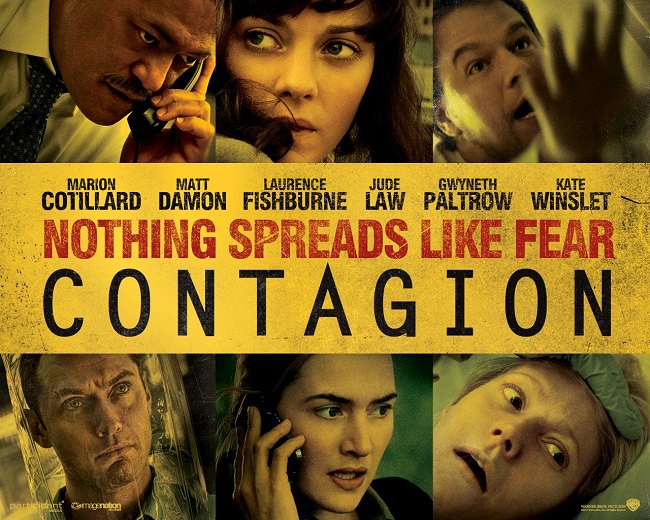
Although the movie is driven by the technicalities of the narrative, there is still a strong ensemble cast. This includes that includes Marion Cotillard, Bryan Cranston, Matt Damon, Laurence Fishburne, Jude Law, Gwyneth Paltrow, Kate Winslet, and Jennifer Ehle. But Contagion is mainly concerned with the logistics of managing an outbreak of global proportions. It also scrutinises the governmental procedures and protocols for dealing with public health issues. The story interestingly draws parallels between the spread of the virus and the resulting panic via social media and Internet. It clearly demonstrates that the weak link in any national strategy for containing a pandemic is the public themselves. The film excels at showing the transference of germs via the most innocuous means. You could also argue that the original source of contamination, made via a credit card, is a broader metaphor itself.
There are some very modern themes included into the story. The idea of blogging and social networks as a potentially negative force (within the confines of the plot) is a clever concept. There is also an exploration of homeopathy and the trend among certain areas of society to reject science and the look for solace elsewhere. The juxtaposition between the proliferation of technology and its failure to cope with the growing public health issue is handled well. Although a lot of traditional ideas and imagery associated with this subgenre are used, they are dealt with in a subtly different fashion from other movies of this idiom. The military response, the use of mass graves and the subsequent social unrest are not skewed by any moral stance. They are simply shown as cause and effect.
There were allegations of racism from some quarters, upon the film’s release, but I do not think this is the case. The fact that the virus originates in the Far East, simply reflects genuine issues that real countries face due to rapidly growing populations and industrialisation. The plot reflects genuine health scares of recent years and does not carry any subtext or message that I was aware of. Viewers have also questioned the irrational behaviour of cast, especially those representing the wider public. Has not history continuously shown us that people often make poor decisions in times of trouble? I would also argue that this is a plot device which enables the narrative to move forward and hence is a necessary evil.
Unlike Wolfgang Petersen’s Outbreak, Contagion purposely avoids an excess of human drama among the wider catastrophe. Rather than grim scenes of carnage, the film builds tension through depicting a credible disaster and remind viewers of the ongoing battle against the microscopic world that society fights every day. I enjoyed Steven Soderbergh’s somewhat cold approach and certainly did not feel that Contagion was a hectoring faux science documentary, as some is labelled it. This is not Irwin Allen. There are no noble sacrifices, broken relationships fixed upon the way, or valuable lessons learned about life. It is Soderbergh’s refusal to add any cinematic sweetener to the proceedings that makes Contagion so effective.
Overlord (2018)
For the first ten minutes or so, World War II action horror movie Overlord ticks a lot of boxes. The film has a surprisingly high budget ($38,000,000) for a niche genre product and as a result has a handsome production design. The cinematography by Laurie Rose and Fabian Wagner is striking, capturing the beauty of the French countryside as well as framing the various unpleasantness in a suitably Teutonic fashion. The visual effects both digital and practical are also of a high calibre, further adding to the authentic atmosphere. Yet despite all these positive points, Overlord is a somewhat slow and underwhelming affair, running fifteen to twenty minutes too long. Like so many modern movies, the focus of the production is on spectacle, rather than on character and script. Hence Overlords fails to meet its potential and makes for a somewhat frustrating viewing experience due to it squandering such a good opportunity.
For the first ten minutes or so, World War II action horror movie Overlord ticks a lot of boxes. The film has a surprisingly high budget ($38,000,000) for a niche genre product and as a result has a handsome production design. The cinematography by Laurie Rose and Fabian Wagner is striking, capturing the beauty of the French countryside as well as framing the various unpleasantness in a suitably Teutonic fashion. The visual effects both digital and practical are also of a high calibre, further adding to the authentic atmosphere. Yet despite all these positive points, Overlord is a somewhat slow and underwhelming affair, running fifteen to twenty minutes too long. Like so many modern movies, the focus of the production is on spectacle, rather than on character and script. Hence Overlords fails to meet its potential and makes for a somewhat frustrating viewing experience due to it squandering such a good opportunity.
On the eve of D-Day, a squad of crack paratroopers (are there any other type?) are tasked with destroying a German radio tower in an old church in France. Their plane is shot down before they can reach their target, leaving only four survivors; Corporal Ford (Wyatt Russell) and soldiers Boyce (Jovan Adepo), Tibbet (John Migaro), and Chase (Iain De Caestecker). A local villager, Chloe (Mathilde Ollivier), offers them shelter in her house where she looks after her younger brother and sick aunt. The unit subsequently learns how many of locals have been taken away to the laboratory under the church by SS Hauptsturmführer Wafner (Pilou Asbæk). What are the nature of the experiments that are conducted there by Dr. Schmidt (Erich Redman)? It soon becomes clear that the Third Reich is seeking to create a Übermensch, using a strange tar that is found under the foundations of the old church. Can Corporal Ford and his men foil this sinister (and extremely formulaic) plan and destroy the radio transmitter before the allied invasion commences?
Overlord is written by Billy Ray who has penned successful screenplays for The Hunger Games and Captain Phillips. During the movie’s production, genre writer Mark L. Smith was brought in to “polish” the existing script. Smith had previously garnered attention with his work on The Revenant. Sadly, despite their efforts the film’s dialogue, story and pacing are distinctly off. Now as this is a genre movie that expects us to embrace the concept of mutant Nazi’s, I’m not going to be too picky about some of the film’s historical inaccuracies. This is not meant to be an authentic historical recreation but an entertaining horror movie, so let’s not get bogged down in issues such as racial segregation that are conspicuously absent from the plot. No Overlords main failing is that not much happens for the first half of the movie. We’re simply presented with characters, a setting and a hint of sinister events. All of which could be established far quicker.
The two main antagonists are sadly two dimensional. For example, how do the writers establish that SS Hauptsturmführer Wafner is “evil”? By having him attempt to rape the only female character within five minutes of him being introduced into the narrative. As for our Mengele-esque Doctor Schmidt, he wanders around with a blood-stained apron and barks orders to verify his “baddy” credentials. It really is extremely lazy writing and a waste of a good cast. Everyone involved seems to be a cut above the standard journeyman genre actors that usually populate such movies. If the writers had taken some of the slack out of the initial story set up, they could have used the screen time to flesh out the various characters back stories. Especially the Nazis. Introducing racial tensions or focusing on the fact that one of the soldiers is a Jew could also have provided some further depth and interest in the proceedings.
There are some good action set pieces in Overlord but most of them are just regular combat sequences. The mutants have surprisingly little to do and appear on screen far too infrequently to be taken to heart as a tangible threat. The science, ideology and human suffering behind these ongoing experiments is never really explored. We briefly see a few “subjects” that have out lived their usefulness, put to the torch but as we don’t know who they were, the drama of the scene is diminished. When the horror elements finally do kick in, they are suitably grim and turned up to eleven. The cast do their best to engage with the story and are surprisingly polished given the paucity of the material. The quality of the production, along with dogged determination of certain cast members to deliver a “performance” irrespective of the scripts failing, is just enough to get things over the finishing line. Although not a complete dog’s dinner, you can’t help but feel that there is a part of the jigsaw missing from Overlord, and if that piece was found and added, you’d be left with a far superior movie.
The Three Stooges (2012)
I had mixed feelings about whether The Three Stooges could be successfully re-imagined and revitalised for a modern audience. When the first trailer was released it seemed to highlight the major differences between the old school slapstick humour of the forties with the worldly adult style of present comedy movies. However, as more information came out regarding the production and it became clear that the Farrelly Brothers are consummate fans of the source material, I began to revise my expectations. After finally having caught up with the movie, six years after its theatrical release, I am afraid all my initial fears have proven true and that The Three Stooges falls into all the traps I anticipated it would. That is not to say that the film is not without merits, but overall it fails to deliver in a manner that pleases all parties.
I had mixed feelings about whether The Three Stooges could be successfully re-imagined and revitalised for a modern audience. When the first trailer was released it seemed to highlight the major differences between the old school slapstick humour of the forties with the worldly adult style of present comedy movies. However, as more information came out regarding the production and it became clear that the Farrelly Brothers are consummate fans of the source material, I began to revise my expectations. After finally having caught up with the movie, six years after its theatrical release, I am afraid all my initial fears have proven true and that The Three Stooges falls into all the traps I anticipated it would. That is not to say that the film is not without merits, but overall it fails to deliver in a manner that pleases all parties.
First off let me make it clear that the casting of Sean Hayes, Will Sasso and Chris Diamantopoulos as Larry, Curly and Moe is spot on and their performances are exceptional. They have successfully captured the style, idiom and physical technique of the original trio and are very funny in themselves. I cannot fault their work. However, the story that the actors have to hang their performance on, is weak, poorly paced and littered with asides that don't work. The depiction of the Catholic Church, nuns and orphanages is lazy and tired. To cater to contemporary tastes there is a degree of cruder material and sexual under current to a lot of the humour. The problem is that it seems out of place and doesn't fit well into the narrative. Therefore, there is a tonal tug of war between slapstick gags that you expect from this franchise and the earthier humour you find in other Farrelly Brothers movies.

I love comedian Larry David, but his character Sister Mary-Mengele has little to do and nowhere to go. Plus naming a nun after a Nazi war criminal really isn't exactly going to have the target audience rolling in the aisles is it? In fact, a lot of the humour centred around the antagonists and support characters seems out of place in a movie that is marketed heavily towards kids. For example, I laughed a lot at Larry (Sean Hayes) giving a dolphin a Heimlich Manoeuvre, but when the offending peanut is then shot out of its blow hole and into a Lion’s testicles, it become an embellishment of a very different nature. The final act which involves Moe appearing on a reality TV show fails as a concept. I can see why it was used as a plot device to try and bridge the cultural divides between prospective audience members, but it just doesn’t work.
The Three Stooges also has another major obstacle to overcome in so far as we now live in extremely litigious times, in a culture dominated by health and safety. The movie ends with a coda in which the directors, the Farrelly Brothers played by male models, explain that all of the Stooges physical hijinks are stunts and should not be imitated. It really does further derail an already flawed production. In the UK, the BBFC still expressed concern over some of the slapstick violence and as a result the distributors elected to re-edit the movie and remove some of the problematic scenes so they could secure a lower rating for theatrical release. The Blu-ray release for the United Kingdom is uncut, however.
The box office taking for The Three Stooges were not bad. The movie recouped its production costs and turned a profit. Whether this means we will see a second movie, I do not know for sure. However, because the lead actors are so good, I would not actually mind giving them a second chance, as long as a greater effort was placed on finding a suitable comedy vehicle for them. Therefore, if you do decide to watch The Three Stooges, then do curb your expectations and focus on the central performances. Try to tune out the wider comedy as it is very poor and at odds with central theme. Then you may then be rewarded with an enjoyable tribute act to Larry, Curly and Moe. However, a sequel will certainly need to be more than just a homage.



Classic Movie Themes: Star Trek II The Wrath of Khan
James Horner was a prolific, yet consistently good composer with a broad range of styles. Consider his score for 48 Hrs with its Jazz under currents and then compare it to his grand swashbuckling approach to Krull. They are radically different soundtracks, but both are extremely effective in embellishing their respective motion pictures. That was James Horner great talent. He knew when to be theatrical and bombastic but could also dial it back and be subtle, gentle and delicate. It made his body of work very diverse and memorable.
James Horner, although possessing a very broad and eclectic musical range, was in many respects a very traditional composer. He was certainly au fait with works of such giants as Miklós Rózsa, Korngold and Bernard Herrmann and it often manifested itself in his music through his use of the leitmotif. Perhaps the reason James Horner was so consistently good and crafted so many outstanding pieces of music, is because he never saw his profession as just a means to an end. As he said in an interview once, “I don’t look at this as just a job. I see music as art”.
James Horner was a prolific, yet consistently good composer with a broad range of styles. Consider his score for 48 Hrs with its Jazz under currents and then compare it to his grand swashbuckling approach to Krull. They are radically different soundtracks, but both are extremely effective in embellishing their respective motion pictures. That was James Horner great talent. He knew when to be theatrical and bombastic but could also dial it back and be subtle, gentle and delicate. It made his body of work very diverse and memorable.
James Horner, although possessing a very broad and eclectic musical range, was in many respects a very traditional composer. He was certainly au fait with works of such giants as Miklós Rózsa, Korngold and Bernard Herrmann and it often manifested itself in his music through his use of the leitmotif. Perhaps the reason James Horner was so consistently good and crafted so many outstanding pieces of music, is because he never saw his profession as just a means to an end. As he said in an interview once, “I don’t look at this as just a job. I see music as art”.
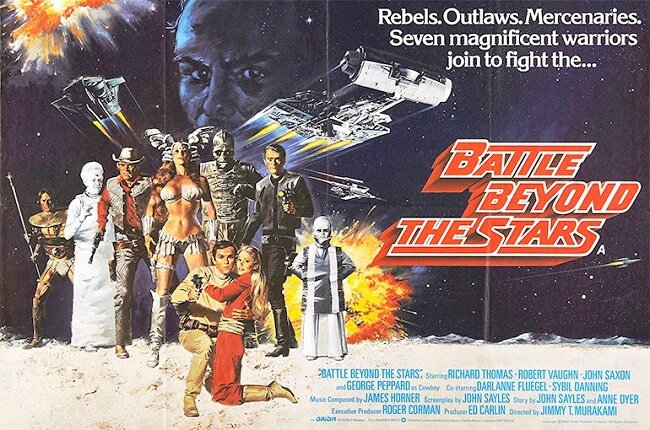
James Horner was very much part of my cinematic youth, having written the soundtracks for many of my favourite movies. I first encountered his work when I saw Battle Beyond the Stars and was immediately captivated by its bold and brass driven title theme. It was this particular soundtrack that brought him to the attention of Paramount Studios and led to him composing his seminal score for Star Trek II: The Wrath of Khan with its graceful nautical themes. The film's director Nicholas Meyer famously quipped that Horner had been hired because the studio couldn't afford to use the first film's composer Jerry Goldsmith again. By the time Meyer returned to the franchise with Star Trek VI: The Undiscovered Country, the director found that he couldn't afford Horner either.
Shout at the Devil (1976)
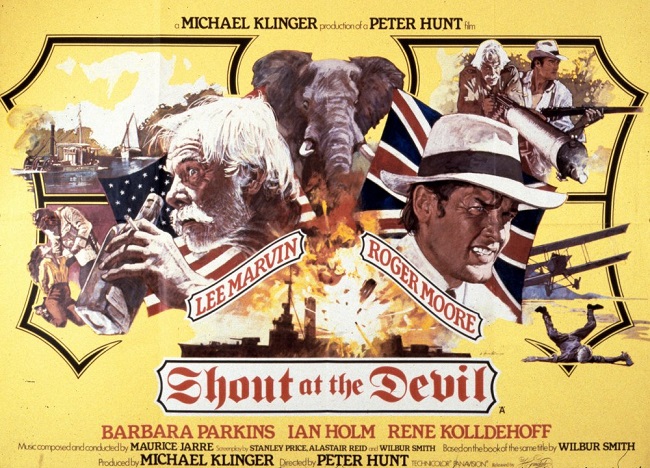
Adapted from the novel by Wilbur Smith, Shout at the Devil is the sort of big budget, sprawling, period set high adventure movie that has fallen out of vogue in recent decades. Its main attraction are its stars, location and robust action scenes. Crafted by former Bond director and long-time editor Peter Hunt, this is a full on, no nonsense character driven drama of the kind that were common place during the seventies. Sometimes the enormity of these sorts of productions meant that something suffered by omission. Be it a weak script, excessive set pieces or too many cameos by an all-star cast. Shout at the Devil broadly manages to avoid such pitfalls. There is however a notable tonal shift in the story about halfway through the film, which does take events in a different direction.
Adapted from the novel by Wilbur Smith, Shout at the Devil is the sort of big budget, sprawling, period set high adventure movie that has fallen out of vogue in recent decades. Its main attraction are its stars, location and robust action scenes. Crafted by former Bond director and long-time editor Peter Hunt, this is a full on, no nonsense character driven drama of the kind that were common place during the seventies. Sometimes the enormity of these sorts of productions meant that something suffered by omission. Be it a weak script, excessive set pieces or too many cameos by an all-star cast. Shout at the Devil broadly manages to avoid such pitfalls. There is however a notable tonal shift in the story about halfway through the film, which does take events in a different direction.
Set in East Africa in 1913 prior to WWI, Flynn O’Flynn (Lee Marvin) is a disreputable American of Irish descent exploiting the “riches” of the African continent. A poacher of ivory and a shameless con man, Flynn and his mute right-hand man Mohammed (Ian Holm) coerce an English Gentleman Sebastian Oldsmith (Roger Moore), into becoming a partner in their ivy poaching trade. This takes them into German colonial territory where they run afoul of Commander Fleischer (Rene Kolldehoff). Barely escaping they return to Flynn’s comfortable lodge located in the African bush. Sebastian meets and falls in love with Flynn’s daughter Rosa (Barbara Parkins) and the two marry and have a baby. The poaching continues but when war breaks out, Fleischer is granted unlimited local power and seeks revenge upon Flynn and Sebastian. He raids Flynn’s lodge but when he finds both Flynn and Sebastian absent, his troops massacre the staff and kill Rosa’s child. Devastated by events Flynn, Sebastian and Rosa undertake guerrilla missions on behalf of British navy. They discover that a German war ship is being hidden in the region and that it is being repaired before returning to sea. Furthermore, they learn that the work is being over seen by Fleischer, providing them with an opportunity for retribution.
The international version of Shout at the Devil has a running time of 150 minutes. This version restores a half hour of footage removed from the American theatrical release. The movie is well paced and has a clear narrative arc. Michael Reed's cinematography is sumptuous and makes the most of African locations. Maurice Jarre's score is suitably rousing and very much of its time. There is also some exceeding good miniature work by Derek Meddings who recreates a very convincing German Battleship. There is also genuine on-screen chemistry between Roger Moore and Lee Marvin. Moore plays straight man to Marvin's scenery-chewing character and the movie has a very jovial light-hearted tone initially. The first raid into German territory depicts the German Commander as a bumbling fool. Yet when Fleischer seeks revenge the plot takes a far more sinister and violent turn. The killing of a child is quite jarring, although far from graphic. The action scenes that follow also ramp up the casual violence. One notable scene has sheet steel being hauled across the savannah on wagons by dozens of native levy troops. In the ensuing gun battle, the wagons crush several people and sliding plate steel decapitates one unfortunate individual.
Shout at the Devil was shot in between The Man with the Golden Gun and The Spy Who Loved Me and boasts a great deal of talent from the Bond franchise. Peter Hunt had edited the early Bond films and directed On Her Majesty's Secret Service. Although Roger Moore and Peter Hunt had never worked on a 007 film together, Moore did star in Hunt's previous adventure film Gold. Other Bond veterans involved in the production were main titles designer Maurice Binder, cinematographer Michael Reed and camera operators Alec Mills and Alan Hume. The movie has a very authentic quality due to the bulk of the production being shot on location. Sadly, this authenticity also extends to the poaching scene. Although no animals were directly harmed during the production, the film does use footage of a genuine elephant hunt and it proves hard to watch for those with modern sensibilities. Also, Caucasian actors playing other ethnicities is anachronistic.
One of the marked differences between modern movies and those from the sixties and seventies, is that contemporary films are often made to a specific rating. Hence every aspect of the film be it themes, dialogue, sex and violence are contrived in advance to be in accord with this. A movie such as Shout at the Devil would be pitched at a broad audience upon its release and would often veer from one idiom to another to accommodate different tastes. Hence you get a comedy fist fight or a humorous scene in which the local natives plead poverty to avoid paying taxes. And if the screenplay required it then you would quickly find yourself dealing with much heavier and dramatic adult themes, which in this case means infanticide, trauma and revenge. I’m not saying it doesn’t work or that it’s a deal breaker, but it is quite a noticeable change to the contained and measured approach of modern PG-13 rated movies.
Shout at the Devil is both an entertaining movie and a snapshot of the British film industry of the times. Elements of the production have dated and have to be judge contextually, if you don’t wish to balk at them. Any film based in twentieth century colonial history is naturally going to be challenging with respect to subjects such a racism and exploitation. Yet on the plus side, the movie does feature two genuine film greats at the height of their careers and their performances do much to carry the story. The films “broad church” approach means that its not stayed or safe and it has capacity to surprise when it decides to become darker. So, if you want an old school adventure movie with an epic scope and explosive climax, along with all the baggage from the era when it was made, then Shout at the Devil has it in spades. Just ensure that you see the international cut of the film in high definition to fully do the production justice.
The Last Hunter (1980)
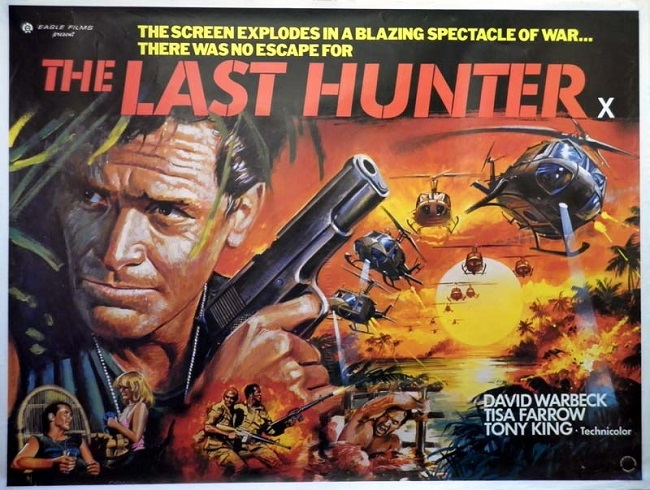
There are many films about war. There are many films about the Vietnam war. A few have transcended mere historical depiction and managed to capture the utter horror and political insanity of the situation, along with the tragic human cost. And then there are those which simply seek to use the setting as a vehicle for an exploitation movie, in the hope of making a fast buck. The Last Hunter (L'ultimo cacciatore) falls firmly into the second camp. This Italian "macaroni combat" movie (yes, I didn’t know that’s a thing either) offers a straight forward tale of an incursion behind enemy lines by an officer charged with destroying a radio transmitter, broadcasting anti-US propaganda. It is violent, action packed and surprisingly honest about what sort of film it is. You’ll find no pretentious philosophical musings here. Just explosions, rotting corpses and Viet Cong booby traps.
There are many films about war. There are many films about the Vietnam war. A few have transcended mere historical depiction and managed to capture the utter horror and political insanity of the situation, along with the tragic human cost. And then there are those which simply seek to use the setting as a vehicle for an exploitation movie, in the hope of making a fast buck. The Last Hunter (L'ultimo cacciatore) falls firmly into the second camp. This Italian "macaroni combat" movie (yes, I didn’t know that’s a thing either) offers a straight forward tale of an incursion behind enemy lines by an officer charged with destroying a radio transmitter, broadcasting anti-US propaganda. It is violent, action packed and surprisingly honest about what sort of film it is. You’ll find no pretentious philosophical musings here. Just explosions, rotting corpses and Viet Cong booby traps.
Directed by veteran Italian film maker Antonio Margheriti (and billed as Anthony Dawson on English language prints), The Last Hunter is a well-made (by Italian cash-in genre standards) exploitation war movie, with a solid international cast and good action set pieces. Margheriti had a background in miniature effects and the film features several scenes of this kind, such as the rail yard bombing at the start and the jungle cave demolition in the films second act. The dialogue is functional (and all dubbed in post-production like so many Italian movies of this kind) and the story efficiently moves the actors from set piece to set piece. There’s even the bonus of a minor twist in the movies climax. David Warbeck is suitably grizzled and burnt out as Captain Morris and Tisa Farrow fills the roll of the “plucky news reporter” embedded with the unit. There’s also wise cracking banter between Tony King and Bobby Rhodes as the units African-American representation. Connoisseurs of eighties Italian genre movies will delight at the cast and the additional inclusion of John Steiner as a suitably deranged Major.
Being an Italian movie of the times, there are copious acts of violence including a graphic gunshot to the eye, a partial decapitation and a leg amputation. There’s also a lot of crude barrack room humour and an attempted rape, but hey that’s how these movies roll. It almost as if there’s a check list being followed. The location cinematography in the Philippines gives the proceedings an authentic feel and like so many Italian movies from this decade, the soundtrack by Franco Micalizzi is contemporary, funky and far more interesting than some traditional orchestral scores. As this movie is not designed to be a cerebral undertaking it has to be judged on what it has to offer. And on that basis, then The Last Hunter is a better than average ninety plus minutes of Italian exploitation cinema. It is also a good steeping stone into the wider works of director Antonio Margheriti. If you enjoy this movie you may wish to try, Codename: Wild Geese (three guesses which movie this rips off), Command Leopard and Killer Fish. All have an interesting international cast, miniatures effects work along with either gore or action.
The Last Hunter Bonus Track: Music from the opening night club scene.
The Lucas Legacy
I was perusing the net recently and came across a story about how a Star Wars fan film that had built up a head of steam online, has been slapped with a copyright strike from Disney. Nothing unusual there as the company is virtually legendary with respect to its litigious proclivities. However, someone over a Lucasfilm interceded and got the strike lifted, because the fan film creator had allegedly sought prior permission and supposedly received it. George Lucas has always maintained an equitable attitude towards fan usage of the Star Wars IP, something he tried to impress upon Disney when he sold the rights to them back in 2012. But it is very difficult to have a balanced discussion about George Lucas as the man is such a paradox. On one hand he is possibly one of the greatest contributors to twentieth century pop culture and has influenced a generation of film makers, writers and fans. On the other he is the man who single headedly has managed to queer his own pitch, with the way he has continuously tinkered with his body of work and appended it with supplemental material that many deemed substandard or to the detriment of the original. He is also still vilified in some quarters for his business arrangement with Disney.
I was perusing the net recently and came across a story about how a Star Wars fan film that had built up a head of steam online, has been slapped with a copyright strike from Disney. Nothing unusual there as the company is virtually legendary with respect to its litigious proclivities. However, someone over a Lucasfilm interceded and got the strike lifted, because the fan film creator had allegedly sought prior permission and supposedly received it. George Lucas has always maintained an equitable attitude towards fan usage of the Star Wars IP, something he tried to impress upon Disney when he sold the rights to them back in 2012. But it is very difficult to have a balanced discussion about George Lucas as the man is such a paradox. On one hand he is possibly one of the greatest contributors to twentieth century pop culture and has influenced a generation of film makers, writers and fans. On the other he is the man who single headedly has managed to queer his own pitch, with the way he has continuously tinkered with his body of work and appended it with supplemental material that many deemed substandard or to the detriment of the original. He is also still vilified in some quarters for his business arrangement with Disney.
Lucas announced back in October 2012 an interview with the New York Times, that he was "retiring" from the sort of film making he had become closely associated with over the last three decades. He was however still going to pursue creating more "personal" films. He also made some fairly broad statements about getting mainstream Hollywood to buy into his last project Red Tails and the movie industries overall inadequacies in dealing with issues of race and African-American history in films per se. He took time to pointedly described how he had to finance Red Tails himself. Sadly, the movie was met with relative indifference at the box office and garnered the usual criticism associated with his work. IE too much emphasis on spectacle and not enough attention of characters and script. Since then Lucas has not produced any major cinematic works and has continued to pursue his philanthropic and charitable endeavours.
There are some who feel that Mr. Lucas is a misunderstood film maker who has suffered at the hands of a rabid and unreasonable fan base and a system that hates him for bypassing their rules. Then there are those who simply see him as a gifted technician, well versed in the mechanics of film making but lacking in the narrative skills shown by the true “greats”. As per usual, the truth more than likely lies somewhere in between these two positions and is far more nuanced. As for his last movie Red Tails (which he produced and then took over the reshoots from incumbent director Anthony Hemmingway), it’s a distinctly average film. It is visually impressive as you would expect, but the story is incredibly formulaic, and the characters are weak. The issue of racism is not given the depth or intelligence required to explore it effectively and the dialogue is unconvincing. Whether the films reception was a key factor in Lucas choosing to semi-retire from the wider industry, is up for debate. For decades he has been a prisoner of his own success and at times it does seems like he still struggles to come to terms with it all. “On the Internet, all those same guys that are complaining I made a change are completely changing the movie … I’m saying: ‘Fine. But my movie, with my name on it, that says I did it, needs to be the way I want it. Why would I make any more when everybody yells at you all the time and says what a terrible person you are?”
Although I fully understand and even agree in principle with his sentiments, such a position is purely an ideological one and is not very practical in reality. Star Wars has become an integral part of popular culture and although there is no legal precedence, the public feel that they have some collective emotional ownership of it and are therefore not going to take an even-handed view to alterations and new material (as the Disney movies have shown). Lucas should have learnt from others who have participated in films and TV that has grown bigger than themselves. You come to terms with it and try to work within the confines that it sets, or you simply withdraw. Lucas may think that the restraints of the Star Wars phenomenon has limited his options and thus he has not had the critical success he looked for. I think more blame can be attributed to his skills set. The original trilogy although overall his own work, had the creative input of additional screenwriters and directors to smooth the rough edges and curb his excesses. The prequels did not and therefore their ideas and visual style were marred by poor dialogue and turgid stories. In fact, I would draw a parallel between George Lucas's career and that of M. Night Shyamalan. Both are talents that possibly require the counterbalance of a third party to reach their full potential.
Of course, George Lucas has not fully retired and has provided himself with a get out of jail card, with the ongoing development of a fifth Indiana Jones film. However, it should be noted that he is only involved as an executive producer and is not contributing to the story. Yet regardless of any future film output, his long-term legacy is clearly established and of considerable magnitude. He created a mythology for a generation that had none and has been instrumental in pushing back the technical boundaries of the film industry. He has demonstrated that the mainstream studios do not need to have it their own way all the time and he has influenced an inordinate amount of people globally to pursue their creative dreams. However, it can be argued that he has also set a precedent of style over substance and spectacle over narrative. Yet, whatever your opinion on the man and his work, we have not heard the last of him. Lucas is by nature a “fixer” and I suspect he has something he still wants to put right or follow up upon before he’s “done”.











Nightwing (1979)
The seventies saw a minor boom in creature feature films after the box office success of Jaws. Hence, we had movies such as Orca (1977), Tentacles (1977), The Pack (1977) and Piranha (1978). If an animal could eat you or potentially pose any threat to people, someone somewhere would make a movie about it. Usually a bad one. A few of these even dared to stray into other hot topics of the time such as pollution and protecting the environment. Some would even invoke mysticism and folk lore to facilitate their protagonists. Nightwing is one such curious genre hybrid which combines vampire bats, shale oil mining and Native American culture in its clumsy and unsubtle plot. It’s a somewhat odd undertaking, directed by Arthur Hiller. His previous work included Love Story (1970) and Silver Streak (1976), so he was not the first person you’d expect to see associated with such material. The film doesn’t work well as either a horror movie or an exploration of social issues, but like so many movies from this era, it is of interest mainly due to its sheer incongruity.
The seventies saw a minor boom in creature feature films after the box office success of Jaws. Hence, we had movies such as Orca (1977), Tentacles (1977), The Pack (1977) and Piranha (1978). If an animal could eat you or potentially pose any threat to people, someone somewhere would make a movie about it. Usually a bad one. A few of these even dared to stray into other hot topics of the time such as pollution and protecting the environment. Some would even invoke mysticism and folk lore to facilitate their protagonists. Nightwing is one such curious genre hybrid which combines vampire bats, shale oil mining and Native American culture in its clumsy and unsubtle plot. It’s a somewhat odd undertaking, directed by Arthur Hiller. His previous work included Love Story (1970) and Silver Streak (1976), so he was not the first person you’d expect to see associated with such material. The film doesn’t work well as either a horror movie or an exploration of social issues, but like so many movies from this era, it is of interest mainly due to its sheer incongruity.
Youngman Duran (Nick Mancuso), a deputy on an Indian reservation in New Mexico, investigates the death of several horses on a local ranch. The bodies are covered in small bites, drained of blood and there is a strong smell of ammonia. Tribal Council chairman Walker Chee (Stephen Macht) is keen to keep the matter quiet, as he is trying to negotiate the mining rites to oil shale deposits that have recently been discovered in nearby canyons. Canyons that also happen to be sacred to the local population. Abner Tasupi (George Clutesi), an ageing medicine man and Duran’s uncle, tells him he’s unleashed forces that will remove the White Man from the land and restore things to how they use to be. Duran dismisses such ideas, but as further death occurs including his uncle, begins to think otherwise. However, the arrival of British scientist Philip Payne (David Warner) points to a more tangible answer. The caves in Maskai Canyon are home to a swarm of deadly vampire bats he’s been tracking.
Nightwing efficiently sets out its stall within the first fifteen minutes. The audience is presented with a beleaguered law enforcment official, a corrupt business man and an obsessed scientist. This is quickly followed by a heavy dose ersatz Indian mysticism and the ubiquitous love interest, via local nurse Anne Dillon (Kathryn Harrold), who runs the town clinic. It’s all formulaic content that’s common to genre movies. There is also an attempt to address some deeper issues regarding the treatment of indigenous peoples by the Federal Government, as well as some nods towards institutional racism. But it’s far from convincing and or subtle. Especially in light of the fact that so few of the main cast are of the correct ethnicity. The film then proceeds to offset the subsequent vampire bat attacks with wider supernatural explanations, but never fully commits to them. The use of datura root as a hallucinogenic offers a “get out of jail card” to the film’s mystic elements.
As for the vampire bat attacks, they’re initially kept off screen until the first major set piece of the movie. This involves a group of Christian missionaries who are visiting the reservation and considering making a substantial charitable investment. It is one of the better plot elements. The attack takes place at night around the camp fire and features animatronic bats created by Carlo Rambaldi (E.T and the 1976 version of King Kong). There is also an optical overlay of a swarm of bats that further adds to the scene. It doesn’t quite work and certainly the rather static close ups of Rambaldi’s bats are far from convincing. However, the effects work is of interest due to the technical limitations of the time. Certainly, the blood flows in this sequence with the victims panicking. One falls into the camp fire while another hides under the camper van, only for it to run over her. Later in the movie Duran, Payne and Dillon construct an anti-bat cage from steel scaffolding and wire mesh. The technical shortcomings of the animatronics are more apparent here.
There are some genre stalwarts in the cast. David warner is suitable driven and even has a Jaws-eque monologue about the inherent “evil” of vampire bats. Sadly, his character has little back story. Strother Martin also appears as the local store owner as does Charles Hallahan as one of the Christian missionaries. But overall the screenplay by Martin Cruz Smith, Steve Shagan and Bud Shrake does the bear minimum and lacks any depth, or standout features. Although the desert locations are strikingly shot at times by Charles Rosher Jr. there is no overt sense of danger from the environment. Nightwing may well have benefitted from a more experienced genre director at the helm, who could have focused more upon the horror elements, rather than trying to expand the scope of the story into wider socio-political themes. However, I still find movies of this kind that hail from the pre-digital age to be of interest. The seventies were a far more experimental time for cinema and studios were prepared to try different things and straddle multiple genres. Nightwing should therefore be filed under such.
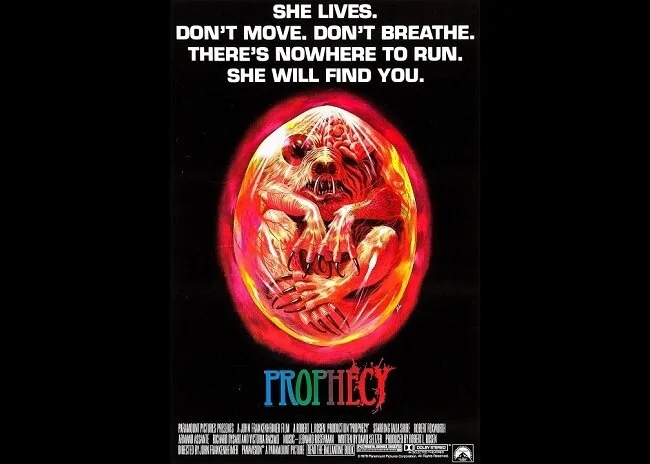
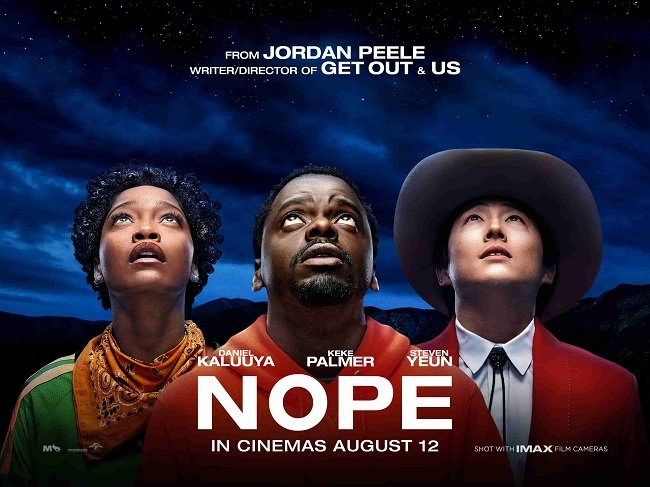
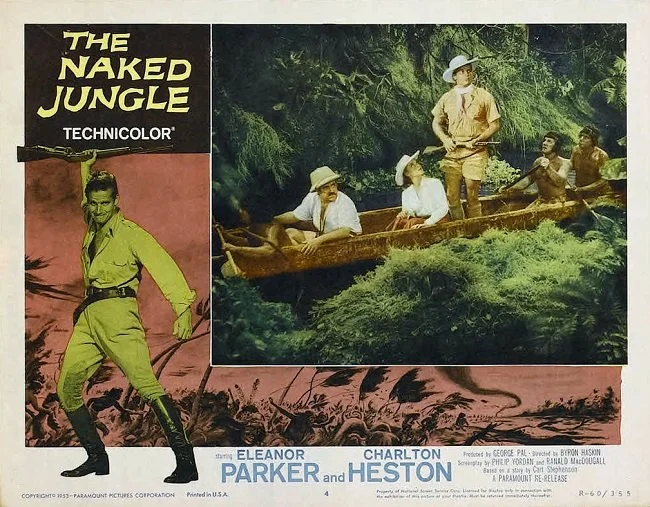
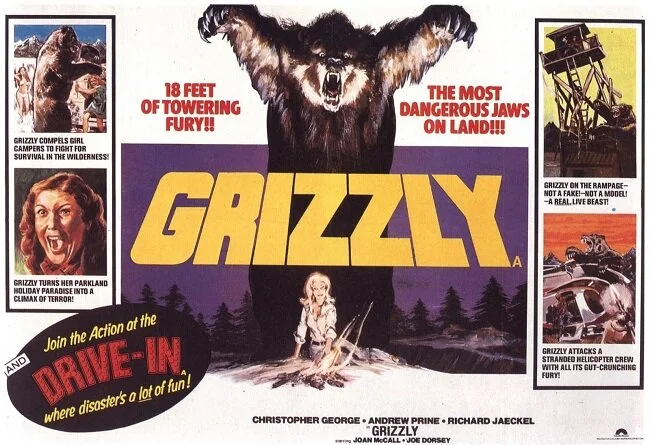
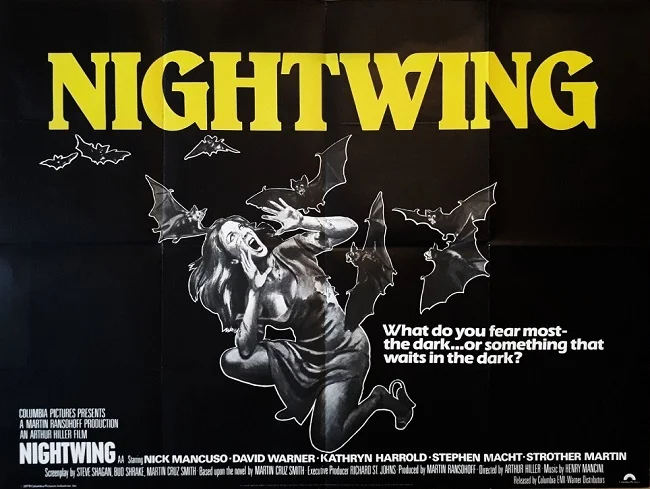
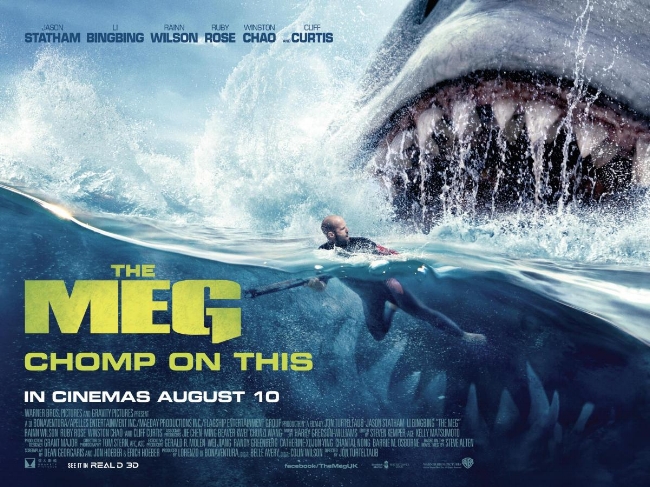

The Satanic Rites of Dracula (1973)
The horror movie genre was changing rapidly in the late sixties and seventies, with films such as the Night of the Living Dead and Rosemary’s Baby moving away from traditional gothic settings and proving to be box office successes. After the success of Count Yorga, Vampire, a movie set in 1970s Los Angeles, Warner Bros commissioned Hammer Films to make two contemporary set Dracula films. The first of these was Dracula A.D. 1972. The film was loosely inspired by the Highgate Vampire case and proved to be moderately successful at the box office. The second being The Satanic Rites of Dracula; a curious hybrid vampire movie that mixes elements of the espionage genre along with traditional Hammer horror content. Sadly, this final outing for both Peter Cushing and Christopher Lee as Van Helsing and Dracula, was not well received by the public and has subsequently been written off in the annals of Hammer Films. Yet despite it’s flaws it does have a few points of interest to the more rigorous horror fan. The recent Blu-ray release via the Warner Archive Collection presented such an opportunity for reappraisal.
The horror movie genre was changing rapidly in the late sixties and seventies, with films such as the Night of the Living Dead and Rosemary’s Baby moving away from traditional gothic settings and proving to be box office successes. After the success of Count Yorga, Vampire, a movie set in 1970s Los Angeles, Warner Bros commissioned Hammer Films to make two contemporary set Dracula films. The first of these was Dracula A.D. 1972. The film was loosely inspired by the Highgate Vampire case and proved to be moderately successful at the box office. The second being The Satanic Rites of Dracula; a curious hybrid vampire movie that mixes elements of the espionage genre along with traditional Hammer horror content. Sadly, this final outing for both Peter Cushing and Christopher Lee as Van Helsing and Dracula, was not well received by the public and has subsequently been written off in the annals of Hammer Films. Yet despite it’s flaws it does have a few points of interest to the more rigorous horror fan. The recent Blu-ray release via the Warner Archive Collection presented such an opportunity for reappraisal.
The Satanic Rites of Dracula is a direct sequel to Dracula A.D. 1972. There is a degree of continuity with both characters and cast. Peter Cushing returns as Lorrimer Van Helsing, as does Michael Coles as Inspector Coles. Joanna Lumley replaces Stephanie Beecham as Jessica Van Helsing. Furthermore, the two movies are directed by Alan Gibson and written by Don Houghton. In an unusual twist the film starts very much as a spy drama, with a secret service agent escaping from the country mansion Pelham House, where cabinet ministers, industrialists and military chiefs indulge in satanic rites. Department head, Colonel Mathews (Richard Vernon) and Secret Service agent Torrence (William Franklyn) fear a major political scandal as well as foreign espionage. Due to the sensitivity of the situation they seek outside help from Special Branch Inspector Coles, who urges them to consult with occult expert Lorrimer Van Helsing. Investigations reveal that a leading scientist Julian Keeley (Freddie Jones) is also involved in the cult and that he is developing a deadly plague virus for the recluse business moghul, D. D. Denham.
The Satanic Rites of Dracula struggles to find its niche as the story veers between genres. Count Dracula doesn’t appear until thirty minutes into the movie and the screenplay is somewhat at a loss as to what to do with him, once he does. The story hinges upon the count having a curious existential crisis and tiring of his undead existence, hence the creation of a plague that will kill all life on earth, leaving him without any prey. It’s an interesting idea but one that is left underdeveloped. As for the horror elements of the film they’re somewhat modest. There are two staking scenes involving female vampires; one of which is now fully restored in the new Blu-ray copy. The remainder of the action is mainly shootouts with the curiously dressed security guards of Pelham house. They sport Afghan Waistcoats and Mauser pistols. Like most Hammer films from this period there’s a lot of cleavage and nudity to bolster the horror elements. Dracula’s demise at the end is suitably creative involving a Hawthorn bush and a picket fence. Les Bowie’s special effects are still enjoyable although far from sophisticated.
However, despite the vagueness of the script and the rather limited scope of action, there are still aspects to enjoy in The Satanic Rites of Dracula. The scenes between Peter Cushing and Freddie Jones are great, demonstrating that even with material as thin as this, both actors can hold the audience’s attention. The chemistry between Cushing and Lee is also present in the film denouement. The contemporary location scenes showing London in 1973 are also a source of interest. The car chase provides glimpses of The Strand and parts of Kensington, all of which have now been heavily redeveloped. But where this movie may appeal to the horror aficionado who has an abiding love with Hammer Films, you can objectively see why it failed at the box office. The studios attempt to move with the time are mainly superficial and beyond this, the film is just doing the same things as its predecessors. Furthermore, Christopher Lee had tired of the role of Dracula and so this was his final appearance as the iconic count for Hammer Films. Later in 1973, The Exorcist would change the horror genre completely, consigning the studio to further decline and inevitable closure. Hence, The Satanic Rites of Dracula was another nail in the coffin for Hammer’s Dracula franchise and a text book example of failing to move with the times.
Conan the Barbarian (2011)
On a superficial level the 2011 Conan reboot provides two hours of blood and thunder. For those who are seeking a quick fix of such material and are not burdened by a strong affiliation to Robert E. Howard’s source material, this will prove adequate. I suspect that Marcus Nispel’s offering will find a home with a younger audience. For purists or those who have fond memories of John Milius’ 1982 version, then this is not the film you are looking for. Move along. But to be honest after watching the various trailers that preceded this release and considering the directors track record, does this really come as any surprise? For those with a longer memory, cast you mind back to Nispel’s Viking versus Indian outing from 2007. Pathfinder was a high concept movie that was chronically mishandled.
On a superficial level the 2011 Conan reboot provides two hours of blood and thunder. For those who are seeking a quick fix of such material and are not burdened by a strong affiliation to Robert E. Howard’s source material, this will prove adequate. I suspect that Marcus Nispel’s offering will find a home with a younger audience. For purists or those who have fond memories of John Milius’ 1982 version, then this is not the film you are looking for. Move along. But to be honest after watching the various trailers that preceded this release and considering the directors track record, does this really come as any surprise? For those with a longer memory, cast you mind back to Nispel’s Viking versus Indian outing from 2007. Pathfinder was a high concept movie that was chronically mishandled.
This re-imagining loosely draws upon Robert E. Howard’s source material, as well as Schwarzenegger’s Conan. It is the opening scenes focusing on Conan’s youth which are the most engaging, from a narrative and character development stance. The brief insight into Cimmerian warrior culture makes for a strong start. But immediately after the death of Conan’s Father (Ron Perlman) it all lapses into by the numbers story telling. Evil Khalar Zym (Stephen Lang) along with sorceress daughter Marique (Rose McGowan), seek an ancient relic to facilitate their fiendish (and formulaic) plans. Throw in a plucky warrior monk named Tamara (Rachel Nichols) and the generic story is complete. Conan’s motivation is purely one of revenge, but without the philosophical musings of Schwarzenegger’s. Jason Momoa has sufficient charm and presence to hold an audience, but the character has none of the depth you would hope.
The film clearly fails at script level. Jason Momoa’s mono-syllabic dialogue is purely reactive, serving as nothing more than an expositionary device. It is also delivered in a contemporary fashion. Nothing kills immersion for me more than period set dramas (be they based in fact or fantasy) utilising current American parlance. Potentially interesting characters are also neglected and given little to do. Rachel Nichols is introduced as a strong female lead but is sidelined as a damsel in distress rather quickly. Both Stephen Lang and Rose McGowan fail to deliver a good performance and maintain their evil nemesis roles purely by dint of the characters they have been assigned. Yet there is the scope for their curious and dysfunctional relationship to have been so much more.
What is so obviously lacking in this cinematic outing is depth. Can movies such as this have any, I hear you ask? Of course they can. Milius explored the nature of revenge and imbued his take on Conan with a Nietzschean subtext. Furthermore, Howard's original work has a multitude of themes and is not simply the pulp fiction it has been glibly labelled over the years. But director Marcus Nispel simply refuses to look beyond two-dimensional, cause and effect structure of the story. His Conan, although personable, has no dignity or nobility. Momoa is brooding but beyond his obvious vengeful motivation, he has few of the qualities of his literary namesake. It seems that the film makers only see the central character as an efficient killing machine and that's what they have brought to the screen.
Subsequently, Conan the Barbarian is totally the sum of its parts. As those respective parts are bland, hollow and uninspired, that is exactly the sort of movie that you get. For those seeking violence and bloodshed, then Conan the Barbarian can provide such commodities. However, it is subject to an excess of CGI and contemporary editing techniques that rob the action scenes of any sense of wonder. Compare them to the physical effects and sword play of the 1982 movie and the difference is obvious. The sequences with the sand spirits and under water creature, along with the films climax fail to offer any real tension. Again, they seem like a dislocated FX show reel that was added by the most economic bidder for the contract.
If Conan the Barbarian had simply been marketed under a different title and not linked to the franchise, perhaps critics would have been more forgiving. Had it just been “Wolgang Rippling Buttocks and the Sword of Kagnazax”, then it may well have been deemed acceptable. However, as it fails so notably to do any justice to Robert E. Howard’s work, it quite rightly merits harsher criticism. Furthermore, the point of failure is abundantly apparent. Director Nispel and the screen writers Thomas Dean Donnelly, Joshua Oppenheimer and Sean Hood are simply not up to the job. They fail to understand the philosophy of Conan and focus purely on spectacle and pandering to ill-conceived market research. The most depressing aspect of this is the fact that the box office failure of the film has pretty much ended any chance for a further reboot by more competent film makers.